




















If you live in Edison and you are looking for acupuncture, you have a lot of listings to sort through and very little information on most of them. This guide is written for that search. It covers where Netra Integrative Health Clinic is in relation to Edison, who treats you, what happens at the first visit, what a session feels like, and how insurance applies. It also explains what the research does and does not show, so you can decide with clear expectations.
We have kept the answers specific. Where the evidence for a condition is mixed, we say so.
Where the clinic is, and how Edison patients get here
Netra Integrative Health Clinic is at 5001 Hadley Road, Suite 210, South Plainfield, NJ 07080. South Plainfield shares a border with Edison, so for most Edison addresses the clinic is a short local drive. Hadley Road sits close to Interstate 287 and the Middlesex Mall, which makes the office easy to reach from North Edison, Oak Tree, Stelton, Clara Barton and Menlo Park without going through downtown traffic.
The clinic is open Monday to Friday from 10:00 AM to 8:00 PM and Saturday from 9:00 AM to 5:00 PM. The evening and Saturday hours matter for Edison commuters. Many of our patients work in New Brunswick, Newark or New York and cannot come in during a normal workday, so they book after 6:00 PM or on Saturday morning.
We see patients by appointment only. There are no walk-ins, and same-day openings are limited, so call (908) 402-7301 if you need to be seen quickly. Driving directions and a map are on our location page.
About your practitioner: Dr. Saikumar Gandapodi

Every patient at the clinic is seen by Dr. Saikumar Gandapodi, DAOM, Dipl. OM, AP, L.Ac. He is the founder and director of Netra Integrative Health Clinic, and he sees patients in person in South Plainfield.
Dr. Gandapodi is known for taking on complex and advanced conditions. Many of the people who come to him from Edison have already tried other practitioners and other treatments without getting results. Long-standing pain, conditions with several overlapping symptoms, and problems that have not been clearly diagnosed make up a large part of his practice. He cannot promise an outcome in any individual case, and he will tell you plainly at the consultation what he thinks treatment can and cannot do for you.
Credentials
- DAOM: Doctor of Acupuncture and Oriental Medicine, a clinical doctorate earned at Five Branches University.
- Master of Traditional Oriental Medicine from Pacific College of Health and Science.
- Dipl. OM: national board certification in Oriental Medicine, which covers both acupuncture and Chinese herbal medicine.
- L.Ac.: Licensed Acupuncturist and Herbalist in New Jersey and New York.
- AP: board-certified Doctor of Oriental Medicine and Acupuncture Physician in Florida.
- Classical training in Ayurvedic medicine, a graduate qualification in Yoga Therapy, and advanced clinical training in India.
Areas of expertise
Dr. Gandapodi practices an integrative approach that draws on three traditional systems of health care: Chinese medicine, Ayurveda and Yoga Therapy. That range matters when a problem has not responded to a single method, because it gives him more than one way to assess and treat it. His areas of special interest include:
- Complex and chronic conditions, including cases where earlier treatment has not helped.
- Orthopedic and pain disorders, such as back, neck and joint pain and sciatica.
- Fertility and women's health.
- Internal medicine, including digestive, endocrine and autoimmune conditions.
You see the same practitioner at every visit. That continuity is useful in acupuncture, because point selection changes from session to session based on how you responded to the last one. He also writes and clinically reviews the condition pages on this website. You can read more on our team page, and in New Jersey you can confirm any practitioner's license through the Division of Consumer Affairs license lookup.
What acupuncture is, in plain terms
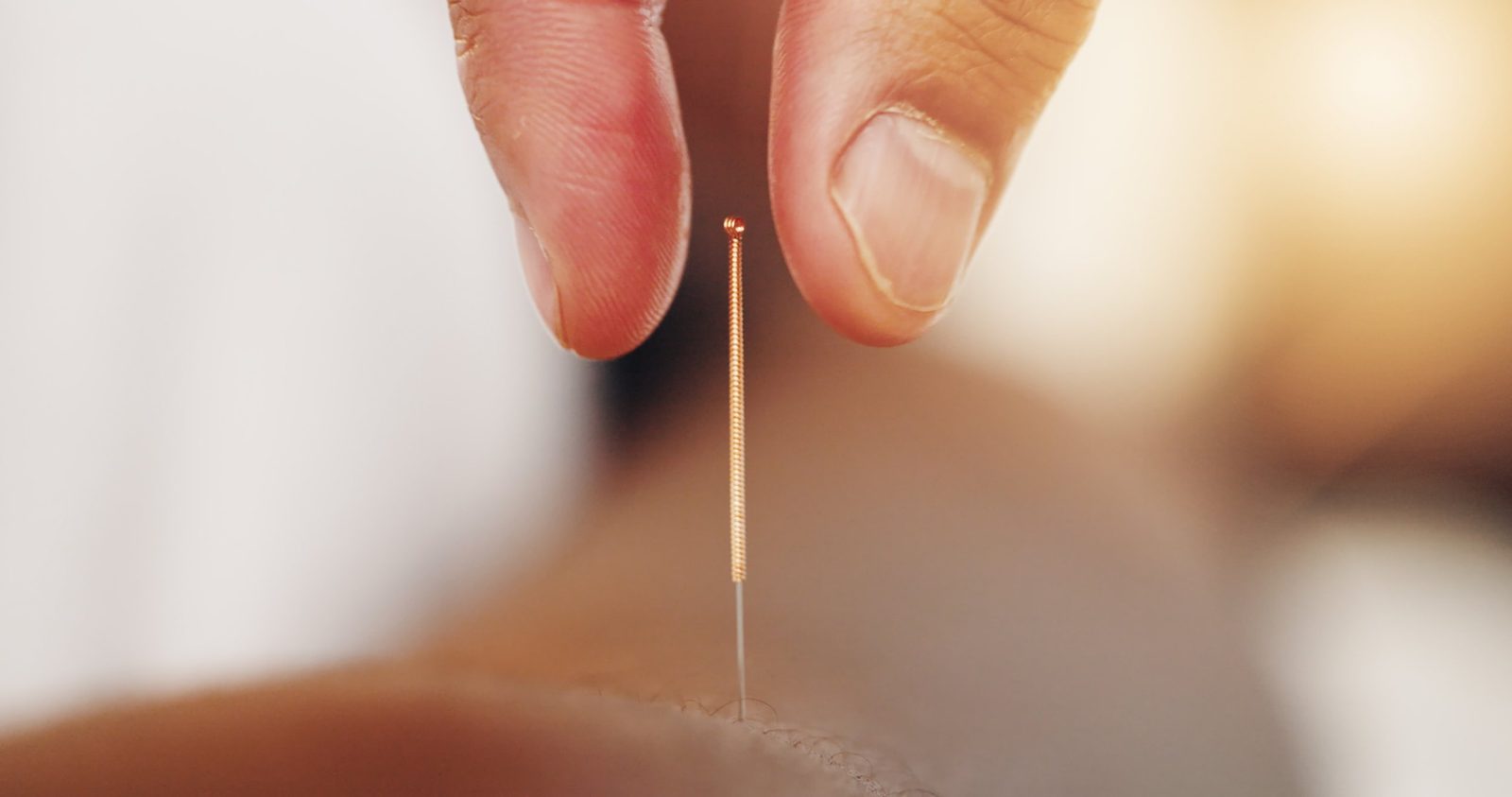
Acupuncture is the insertion of very thin, solid needles through the skin at specific points on the body. The needles are much finer than the hollow needles used for injections or blood draws. Nothing is injected. Each needle is sterile, used once and then discarded. The U.S. Food and Drug Administration regulates acupuncture needles as medical devices and requires them to be sterile and labeled for single use.
The practice comes from Chinese medicine, where it has been used for more than two thousand years. In that tradition, points are chosen according to patterns the practitioner identifies from your symptoms, your pulse, your tongue and your history. Two people with the same Western diagnosis, such as migraine, may get different points because their patterns differ.
Modern research looks at the same treatment through a different lens. The National Center for Complementary and Integrative Health (NCCIH), part of the National Institutes of Health, says how acupuncture works is not fully understood. The proposed explanations include effects on the nervous system, direct effects on the tissue where the needle is placed, and nonspecific effects, which include the expectation of benefit. You can read the NCCIH summary here.
We think it is fair to tell you both things. Acupuncture has a long clinical tradition, and it has a growing research base for some conditions. It is not a cure-all, and the evidence is stronger for some problems than others. The next section goes through that in detail.
What Edison patients come in for, and what the research says
Most people who search for acupuncture near Edison have a specific problem in mind. Pain is the most common. Below are the conditions we are asked about most, with a plain summary of the research as NCCIH reports it. We use that source because it is a federal research agency with no stake in whether you book.
Back and neck pain
This is the best-studied use of acupuncture. A 2018 review found acupuncture more effective than no treatment for back or neck pain across 12 studies with 8,003 participants, and more effective than sham acupuncture across 10 studies with 1,963 participants. The pain relief was comparable to that of nonsteroidal anti-inflammatory drugs. The American College of Physicians' 2017 guideline lists acupuncture as a first-line nondrug option for chronic low back pain.
For Edison residents who sit through a long commute on Route 1, the Turnpike or NJ Transit, chronic low back and neck pain is the complaint we hear most.
Knee and joint osteoarthritis
A 2018 review found acupuncture better than no treatment for osteoarthritis pain (10 studies, 2,413 participants) and better than sham (9 studies, 2,376 participants). A 2019 guideline from the American College of Rheumatology and the Arthritis Foundation conditionally recommends acupuncture for osteoarthritis of the knee, hip or hand. Results for hip osteoarthritis specifically were weaker than for the knee.
Migraine and tension headache
NCCIH reports moderate-quality evidence, from 22 studies with nearly 5,000 people, that acupuncture reduces how often migraines occur. The advantage over sham acupuncture was small. A 2020 review of 9 studies found acupuncture slightly more effective than preventive medication, with fewer people stopping because of side effects. For tension headache the evidence is of moderate to low quality.
Sciatica
Two reviews from 2015 suggested acupuncture may help sciatica, but the studies were not strong enough for a firm conclusion. In practice, many patients with leg pain from the low back try acupuncture alongside physical therapy. We tell them the honest position: it is reasonable to try, and you should expect to know within several sessions whether it is helping you.
Fibromyalgia
A 2019 review of 12 studies with 824 participants found that acupuncture relieved pain significantly better than sham acupuncture. The quality of that evidence was rated low to moderate.
Seasonal allergies
Central New Jersey has a long pollen season. A 2015 review of 13 studies with 2,365 participants found evidence that acupuncture relieves nasal symptoms of seasonal allergies.
Where the evidence is weaker
You should also know where studies have not shown a clear benefit over sham acupuncture. NCCIH lists irritable bowel syndrome, carpal tunnel syndrome and menopausal hot flashes in that group, although acupuncture did better than no treatment for hot flashes and showed some benefit as an add-on for irritable bowel syndrome. For IVF, a 2021 review of 6 studies with 2,507 participants found no difference from sham in pregnancy or live birth rates. For quitting smoking, a 2014 review found no significant benefit at six months.
That does not mean nobody with those conditions feels better after treatment. It means the research cannot yet separate the effect of needling from the effect of time, attention and expectation. If you come in for one of these, we will tell you that at the consultation, and we will set a short trial period so you are not committed to open-ended care.
Complex cases that do not fit one diagnosis
Some Edison patients arrive with a folder of normal test results and symptoms that have not gone away: fatigue, widespread pain, poor sleep, digestive trouble, often together. Others have a clear diagnosis but have stopped improving. Research trials rarely study people like this, because trials need one well-defined condition. This is the group Dr. Gandapodi sees most often. The consultation for a complex case looks at how the symptoms relate to each other, which is where an assessment that draws on Chinese medicine and Ayurveda together can add something to the picture you already have from your doctors.
The full list of what we see is on our conditions page. Pain conditions are described under pain management, and harder-to-classify problems under complex conditions.
Your first visit: the consultation
The first appointment is a 60-minute initial consultation. It is a conversation and an assessment, and in most cases it does not include needling. Treatment is generally booked for a separate day. Patients are sometimes surprised by this, so it is worth knowing in advance.
The reason is practical. A good treatment plan depends on a full history, and an hour goes quickly. During the consultation Dr. Gandapodi will ask about:
- The main problem: when it started, what makes it better or worse, and what you have already tried.
- Your medical history, including surgeries, diagnoses and any imaging or test results.
- Medicines and supplements you take.
- Sleep, digestion, energy, stress and, where relevant, menstrual history.
He will also look at your tongue and feel the pulse at both wrists. These are standard parts of a Chinese medicine assessment. They take a minute or two and are painless.
Please bring the following:
- A photo ID.
- Your insurance card, if you plan to use insurance.
- Your most recent complete blood work reports. You can send these ahead of time or bring printed copies.
- A list of your medications and supplements, with doses.
If you have already seen other practitioners for the same problem, bring what you have from them as well: reports, imaging results, and a note of which treatments you tried and for how long. Knowing what has already failed saves time and avoids repeating it.
At the end of the consultation you will get a proposed plan: which treatment is recommended, how often, and for how long. You are free to take that away and think about it. More detail is on our new patients page.
What a treatment session is like
Treatment sessions are 30 minutes. You lie on a padded table, face up or face down depending on the points being used. Wear loose clothing that can be rolled above the knees and elbows. For back or shoulder treatment you may be asked to uncover the area, and you will be draped.
The skin is cleaned and the needles are placed one at a time. Most people feel a brief pinch or nothing at all as the needle goes in. Once it reaches the right depth you may feel a dull ache, heaviness, warmth or a mild tingling around the point. Practitioners consider that sensation a sign the point is active. It should not be sharp. If any needle is uncomfortable, say so and it will be adjusted or removed.
The needles then stay in place while you rest. The room is quiet. Many patients fall asleep. At the end, the needles are removed and counted, and you can get up slowly.
Afterwards, most people feel relaxed or slightly drowsy. Some feel energized. A small number feel tired or a little sore for the rest of the day, especially after the first session. If you are driving back to Edison and feel lightheaded, sit in the waiting area for a few minutes first.
How to prepare, and what to do afterwards
A little preparation makes the session more comfortable.
- Eat a light meal one to two hours before. Treatment on an empty stomach makes lightheadedness more likely, and a heavy meal makes lying face down uncomfortable.
- Skip alcohol on the day, and hold the coffee until afterwards if caffeine makes you jittery.
- Arrive a few minutes early. Rushing in from Route 1 traffic with your heart pounding is a poor start to a treatment that is meant to settle you.
- Do not brush or scrape your tongue that morning, and avoid foods that stain it, because the tongue is part of the assessment.
- Bring a note of how you have been since the last visit: pain levels, sleep, anything new. Specifics help more than "a bit better".
Afterwards, keep the rest of the day easy if you can. Drink water. Gentle walking is fine. Leave heavy lifting, hard exercise and hot tubs for the next day. Some people notice their symptoms flare slightly for a day before they ease, and this is usually short. If a flare lasts longer than two days, or you notice increasing pain, swelling or redness at a needle site, call us.
It also helps to keep a simple record between visits. Write down your pain score each evening, how you slept, and how many pain tablets you took. After four or five sessions that record shows whether treatment is working far more reliably than memory does.
How many sessions, and how often
This is the question every new patient asks, and the true answer is that it depends on the condition and on how you respond. We do not promise a number.
Some reference points help. Medicare's coverage rule for chronic low back pain allows up to 12 sessions in 90 days and 8 more if the patient is improving, to a maximum of 20 in a year. Research on joint pain from breast cancer medication found benefit from six to eight weeks of treatment.
In general terms:
- A recent problem, such as a neck strain from last month, tends to need fewer visits than one you have had for ten years.
- Treatment usually starts at once or twice a week, then spaces out as symptoms settle.
- You should see some change within the first several sessions. If nothing has shifted by then, we reassess the plan with you instead of continuing unchanged.
- Complex and advanced conditions usually need a longer course, and progress is often gradual. We set review points so you can see whether the direction is right.
- Some patients with long-term conditions choose occasional maintenance visits after the main course ends. That is optional.
What the first month usually looks like
Every plan is individual, but new patients often ask for a picture of the first few weeks. A common pattern for a long-standing pain problem looks like this.
- Before you come in: you send your insurance details and we check your acupuncture benefits. This takes three to five business days.
- Visit one: the 60-minute consultation. You leave with a proposed plan.
- Weeks one and two: treatment sessions once or twice a week. The first sessions are kept gentle while we see how you respond.
- Weeks three and four: points are adjusted based on your record of symptoms. If you are improving, visits may drop to once a week.
- Review: a follow-up consultation to compare where you are with where you started, and to decide together whether to continue, space visits out or stop.
The review matters. A course of acupuncture should have a planned point at which someone asks whether it is working. If a clinic cannot tell you when it expects to reassess, ask.
Insurance: how it works at our clinic
Dr. Gandapodi is in network with most insurance plans. The exceptions are Medicare and Medicaid, which the clinic does not participate in. Medicare Supplemental insurance is accepted when the plan covers acupuncture.
A few points cause most of the confusion, so here they are plainly.
Being in network does not guarantee your plan covers acupuncture. Coverage varies from plan to plan, even within the same insurer. Some plans cover a set number of visits per year. Some cover acupuncture only for certain diagnoses. Some do not cover it at all.
Insurance applies to acupuncture only. Ayurvedic medicine, Chinese herbal medicine, Panchakarma and Transdermal Medication Therapy are not billed to insurance.
Deductibles and copays still apply. Your share depends on your plan and on how much of your deductible you have met for the year.
The simplest way to settle all of this is our free benefits check. Send us your plan details through the insurance verification form and we will contact your insurer. It takes three to five business days. We recommend doing it before your first visit so there are no surprises. More information is on the insurance page.
Medicare and Medicaid
The clinic does not participate in Medicare or Medicaid. If you have Original Medicare or Medicaid, we cannot bill it for your visits.
If you have Medicare Supplemental insurance, we accept it when the plan covers acupuncture. The benefits check will confirm whether yours does.
For background, Original Medicare Part B covers acupuncture only for chronic low back pain, defined as pain lasting 12 weeks or longer with no identified cause, and it cannot pay licensed acupuncturists directly. The official rules are on Medicare.gov.
Other ways to pay
You can pay for acupuncture with a Health Savings Account, Flexible Spending Account or Health Reimbursement Arrangement. Acupuncture is a qualified expense for these accounts. Some plan administrators ask for a Letter of Medical Necessity, and we can provide one. See our HSA and FSA page.
We also accept CareCredit, a health care credit card, for patients who prefer to spread payments. Discounts are available for seniors and, through our financial assistance program, for households that qualify by size and income. Our office can go through the options with you when you call.
Is acupuncture safe?
When it is done by a trained, licensed practitioner using sterile single-use needles, acupuncture has a good safety record. NCCIH states that relatively few complications have been reported, and that problems have come from nonsterile needles and improper technique. Serious complications, such as infection or injury to an organ, are rare and are linked to poor practice.
Minor effects are more common and usually pass within a day:
- A drop of blood or a small bruise where a needle was placed.
- Mild soreness at a point.
- Feeling tired or lightheaded after a session.
Tell us before treatment if any of the following apply to you. None of them automatically rules acupuncture out, but each one changes how we treat.
- You take a blood thinner or have a bleeding disorder.
- You are pregnant or might be. Certain points are avoided in pregnancy.
- You have a pacemaker or other implanted electrical device.
- You have a skin infection, an open wound or lymphedema in the area to be treated.
- You have a condition or take a medicine that weakens your immune system.
- You tend to faint with needles or blood draws.
Acupuncture does not replace emergency or urgent medical care. Sudden severe headache, chest pain, new weakness or numbness, loss of bladder or bowel control, or pain after a serious fall need a doctor or an emergency department first. JFK University Medical Center is the hospital in Edison itself.
How to choose an acupuncturist near Edison
Edison and the towns around it have many acupuncture offices, particularly along Route 27 and in the Oak Tree Road area. Online directories list well over a hundred practitioners for the Edison area. Most patients choose by distance and star rating, which tells you little. These questions tell you more.
- Is the practitioner licensed in New Jersey? Look for L.Ac. and confirm the license with the state.
- What training do they have beyond the license? National board certification and doctoral training indicate additional study.
- Do they have experience with your kind of problem? This matters most for complex or long-standing conditions. Ask how often they treat it.
- Who will treat you at each visit? In some larger offices you may see a different person each time.
- Is there a real consultation? A practitioner who takes a full history before needling is more likely to adapt treatment to you.
- Will they check your insurance before you start? A benefits check in advance prevents an unexpected bill.
- Do they tell you what to expect and when to stop? Be cautious of anyone who promises a cure or sells a large prepaid package at the first visit.
- Do they work with your doctor? A good acupuncturist asks about your diagnoses and medicines and is willing to share notes with your physician.
If you have already tried acupuncture elsewhere without results, that does not settle the question. Training, assessment and point selection differ a great deal between practitioners, and a second opinion from someone who works with advanced cases is reasonable before you rule the treatment out.
Acupuncture, dry needling and other options near Edison
When you search for needling treatment around Edison you will find more than one kind of provider, and the differences are easy to miss.
Licensed acupuncturists complete a graduate program in acupuncture and Chinese medicine and hold a state license. They assess the whole person and choose points across the body, including points far from where it hurts.
Dry needling is offered by some physical therapists and other providers. It uses the same kind of fine needle, placed into tight bands of muscle known as trigger points. The aim is local: to release that muscle. NCCIH notes that needling of trigger points reduced pain intensity in myofascial pain syndrome in five studies with 215 participants. Medicare groups dry needling with acupuncture in its coverage rule.
Medical acupuncture is practiced by some physicians who have taken additional training in it.
None of these is wrong for everyone. If your problem is one tight muscle after a sports injury, dry needling within a physical therapy plan may be all you need. If you have a long-term condition, several symptoms at once, or pain that has not responded to local treatment, a full assessment by a licensed acupuncturist is the better fit. Many patients do both, and we are glad to coordinate with your physical therapist.
Acupuncture alongside your regular medical care
We practice acupuncture as complementary care. That means it is used with your regular medical treatment and not in place of it. Keep your primary care doctor and your specialists. Do not stop or change a prescribed medicine because you have started acupuncture. If treatment reduces your symptoms and you want to lower a dose, that is a conversation to have with the prescribing doctor.
With your permission we can send a summary of your treatment to your physician. Doctors who want to send a patient to us can use the referring providers page.
Other treatments available at the clinic
Some Edison patients come for acupuncture and later ask about other care. The clinic also offers Ayurvedic medicine, Chinese herbal medicine, Panchakarma and Transdermal Medication Therapy. Edison has one of the largest Indian American communities in New Jersey, and many of our patients from the township are already familiar with Ayurveda from family practice. These treatments are described on our treatments page. Any herbal prescription is checked against the medicines you already take.
Common questions from Edison patients
Does acupuncture hurt?
Most people feel a brief pinch at most when a needle goes in, followed by a dull ache or heaviness at the point. It should not be sharp. Tell us if a needle bothers you and we will adjust it.
Will I be treated at my first appointment?
Usually not. The first visit is a 60-minute consultation. Treatment is generally scheduled for a separate day once the plan is agreed.
How long is each session?
Treatment sessions are 30 minutes.
Who will treat me?
Dr. Saikumar Gandapodi, DAOM, Dipl. OM, AP, L.Ac. He sees every patient himself.
I have tried acupuncture before and it did not work. Is it worth trying again?
It can be. Dr. Gandapodi regularly sees patients whose earlier treatment gave no results. At the consultation he will review what was done before and tell you whether he thinks a different approach has a reasonable chance of helping.
Are the needles reused?
No. Every needle is sterile, used once and discarded in a sharps container.
Do you take my insurance?
Dr. Gandapodi is in network with most insurance plans, with the exception of Medicare and Medicaid. Medicare Supplemental insurance is accepted if acupuncture is covered. We can check your benefits for free in three to five business days.
What if I have no insurance?
You can pay directly, including with HSA or FSA funds or CareCredit. Call (908) 402-7301 and our office will explain the options.
Can I come after work?
Yes. We are open until 8:00 PM on weekdays and from 9:00 AM to 5:00 PM on Saturdays.
How soon can I get an appointment?
It depends on the week. Same-day appointments are limited, so call (908) 402-7301 if your problem is pressing and we will tell you the first opening.
Do I need a referral from my doctor?
You do not need one to book with us. Some insurance plans ask for a referral or a specific diagnosis before they pay, and the benefits check will show whether yours does.
Can I have acupuncture while I am pregnant?
Tell us before treatment if you are pregnant or think you might be. Certain points are avoided during pregnancy, and we ask that your obstetric provider knows you are having acupuncture.
What should I wear?
Loose, comfortable clothing that rolls up past the elbows and knees.
Can I drive home afterwards?
Yes. Most people feel relaxed and are fine to drive. If you feel lightheaded, rest in the waiting area for a few minutes before you leave.
What if I need to cancel?
Please give at least 24 hours' notice by calling (908) 402-7301.
Is one session enough?
Occasionally, for a minor recent problem. Most conditions need a course of treatment. You should notice a change within the first several sessions, and if you do not, we will review the plan with you.
Booking an appointment
To book, use the appointment page or call (908) 402-7301. Online bookings are confirmed by text and email. If you plan to use insurance, send your plan details through the verification form first so your benefits are confirmed before the consultation.
This article is general health information and does not replace advice from your own doctor. Research summaries are taken from the National Center for Complementary and Integrative Health and Medicare.gov, linked above.