














- What it is: Painful narrowing and irritation of the tunnel (first dorsal compartment) that guides two thumb tendons along the thumb side of the wrist.
- Common symptoms: Pain over the thumb side of the wrist that worsens with gripping, pinching or turning the hand, often with tenderness and swelling.
- Conventional care: Activity changes, a thumb splint, anti-inflammatory medicine, corticosteroid injection, hand therapy, and surgery to open the tunnel when other treatment fails.
- How integrative care fits: Acupuncture, Ayurvedic therapies and individually prescribed herbs are used alongside medical care to help with pain and general health.
- Evidence at a glance: Limited for acupuncture, with one small trial and mixed reviews; none for Ayurveda or herbal medicine in this condition.
What is De Quervain's Tendinitis?
De Quervain's tendinitis is a painful condition of the first dorsal compartment of the wrist, a tunnel on the thumb side that holds the tendons of the abductor pollicis longus and extensor pollicis brevis.[1] Its more precise name is De Quervain's tenosynovitis, a narrowing (stenosis) of this tunnel that restricts how the tendons glide and causes pain over the radial styloid, the bony bump at the base of the thumb side of the wrist.[2]
Common symptoms
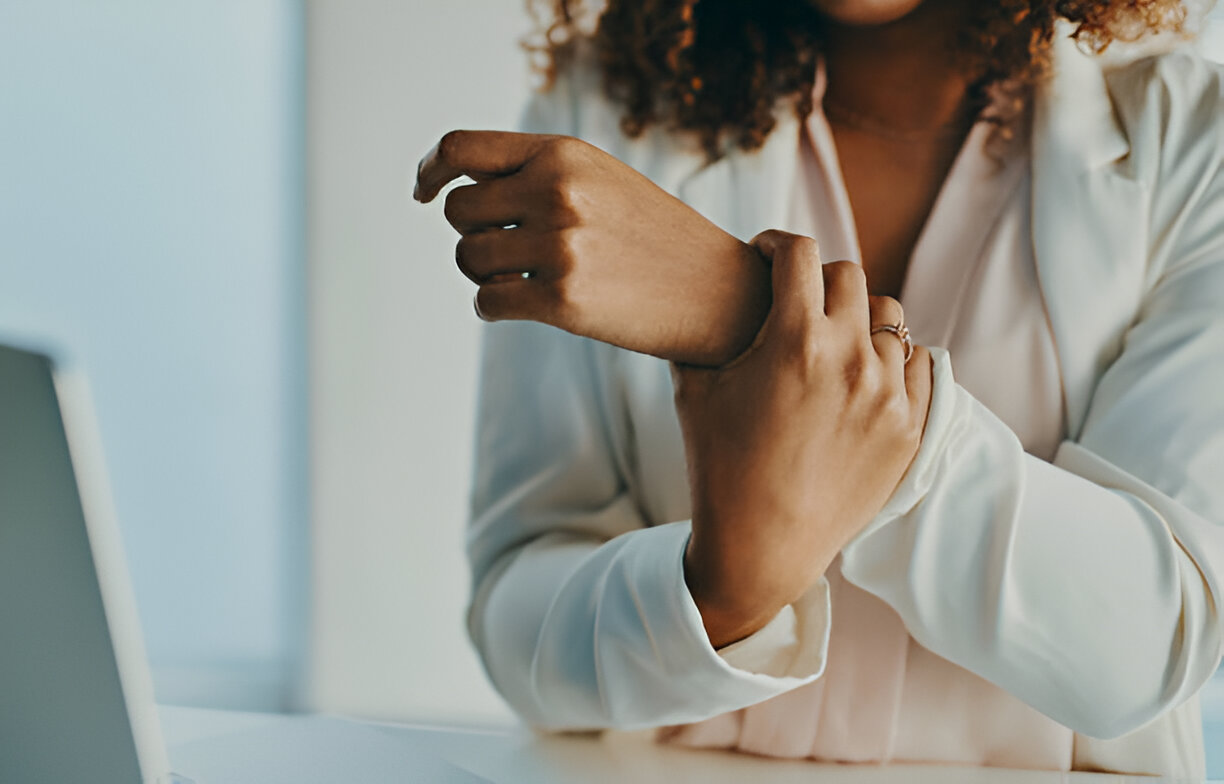
The main symptom is pain on the thumb side of the wrist, which gets worse when you grip, pinch, lift or turn the hand.[1, 2] Tenderness and swelling over the area are common, and the pain can limit everyday tasks such as work, sport or caring for a baby.[2]
Causes and risk factors
The exact cause is still debated. Some researchers favor an inflammatory process and others favor degenerative change in the tendon sheath, and there is substantial evidence for both views.[1] Repetitive movements of the thumb are linked to the condition, and anatomical differences in the tunnel may make some people more likely to develop it.[1, 3]
A review of studies on smartphone use found that more frequent text messaging was associated with a higher rate of De Quervain's, although an association like this does not prove cause.[3] In one large review of trials, about 80% of the participants were women.[4]
How it is diagnosed and treated conventionally
The diagnosis is made mainly from your history and a physical examination, using tests such as Finkelstein's test. These tests are not very specific, and ultrasound can help, especially to find anatomical variations before an injection.[1, 2]
Treatment is usually conservative first: rest from the aggravating activity, a thumb splint, anti-inflammatory medicine and corticosteroid injection, with surgery to open the compartment if these do not work.[5, 6] A network meta-analysis of trials concluded that a corticosteroid injection followed by 3 to 4 weeks of thumb splinting should be considered first-line treatment.[4] Another review reported that injection plus a splint appeared to work better than either one alone, although corticosteroid use is not harmless and should be done with caution.[5] Surgical release gives excellent symptom relief in many people when conservative treatment fails.[6]
Why De Quervain's Tendinitis calls for a whole-person approach
De Quervain's is not just a thumb problem. The way the hand is used, the tendon itself, the tunnel anatomy and the person's wider health all play a part, and researchers do not agree on a single cause.[1]
Care that looks at these factors alongside splinting and medical treatment is a reasonable addition. It does not replace them.
Repetitive hand use
Repeated thumb movements are linked to the condition, and in one review the amount of texting, browsing and gaming on a phone was associated with higher odds of De Quervain's.[3] Changing how you grip and use the hand is a standard part of hand therapy.[7]
Tendon sheath inflammation and degeneration
Researchers have proposed both an inflammatory and a degenerative explanation for the thickened sheath, and the evidence supports both.[1]
Anatomy of the compartment
Structural differences from the usual anatomy are partly linked to who develops the condition, and a divider inside the tunnel matters for treatment planning.[1, 2] That is why ultrasound is sometimes used before an injection.[5]
Muscle tension in the forearm and hand
Tendon problems often go along with problems in the muscles that move them, and one acupuncture author has proposed needling the affected forearm and thumb muscles as well as the painful spot. This is a proposal in a short opinion paper, not tested evidence.[8]
Acupuncture for De Quervain's Tendinitis
What the research shows
The evidence for acupuncture in De Quervain's is limited, with one small trial and mixed results in reviews. In a trial of 30 patients, five 30-minute acupuncture sessions were compared with a single methylprednisolone injection. Both groups improved in pain and function over 6 weeks, and the injection group did somewhat better.[9] The trial had no sham or no-treatment group.
Two network meta-analyses reached different conclusions. One of 21 studies (1,178 adults) ranked acupuncture third, after splint plus injection and injection alone, with all active treatments outperforming waitlist controls. The authors rated the certainty of the evidence as low to very low and most studies as high risk of bias.[10] The other, of 14 randomized trials, found that acupuncture, like injection alone, platelet-rich plasma and a splint alone, did not differ significantly from placebo for short-term pain.[11]
A review of treatments for De Quervain's and similar hand tendon conditions concluded that more high-quality trials are still needed.[12]
How acupuncture may work
How acupuncture might help De Quervain's has not been shown. The trial above measured pain and function only.[9] In traditional Chinese medicine, wrist pain like this is described as blocked qi and blood in the channels along the thumb side of the forearm, and points along the lung and large intestine channels are often used. This is a traditional framework, not a proven mechanism.
What treatment involves
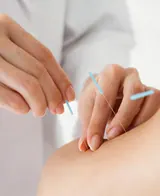
Treatment uses fine, sterile, single-use needles placed at points on the forearm, hand and wrist, and sometimes elsewhere in the body, usually left in place for about 20 to 40 minutes. The trial gave five sessions of 30 minutes, using points on the arm and tender spots.[9] We plan a short course of visits and reassess whether it is helping.
Serious problems from acupuncture are rare. In prospective studies, about 9 in 100 patients had a minor reaction such as bleeding, pain or redness at a needle site, and serious events occurred in about 1 in 10,000 patients.[13] Tell the practitioner first if you have a bleeding disorder, take blood thinners, are pregnant, or have a pacemaker (relevant to electroacupuncture). Redness, warmth and fever at the wrist need medical assessment first.
Ayurvedic medicine for De Quervain's Tendinitis
The Ayurvedic view
Ayurveda has no classical name that matches De Quervain's. In this tradition, tendon and joint pain with stiffness and pain on movement is described as a Vata imbalance, sometimes with swelling linked to Kapha or heat linked to Pitta. These are traditional categories used to plan care, not biomedical diagnoses.
Therapies that may be used
Care is chosen for the individual and traditionally combines:
- Diet and daily routine intended to calm Vata, such as warm, regular meals and steady sleep
- Warm medicated oil massage of the forearm and hand, and gentle local heat
- Herbs traditionally used for pain and swelling, such as turmeric, ginger and Boswellia, which need review if you take blood thinners[14]
- Rest from aggravating hand movements, alongside any splint your clinician recommends[5]
Panchakarma, the traditional cleansing program, is not directed at a single tendon sheath and is not appropriate during pregnancy, acute illness or frailty.
What the research shows
There is no clinical research on Ayurveda for De Quervain's tendinitis. A PubMed search found no trials of Ayurvedic treatment, oil therapy or Ayurvedic herbs in this condition. The therapies above are traditional practice, and we cannot point to evidence that they relieve De Quervain's pain.
Herbal medicine for De Quervain's Tendinitis
Herbs and formulas that have been studied
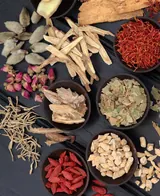
No herbal formula has been tested in a clinical trial for De Quervain's tendinitis, as far as we could find. Chinese herbal medicine is traditionally used for tendon and joint pain, often taken by mouth or applied to the skin as a wash, plaster or liniment. Herbal preparations applied to the skin fall under the clinic's transdermal medication therapy.
What the research shows
The evidence is absent. We found no randomized trials, systematic reviews or controlled studies of herbs, Chinese formulas or Ayurvedic herbs for De Quervain's tendinitis. We therefore cannot say whether herbs help, and no herb should be taken in place of splinting, injection or surgery.
Safety and herb-drug interactions
Herbs are active substances and can interact with medicines. Case reports describe serious problems such as bleeding and hematomas when warfarin was combined with herbs including dan shen (Salvia miltiorrhiza), dang gui (Angelica sinensis), ginger and Boswellia.[14] A broader review found that herb-drug interactions can have serious clinical consequences, so people taking blood thinners, aspirin or other prescription drugs need a practitioner's review first.[15]
In one study, about one fifth of Ayurvedic products bought online contained detectable lead, mercury or arsenic.[16] Herbs should come from tested sources and be prescribed individually. Tell us if you are pregnant or breastfeeding, have liver or kidney disease, or have surgery planned. Skin preparations should not be used on broken or inflamed skin.
Translating traditional medicine into modern biological language
The links drawn here are interpretation, not equivalence. Chinese medicine describes De Quervain's as obstruction of qi and blood in the channels of the thumb side of the forearm. Biomedicine describes a thickened sheath around two tendons in a narrow tunnel, with debate over whether inflammation or degeneration drives it.[1, 2]
Ayurveda's description of aggravated Vata with pain on movement covers a similar picture in different words. No study has shown that a dosha or a qi pattern corresponds to a specific biological process in the wrist.
How this care fits with your medical care
Integrative care for De Quervain's tendinitis is complementary. Keep your physician, hand specialist or hand therapist, and continue the splinting, injection plan or surgery they recommend, because these are the best-supported treatments.[4, 12] Do not stop or change prescribed medicines without your prescriber.
We do not diagnose the cause of wrist pain, so new thumb-side wrist pain should be medically evaluated first. Please bring your diagnosis, any ultrasound reports, a full list of medicines and supplements, and details of past or planned injections or surgery.
When to seek urgent medical care
Some causes of wrist and hand pain need prompt medical assessment.
- Redness, warmth, swelling and fever in the wrist or hand, which can mean infection
- Numbness or tingling that spreads in the hand, or loss of grip strength
- Severe pain after a fall or injury, or a deformed wrist
- A hand that turns pale, cold or blue
- Pain that is getting steadily worse despite treatment
If any of these occur with severe symptoms, call 911 or go to the nearest emergency department.
Frequently asked questions
What is De Quervain’s tendinitis?
De Quervain’s tendinitis, more precisely called De Quervain’s tenosynovitis, is pain on the thumb side of the wrist caused by irritation and thickening around two thumb tendons where they pass through a narrow tunnel. It causes pain with gripping, pinching or turning the hand. Doctors still debate whether inflammation or degeneration is the main cause.
Can acupuncture help with De Quervain’s tendinitis?
It may help, but the evidence is limited. A trial of 30 people found improvement after five acupuncture sessions, though a corticosteroid injection did somewhat better and there was no sham group. Two network meta-analyses differed: one ranked acupuncture third among conservative options with low-certainty evidence, and the other found it no different from placebo for short-term pain. Acupuncture is used alongside medical care, not in place of it.
Does Ayurvedic or herbal medicine work for De Quervain’s tendinitis?
We found no clinical studies of Ayurvedic treatment or herbs for De Quervain’s tendinitis, so we cannot say whether they help. They are used traditionally for tendon and joint pain. Any herbs should be prescribed individually and checked against your medicines, and they do not take the place of splinting or injection.
Can I stop my splint, injection plan or medicine if I have acupuncture?
No. Splinting, corticosteroid injection and, if needed, surgery are the best-supported treatments. Acupuncture, Ayurveda and herbal medicine are complementary care. Do not stop or change prescribed medicines without talking to your prescriber. Spreading redness, fever or numbness in the hand needs prompt medical assessment.
How soon might I notice a change with acupuncture?
It differs from person to person and no result can be promised. In the one small trial, people had five sessions and were followed for 6 weeks. We reassess after a short course of visits to see whether treatment is helping.
Does insurance cover acupuncture for De Quervain’s tendinitis?
It may. Netra Integrative Health Clinic is in-network with Blue Cross Blue Shield, Cigna and UnitedHealthcare. Other plans may be covered through out-of-network benefits, and we offer a free benefits check. HSA and FSA cards and CareCredit are also accepted. Call (908) 402-7301 to ask about your plan.
References
- Fakoya AO, Tarzian M, Sabater EL, et al. De Quervain's Disease: A Discourse on Etiology, Diagnosis, and Treatment. Cureus. 2023;15(4):e38079. PMID 37252462. Review of De Quervain's disease covering the two affected thumb tendons, the inflammatory versus degenerative debate, diagnostic tests, ultrasound and conservative-first management.
- Allbrook V. 'The side of my wrist hurts': De Quervain's tenosynovitis. Aust J Gen Pract. 2019;48(11):753-756. PMID 31722458. Australian review explaining De Quervain's as a stenosing condition of the first dorsal compartment, with ultrasound, corticosteroid injection and orthosis in management.
- Morgan SD, Sivakumar BS, An VG, et al. A Review of De Quervain's Stenosing Tenovaginitis in the Context of Smartphone Use. J Hand Surg Asian Pac Vol. 2020;25(2):133-136. PMID 32312208. Systematic review finding that more frequent smartphone text messaging was associated with higher odds of De Quervain's tenosynovitis, based on observational studies.
- Challoumas D, Ramasubbu R, Rooney E, et al. Management of de Quervain Tenosynovitis: A Systematic Review and Network Meta-Analysis. JAMA Netw Open. 2023;6(10):e2337001. PMID 37889490. JAMA Network Open network meta-analysis of 30 trials (1,663 patients) supporting corticosteroid injection followed by short thumb splinting as first-line treatment.
- Abi-Rafeh J, Kazan R, Safran T, et al. Conservative Management of de Quervain Stenosing Tenosynovitis: Review and Presentation of Treatment Algorithm. Plast Reconstr Surg. 2020;146(1):105-126. PMID 32590652. Review of conservative treatment of De Quervain disease, finding splint plus corticosteroid injection beneficial and noting that steroid use needs caution.
- Larsen CG, Fitzgerald MJ, Nellans KW, et al. Management of de Quervain Tenosynovitis: A Critical Analysis Review. JBJS Rev. 2021;9(9). PMID 34506345. Critical analysis review of De Quervain management: most cases settle without surgery, injection is the mainstay, and release helps when it fails.
- Goel R, Abzug JM. de Quervain's tenosynovitis: a review of the rehabilitative options. Hand (N Y). 2015;10(1):1-5. PMID 25762881. Review with a case example of rehabilitation options for De Quervain's, including splinting, activity modification, hand therapy, injection and surgery.
- da Silva JB, Batigália F. Acupuncture in De Quervain's disease: a treatment proposal. Acupunct Med. 2014;32(1):70-2. PMID 24323632. Short opinion paper proposing that acupuncture for De Quervain's should identify and needle the affected forearm and thumb muscles; not a trial.
- Hadianfard M, Ashraf A, Fakheri M, et al. Efficacy of acupuncture versus local methylprednisolone acetate injection in De Quervain's tenosynovitis: a randomized controlled trial. J Acupunct Meridian Stud. 2014;7(3):115-21. PMID 24929455. Randomized trial of 30 patients comparing five acupuncture sessions with one steroid injection; both improved, with injection somewhat better.
- Cuenca-Zaldívar JN, Martínez-Pozas O, Riba E, et al. Conservative treatments for De Quervain's tenosynovitis: A systematic review and network meta-analysis. J Hand Ther. 2026;39(3):479-495. PMID 41298159. 2026 network meta-analysis of 21 studies (1,178 adults) ranking splint plus injection highest and acupuncture third, with low to very low certainty.
- Chong HH, Pradhan A, Dhingra M, et al. Advancements in de Quervain Tenosynovitis Management: A Comprehensive Network Meta-Analysis. J Hand Surg Am. 2024;49(6):557-569. PMID 38613563. Network meta-analysis of 14 trials finding shockwave and injection combinations favorable, while acupuncture and several other treatments did not differ from placebo for pain.
- Huisstede BM, Gladdines S, Randsdorp MS, et al. Effectiveness of Conservative, Surgical, and Postsurgical Interventions for Trigger Finger, Dupuytren Disease, and De Quervain Disease: A Systematic Review. Arch Phys Med Rehabil. 2018;99(8):1635-1649.e21. PMID 28860097. Systematic review of trials for trigger finger, Dupuytren and De Quervain disease, with moderate evidence for injection plus splint and a call for better trials.
- Bäumler P, Zhang W, Stübinger T, et al. Acupuncture-related adverse events: systematic review and meta-analyses of prospective clinical studies. BMJ Open. 2021;11(9):e045961. PMID 34489268. Systematic review of 21 prospective studies finding minor acupuncture reactions in about 9 percent of patients and serious events in about 1 per 10,000.
- Milić N, Milosević N, Golocorbin Kon S, et al. Warfarin interactions with medicinal herbs. Nat Prod Commun. 2014;9(8):1211-6. PMID 25233607. Review of reported interactions between warfarin and medicinal herbs, with case reports of serious bleeding events involving herbs including dan shen, dang gui, ginger and Boswellia.
- Hu Z, Yang X, Ho PC, et al. Herb-drug interactions: a literature review. Drugs. 2005;65(9):1239-82. PMID 15916450. Literature review of herb-drug interactions, many from case reports, concluding that interactions can have serious clinical consequences.
- Saper RB, Phillips RS, Sehgal A, et al. Lead, mercury, and arsenic in US- and Indian-manufactured Ayurvedic medicines sold via the Internet. JAMA. 2008;300(8):915-23. PMID 18728265. JAMA study finding detectable lead, mercury or arsenic in about one fifth of Ayurvedic medicines purchased over the Internet.
This page is for general education and is not medical advice. Acupuncture, Ayurvedic medicine and herbal medicine are complementary therapies; they do not replace diagnosis or treatment by your physician. Do not stop or change prescribed treatment without talking to your prescriber. In an emergency call 911.