
















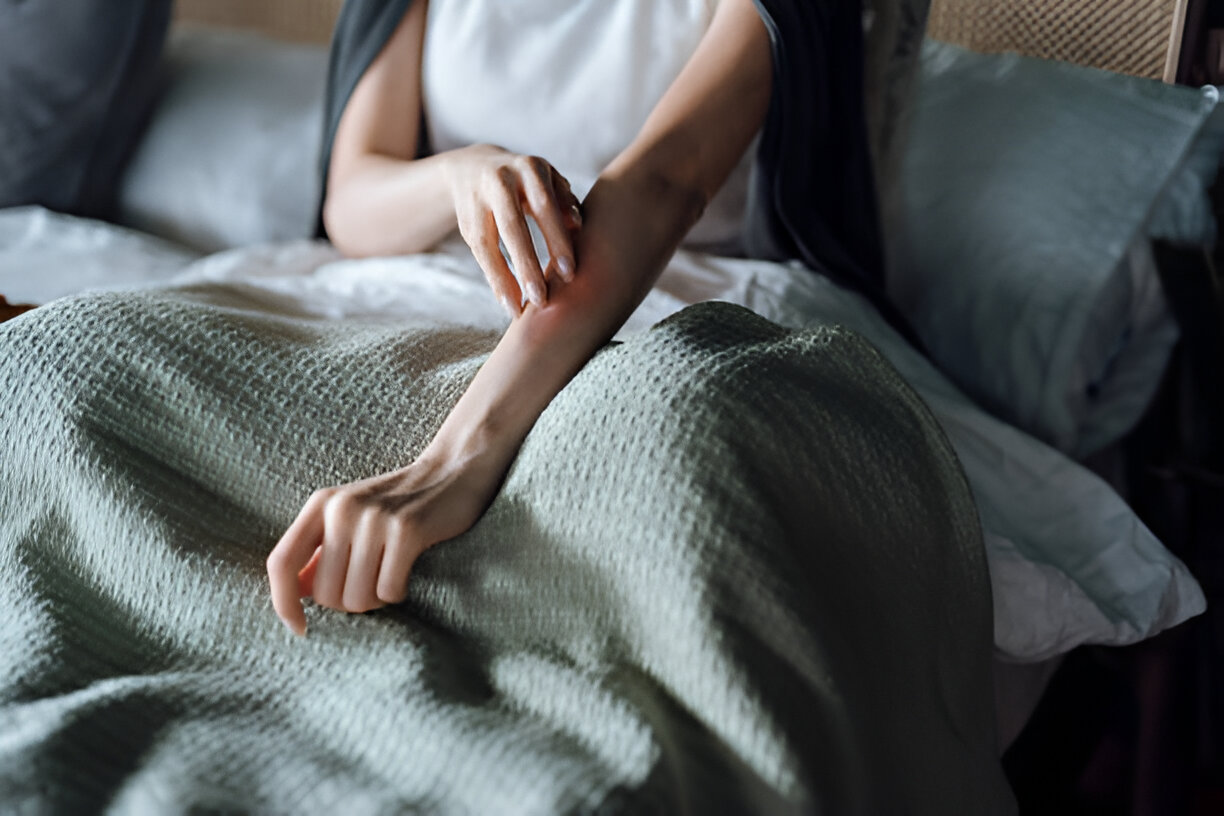
- What it is: Itch that lasts six weeks or longer. It is a symptom with many possible causes, not one disease.
- Common symptoms: Persistent urge to scratch, scratch marks or thickened skin, and poor sleep, low mood or anxiety from the constant itch.
- Conventional care: Finding and treating the cause, moisturizers, topical anti-inflammatory or numbing treatments, and in some cases oral medicines chosen by a physician.
- How integrative care fits: Acupuncture, Ayurvedic therapies and individually prescribed herbs are used alongside medical care to help with itch, sleep and stress.
- Evidence at a glance: Limited for acupuncture, mostly in kidney-related itch and from low-quality trials; limited for herbal medicine; none found for Ayurveda in chronic itch.
What is Chronic Itching?
Chronic itching is itch that lasts six weeks or longer. It is common: about one in five people has it at some point in life, and it accounts for roughly 1 percent of physician visits.[1] Chronic itch is a symptom of many conditions, so the first task is to find out why it is happening.[2]
Common symptoms
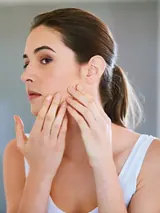
The main symptom is an itch that keeps returning and makes you want to scratch. Scratching can leave marks, thickened skin or sores, and these can in turn keep the itch going.[3]
- Itch that is limited to one area or spread over the whole body
- Dry, red, scaly or rough skin, or skin that looks normal
- Poor sleep because of itching at night
- Anxiety, low mood or avoiding social situations[4]
Causes and risk factors
About 60 percent of chronic itch comes from inflammatory skin disease such as eczema, psoriasis or seborrheic dermatitis. About 25 percent is neuropathic or mixed, meaning the nerves that carry itch signals are involved, as in postherpetic neuralgia. The remainder comes from systemic illness such as kidney or liver disease, from medicines, or from infections such as scabies.[1]
Age and other factors matter too. Itch is more common in older adults and can accompany diseases of the kidney, liver, thyroid or blood.[4]
How it is diagnosed and treated conventionally
Diagnosis starts with a history and skin examination. When there are few skin changes, doctors often order blood tests such as a blood count, kidney, liver and thyroid tests to look for an underlying illness.[1, 4]
Treatment aims at the underlying disease, the skin and the itch itself. First-line care for inflammatory itch is a topical anti-inflammatory such as a corticosteroid or tacrolimus ointment. Neuropathic itch may be treated with topical agents such as menthol or pramoxine, or with medicines such as gabapentin or certain antidepressants. Dermatology referral is considered if topical care fails.[1] Guidelines also advise treating sleep problems and, where needed, anxiety or depression.[3]
Why Chronic Itching calls for a whole-person approach
Chronic itch rarely has a single driver. The skin, the nerves that signal itch, the immune system, and the state of the mind and body all influence it, which is why guidelines call for a stepwise, multimodal approach.[2]
Care that addresses stress, sleep and skin comfort alongside medical treatment of the cause is therefore a reasonable addition, though it cannot replace finding the cause.
Skin inflammation
Inflammation is the most common cause of chronic itch, so controlling it is central to treatment.[1] Anything that keeps the skin inflamed, including repeated scratching, can prolong the problem.[3]
Nerve signaling
In a quarter of patients the main problem is nerve dysregulation, either in the skin or along the nerve pathway, and this type often responds poorly to skin creams alone.[1]
Stress and anxiety
Stress makes itch worse, and itch in turn raises stress, creating a vicious cycle. A review links this to activation of the stress hormone axis and the sympathetic nervous system, which act on skin mast cells and on nerves.[5]
Sleep and quality of life
Chronic itch is associated with disturbed sleep and a lower quality of life.[4] Guidelines include sleep promotion as part of care.[3]
Acupuncture for Chronic Itching
What the research shows
Research suggests acupuncture may reduce itch in some settings, but the evidence is limited and mostly concerns itch in people on dialysis. A 2023 meta-analysis of 7 trials with 504 patients with uremic pruritus found acupuncture more effective than conventional treatment overall (though comparable to anti-itch medicines in a subgroup), and combined with hemodialysis it worked better than hemodialysis alone.[6] A larger 2022 meta-analysis of 40 trials with 2,735 patients found that acupuncture and ear acupressure improved uremic itch, while asking for larger and longer studies.[7] Another meta-analysis of 12 trials found ear acupressure lowered itch scores in people on dialysis, but the authors advised caution because the included studies were of low quality.[8]
Outside kidney disease the findings are small. In one placebo-controlled crossover trial of 30 adults with atopic eczema, acupuncture at specific points reduced itch from a skin allergy test more than no acupuncture, and in some measures more than acupuncture at non-specific points. This was a laboratory-style trial of short-term itch, not of everyday chronic itch.[9] A sham-controlled trial of 30 women found that acupuncture did not prevent itch caused by spinal morphine after cesarean delivery.[10]
An updated review of acupuncture in dermatology concluded that results were promising for uremic itch, atopic dermatitis, urticaria and itch, but that larger sham-controlled trials are needed.[11]
How acupuncture may work
Researchers propose that acupuncture needling produces signals in skin and muscle that interact with cells and nerve fibers, change mediators and receptors, and reduce the transmission of itch signals in the nerves and brain.[12] Stress reduction may also play a part, since stress feeds itch.[5] These are proposed explanations, not settled facts, and the same review notes that acupuncture for itch was not recommended in recent clinical guidelines.[12]
What treatment involves
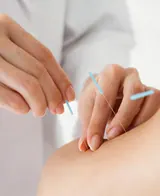
Treatment uses fine, sterile, single-use needles placed at points chosen for you, often on the arms, legs and ears, and usually left in place for about 20 to 40 minutes. A course of several visits is typical, with reassessment along the way.
In prospective studies, about 9 in 100 patients had a minor reaction such as bleeding, soreness or redness at a needle site, and serious events occurred in about 1 in 10,000 patients.[13] Tell the practitioner first if you have a bleeding disorder, take blood thinners, are pregnant, or have a pacemaker (relevant to electroacupuncture). If your itch comes from kidney disease or liver disease, we ask that your treating team knows you are receiving acupuncture.
Ayurvedic medicine for Chronic Itching
The Ayurvedic view
Ayurveda describes itch under the name Kandu, and it is linked to several skin conditions in the classical texts. In this traditional framework, itching is often described as an imbalance of Kapha, sometimes with Pitta, and related to impaired digestion and the buildup of ama (undigested material). These are traditional categories used to choose treatment, not biomedical diagnoses.
Therapies that may be used
Care is chosen for the individual and traditionally combines:
- Diet and daily routine, for example avoiding foods a person finds trigger flare-ups and keeping regular meals and sleep
- Soothing oil applications for dry skin
- Herbs such as turmeric (Curcuma longa) and neem, traditionally used for skin conditions; turmeric has also been studied in trials for itch[14]
- Transdermal medication therapy, meaning an herbal preparation applied to the skin, where an individually chosen preparation is appropriate
Panchakarma, a set of traditional cleansing procedures, is not appropriate during pregnancy, acute illness or frailty, and it is not suited to people with kidney or liver disease unless their physician agrees.
What the research shows
We found no clinical trials of Ayurvedic treatment for chronic itch as a whole, only individual case reports of Ayurvedic care for skin conditions. Research on Ayurvedic herbs for itch is therefore limited to single ingredients, mainly turmeric, described below.[14, 15]
Herbal medicine for Chronic Itching
Herbs and formulas that have been studied
A review of 17 clinical trials of herbal and complementary treatments for chronic itch listed turmeric, Fumaria parviflora, oat (Avena sativa), capsaicin, sweet almond oil, peppermint oil, violet oil and vinegar applied to the skin, along with aromatherapy, ear acupressure and acupuncture.[14] In uremic itch, Chinese herbal medicine has been tested as an add-on to dialysis and standard antiitch care.[16]
What the research shows
The evidence is limited. The review of 17 trials found that several of these remedies were effective, but noted that few studies exist and more are needed.[14] A meta-analysis of 50 trials with 3,311 dialysis patients found that adding Chinese herbal medicine improved overall response and lowered itch scores, without a higher rate of reported adverse events, although the comparison groups received hemodialysis alone or with standard anti-itch treatment rather than a placebo herb.[16]
A systematic review of curcumin trials for skin disease graded the recommendation for pruritus as grade B and described the safety profile in trials as excellent; it also called for larger trials to determine optimal treatment.[15] In a trial of 100 adults with post-burn itch, curcumin added to standard care modestly lowered total itch intensity compared with standard care alone, although individual itch measures did not differ significantly.[17]
Safety and herb-drug interactions
Herbs are active substances and can interact with medicines. Case reports describe bleeding when warfarin was combined with herbs including dang gui (Angelica sinensis), dan shen (Salvia miltiorrhiza), ginger, ginseng and Boswellia.[18] People taking blood thinners need a practitioner's review before using herbs.
Some herbal products can harm the liver, and liver injury is itself a cause of itch. A case series of ashwagandha supplements described jaundice with prolonged itching.[19] Because liver disease is itself a cause of itch, anyone with liver or kidney disease, or who is pregnant or breastfeeding, should have herbs reviewed with their physician first.
About one fifth of Ayurvedic medicines bought online contained detectable lead, mercury or arsenic.[20] Herbs should come from tested sources and be prescribed individually. Stop any herb and contact your physician if itch worsens or your skin or eyes turn yellow.
Translating traditional medicine into modern biological language
The links drawn here are interpretation, not equivalence. Chinese medicine often describes chronic itch as wind, heat or dryness in the skin, sometimes with blood deficiency. Researchers studying acupuncture for itch measure things that loosely parallel this picture: the activity of itch-sensing nerve fibers, mast cells and inflammatory signaling, and the way the brain processes itch.[12]
Ayurveda's account of imbalance and ama has no direct biomedical counterpart. The nearest ideas researchers study are skin inflammation and the effect of stress on the nervous and immune systems.[5] No study has shown that a dosha or a pattern corresponds to a specific biological process.
How this care fits with your medical care
Integrative care for chronic itch is complementary. Chronic itch can signal kidney, liver, thyroid or blood disease, so it should be medically evaluated before or alongside any complementary care.[4] Keep your physician or dermatologist, and do not stop or change prescribed medicines without your prescriber. We do not diagnose the cause of itch.
Please bring your diagnosis, recent blood test results, a full list of medicines, creams and supplements, and notes on what makes your itch better or worse.
When to seek urgent medical care
Some symptoms point to a serious cause and need prompt medical attention.[4]
- Itch with yellow skin or eyes, dark urine or pale stools
- Itch with unexplained weight loss, night sweats, fever or swollen glands
- Itch that began recently and is widespread, especially after age 60
- Swelling of the lips, tongue or face, or trouble breathing after a new medicine or food
- Skin that is spreading red, hot, painful, oozing or blistering, which may be infected
If you have trouble breathing or swelling of the face or throat, call 911 or go to the nearest emergency department.
Frequently asked questions
What is chronic itching?
Chronic itching, or pruritus, is itch that lasts six weeks or longer. It is a symptom, not a single disease. Causes include eczema and other skin conditions, nerve problems, kidney or liver disease, medicines and infections. Because some causes are serious, a physician should look for the reason, and treatment is aimed at both the cause and the itch itself.
Can acupuncture help with chronic itching?
It may help some people, but the evidence is limited. Most trials involve itch in people on dialysis, and many were of low quality, although pooled results were favorable. One small controlled study suggested an effect on allergy-induced itch, while another trial found no benefit for itch from spinal morphine. Acupuncture is used alongside medical care, not in place of it.
Does Ayurvedic or herbal medicine work for chronic itching?
The evidence is thin. We found no clinical trials of Ayurvedic treatment for chronic itch as a whole. For herbs, a small number of trials of turmeric, oat, capsaicin and Chinese herbal formulas show some benefit, but studies are few and often low quality. Herbs should be prescribed individually and checked against your medicines.
Can I stop my itch medicine or skip seeing my doctor if I have acupuncture?
No. Acupuncture, Ayurveda and herbal medicine are complementary care. Do not stop or change prescribed medicines or creams without talking to your prescriber. Chronic itch can be a sign of kidney, liver, thyroid or blood problems, so a medical evaluation of the cause is important.
How soon might I notice a change with acupuncture?
It differs from person to person and no result can be promised. Studies in people on dialysis used a course of several sessions and reported results over weeks. We reassess after a short course of visits to see whether treatment is helping, and we keep your physician’s treatment in place throughout.
Does insurance cover acupuncture for chronic itching?
It may. Netra Integrative Health Clinic is in-network with Blue Cross Blue Shield, Cigna and UnitedHealthcare. Other plans may be covered through out-of-network benefits, and we offer a free benefits check. HSA and FSA cards and CareCredit are also accepted. Call (908) 402-7301 to ask about your plan.
References
- Butler DC, Berger T, Elmariah S, et al. Chronic Pruritus: A Review. JAMA. 2024;331(24):2114-2124. PMID 38809527. JAMA review of chronic pruritus covering frequency, inflammatory versus neuropathic causes, evaluation with blood tests, and first-line topical and systemic treatments.
- Weisshaar E, Müller S, Szepietowski JC, et al. European S2k Guideline on Chronic Pruritus. Acta Derm Venereol. 2025;105:adv44220. PMID 40843597. 2025 European guideline on chronic pruritus describing prevalence, the need to find causes and comorbidities, and stepwise multimodal treatment.
- Ständer S, Zeidler C, Augustin M, et al. S2k guideline: Diagnosis and treatment of chronic pruritus. J Dtsch Dermatol Ges. 2022;20(10):1387-1402. PMID 36252071. German S2k guideline on diagnosis and treatment of chronic pruritus, covering the itch-scratch cycle, sleep, anxiety and depression, and treatment of the underlying disease.
- Roh YS, Choi J, Sutaria N, et al. Itch: Epidemiology, clinical presentation, and diagnostic workup. J Am Acad Dermatol. 2022;86(1):1-14. PMID 34428534. Review of itch epidemiology, causes, sleep and quality-of-life effects, and the recommended diagnostic blood tests and red flags such as age over 60.
- Golpanian RS, Kim HS, Yosipovitch G. Effects of Stress on Itch. Clin Ther. 2020;42(5):745-756. PMID 32147148. Review showing stress worsens itch and itch worsens stress, via the stress hormone axis, sympathetic nervous system and skin mast cells and nerves.
- Zhang L, Li Y, Xiao X, et al. Acupuncture for Uremic Pruritus: A Systematic Review and Meta-Analysis. J Pain Symptom Manage. 2023;65(1):e51-e62. PMID 36055470. Meta-analysis of 7 trials (504 patients) finding acupuncture more effective than conventional treatment for uremic pruritus, and better than hemodialysis alone when added to it.
- Lu PH, Chung CH, Chuo HE, et al. Efficacy of acupoint stimulation as a treatment for uremic pruritus: A systematic review and meta-analysis. Front Med (Lausanne). 2022;9:1036072. PMID 36530891. Meta-analysis of 40 trials (2,735 patients) finding acupuncture and ear acupressure improved uremic pruritus, with calls for larger, longer studies.
- Yang T, Wang S, Zhang X, et al. Efficacy of auricular acupressure in maintenance haemodialysis patients: A systematic review and meta-analysis. J Clin Nurs. 2022;31(5-6):508-519. PMID 34268817. Meta-analysis of 12 trials (805 patients) of auricular acupressure in hemodialysis, lowering itch and sleep scores, with low-quality included studies.
- Pfab F, Huss-Marp J, Gatti A, et al. Influence of acupuncture on type I hypersensitivity itch and the wheal and flare response in adults with atopic eczema - a blinded, randomized, placebo-controlled, crossover trial. Allergy. 2010;65(7):903-10. PMID 20002660. Blinded crossover trial of 30 people with atopic eczema in which acupuncture at correct points reduced allergen-induced itch more than no acupuncture, and in some measures more than placebo points.
- Mazda Y, Kikuchi T, Yoshimatsu A, et al. Acupuncture for reducing pruritus induced by intrathecal morphine at elective cesarean delivery: a placebo-controlled, randomized, double-blind trial. Int J Obstet Anesth. 2018;36:66-76. PMID 30131262. Placebo-controlled trial of 30 women finding acupuncture did not reduce itch from spinal morphine after cesarean delivery.
- Hwang J, Lio PA. Acupuncture in Dermatology: An Update to a Systematic Review. J Altern Complement Med. 2021;27(1):12-23. PMID 32955916. Systematic review update of acupuncture in dermatology finding promising results for uremic itch, atopic dermatitis and urticaria, but needing larger sham-controlled trials.
- Tang Y, Cheng S, Wang J, et al. Acupuncture for the Treatment of Itch: Peripheral and Central Mechanisms. Front Neurosci. 2021;15:786892. PMID 35431769. Review of proposed peripheral and central mechanisms by which acupuncture may reduce itch, noting guidelines did not recommend it.
- Bäumler P, Zhang W, Stübinger T, et al. Acupuncture-related adverse events: systematic review and meta-analyses of prospective clinical studies. BMJ Open. 2021;11(9):e045961. PMID 34489268. Systematic review of 21 prospective studies finding minor acupuncture reactions in about 9 percent of patients and serious events in about 1 per 10,000.
- Parvizi MM, Salami MH, Moini Jazani A, et al. Complementary and integrative remedies in the treatment of chronic pruritus: A review of clinical trials. J Cosmet Dermatol. 2022;21(11):5360-5369. PMID 35579366. Review of 17 trials of herbal and complementary remedies for chronic itch, listing turmeric, oat, capsaicin, aromatherapy, ear acupressure and acupuncture, with a call for more studies.
- Patel P, Wang JY, Mineroff J, et al. Evaluation of curcumin for dermatologic conditions: a systematic review. Arch Dermatol Res. 2023;316(1):37. PMID 38085369. Systematic review of 18 curcumin trials in skin disease, grading the recommendation for pruritus as B and calling for larger trials.
- Lu PH, Lai CC, Lin IH, et al. Clinical Efficacy and Safety of Chinese Herbal Medicine in the Treatment of Uremic Pruritus: A Meta-Analysis of Randomized Controlled Trials. Pharmaceuticals (Basel). 2022;15(10). PMID 36297351. Meta-analysis of 50 trials (3,311 patients) finding adjunctive Chinese herbal medicine improved response and itch scores in uremic pruritus without more adverse events.
- Alirezaei L, Golmohammadi H, Pourrashid MH, et al. Adjunctive curcumin nano-micelles reduce overall pruritus intensity in refractory post-burn pruritus: A randomized controlled trial. Burns. 2025;51(9):107761. PMID 41197197. Randomized trial of 100 adults with post-burn itch finding curcumin nano-micelles added to standard care modestly reduced total itch intensity.
- Milić N, Milosević N, Golocorbin Kon S, et al. Warfarin interactions with medicinal herbs. Nat Prod Commun. 2014;9(8):1211-6. PMID 25233607. Review of reported interactions between warfarin and medicinal herbs, including bleeding events with dang gui, dan shen, ginger, ginseng and Boswellia.
- Björnsson HK, Björnsson ES, Avula B, et al. Ashwagandha-induced liver injury: A case series from Iceland and the US Drug-Induced Liver Injury Network. Liver Int. 2020;40(4):825-829. PMID 31991029. Case series of five people with liver injury from ashwagandha supplements, with jaundice and prolonged itching.
- Saper RB, Phillips RS, Sehgal A, et al. Lead, mercury, and arsenic in US- and Indian-manufactured Ayurvedic medicines sold via the Internet. JAMA. 2008;300(8):915-23. PMID 18728265. JAMA study finding detectable lead, mercury or arsenic in about one fifth of Ayurvedic medicines purchased over the Internet.
This page is for general education and is not medical advice. Acupuncture, Ayurvedic medicine and herbal medicine are complementary therapies; they do not replace diagnosis or treatment by your physician. Do not stop or change prescribed treatment without talking to your prescriber. In an emergency call 911.