











- What it is: A symptom syndrome of sudden urinary urgency, usually with frequent urination and nocturia, with or without urgency leaks.
- Common symptoms: A sudden urge to urinate that is hard to put off, frequent daytime voiding, waking at night to urinate, and sometimes leaking before reaching the toilet.
- Conventional care: Medical evaluation, lifestyle changes, bladder training, pelvic floor therapy, medicines, and procedures such as nerve stimulation or botulinum toxin injections for those who need them.
- How integrative care fits: Acupuncture, Ayurvedic therapies and individually prescribed herbs may be used alongside medical care for urinary symptoms and quality of life.
- Evidence at a glance: Limited for acupuncture, with low-quality trials and mixed results against sham treatment; none found for Ayurveda; limited for herbal medicine, from small trials.
What is Overactive Bladder?
Overactive bladder (OAB) is a symptom syndrome defined by sudden, strong urges to urinate that are hard to delay, usually with frequent urination and night-time urination, with or without urgency incontinence. It is common: a meta-analysis of 53 studies estimated that about 20% of people worldwide are affected, with higher rates in women, older adults and people with obesity.[1]
Common symptoms
The core symptom is urgency, a sudden need to urinate that is hard to put off. It usually comes with other storage symptoms.[2, 3]
- Urinating more often than usual during the day
- Waking at night to urinate (nocturia)
- Leaking urine with the urge to go (urgency incontinence), in some people
About half of people with daytime urgency also have nocturia.[4]
Causes and risk factors
The causes of OAB are not fully understood. It was historically blamed on an overactive bladder muscle, but many people with OAB symptoms show no such overactivity on testing. Researchers now view OAB as a complex, multifactorial syndrome, with proposed contributors including signaling from the bladder lining, metabolic syndrome, mood disorders, low sex hormones and changes in the autonomic nervous system.[5]
Known risk factors include older age, female sex and obesity.[1]
How it is diagnosed and treated conventionally
OAB is diagnosed from symptoms after other causes are ruled out, and treatment is chosen through shared decision-making between patient and clinician.[2] Guidelines describe a stepwise approach that covers non-invasive therapies, medicines, minimally invasive treatments and invasive therapies.[2]
Bladder training is a standard first-line treatment. A Cochrane review of 15 trials found low-certainty evidence that bladder training may improve OAB symptoms compared with no treatment, and it may work better than anticholinergic medicines with fewer adverse events, although the evidence for adverse events is very uncertain and most of the trials had a high risk of bias.[6] Your physician or urologist guides medicine choices and any procedures.
Why Overactive Bladder calls for a whole-person approach
Overactive bladder is described as a multifactorial syndrome, not a single disease. Different people may have different mechanisms, which is why individual evaluation is encouraged.[5]
For this reason, care that looks beyond the bladder, for example at sleep, stress and metabolic health, can be a reasonable addition to medical care. The links below come from research on possible contributing factors, and they show associations, not proof that treating them cures OAB.
Signals from the bladder lining and nerves
Researchers now think that urgency may start in the bladder lining or the urethra, where nerve signaling can be altered, and not only in the bladder muscle.[5]
Metabolic health and weight
Metabolic syndrome is among the factors implicated in OAB, and obesity is linked to higher prevalence.[1, 5]
Mood, stress and the autonomic nervous system
Affective disorders and subtle autonomic nervous system dysfunction have been implicated in OAB.[5]
Hormones and age
Sex hormone deficiency is another proposed contributor, and prevalence rises with age and in women.[1, 5]
Sleep and night-time urination
Nocturia often accompanies OAB and can disrupt sleep and raise the risk of falls in older adults.[4]
Acupuncture for Overactive Bladder
What the research shows
Research suggests acupuncture may help some people, but the evidence is limited and of low quality. A 2022 Cochrane review included 15 studies with 1,395 participants and found that all had some concerns about risk of bias. Compared with sham acupuncture, the evidence was very uncertain, and the review could not show a clear difference. Compared with medication, low-certainty evidence suggested acupuncture may slightly improve symptoms, with fewer minor adverse events. The review called its conclusions tentative until larger, higher-quality studies are done.[3]
A 2018 meta-analysis of 10 trials with 794 patients suggested electroacupuncture may reduce nocturia episodes compared with sham electroacupuncture, but it judged the evidence insufficient to show an effect of acupuncture alone.[7] A 2025 umbrella review of seven reviews rated confidence in them as critically low or low, while noting that most outcomes favored acupuncture, and it said the evidence should be considered carefully because of methodological flaws.[8]
One trial of 90 women compared acupuncture, the medicine solifenacin and a placebo. Acupuncture and the medicine both improved symptom and quality-of-life scores compared with placebo, though some acupuncture patients did not improve enough.[9] A 2025 trial of 147 postmenopausal women compared two types of electroacupuncture with manual acupuncture and found no significant difference in the main outcome between them.[10] A small crossover pilot of moxibustion with behavioral training suggested possible benefit, but it was a feasibility study.[11]
How acupuncture may work
The mechanism in OAB is not established. In one trial, urine levels of nerve growth factor, a signaling molecule linked to bladder nerve activity, fell after acupuncture, which suggests one possible pathway, but the finding does not prove how acupuncture works.[9]
What treatment involves
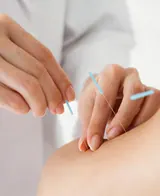
Treatment uses fine, sterile, single-use needles placed at points on the lower abdomen, lower back, legs and sometimes the head, usually left in place for about 20 to 40 minutes. A course is typically several visits, with reassessment. The trials above used sessions twice a week for 4 to 6 weeks.[9, 10] Electroacupuncture or moxibustion may also be used.
Serious problems from acupuncture are rare. In prospective studies, about 9 in 100 patients had a minor reaction such as bleeding, pain or redness at a needle site, and serious events occurred in about 1 in 10,000 patients.[12] Tell the practitioner first if you have a bleeding disorder, take blood thinners, are pregnant, or have a pacemaker (relevant to electroacupuncture).
Ayurvedic medicine for Overactive Bladder
The Ayurvedic view
Ayurveda does not have an exact match for overactive bladder. Frequent, urgent urination is traditionally discussed under disorders of the urinary system, often tied to aggravated Vata, and sometimes Pitta, depending on the person. These are traditional frameworks used to choose care, not biomedical diagnoses.
Therapies that may be used
Care is individualized and traditionally may combine:
- Diet and daily routine aimed at calming Vata, such as regular meals and consistent sleep
- Warm oil massage of the lower back and abdomen
- Herbs selected by the practitioner, from tested sources
- Breathing and relaxation practices
Panchakarma procedures are not appropriate during pregnancy, acute illness or frailty, and they are not started until urinary symptoms have been medically assessed. Standard measures such as bladder training remain part of first-line care.[6]
What the research shows
We found no clinical trials of Ayurvedic treatment or Panchakarma for overactive bladder, so the evidence for the condition is none. A related herbal trial, described below, tested Crataeva nurvala, a plant known in Ayurveda as varuna, within a multi-herb extract. It was not a test of Ayurvedic practice.[13] Because about one fifth of Ayurvedic medicines bought online contained detectable lead, mercury or arsenic, product quality matters.[14]
Herbal medicine for Overactive Bladder
Herbs and formulas that have been studied
Studied herbal products include a combination extract of Crataeva nurvala, horsetail (Equisetum arvense) and Lindera aggregata, the Japanese traditional formula gosha-jinki-gan, a cinnamon patch applied to the skin, and a Chinese acupoint application with warming herbs.[13, 15, 16, 17]
What the research shows
The evidence is limited and comes from small trials, each testing a single product. In a double-blind trial of 150 people, the multi-herb extract was reported to reduce day and night urination and urgency compared with placebo over 8 weeks.[13] A 6-week placebo-controlled trial of 66 people found a cinnamon patch lowered symptom scores compared with placebo.[16] A pilot placebo-controlled trial of 69 people found improved symptom scores with a warming-herb acupoint application.[17]
Gosha-jinki-gan was studied in 44 women without a comparison group. Symptom and urination counts fell, but without a control group it cannot show that the formula caused the change.[15] Each of these studies tested one product, and none has been broadly confirmed. Applying herbal preparations to the skin is one of the clinic's services, but these trials do not show that any particular preparation works.
Safety and herb-drug interactions
Herbs are active substances and can interact with medicines. Reviews describe interactions with blood thinners, blood pressure medicines including diuretics, and other drugs.[18] Tell us about all of your bladder medicines and other prescriptions before any herb is considered.
Tell us if you are pregnant or breastfeeding, or have liver or kidney disease. Herbs should come from tested sources, because some Ayurvedic products contain lead, mercury or arsenic.[14]
Translating traditional medicine into modern biological language
This is interpretation, not equivalence. In Chinese medicine, frequent and urgent urination is often described as weakness of kidney qi or yang, or as damp-heat in the bladder. Modern researchers instead describe bladder signaling, bladder lining sensitivity and autonomic nervous system function.[5]
Ayurveda's aggravated Vata, the principle of movement, loosely parallels the idea of over-excitable bladder nerves, but no study has shown that a dosha corresponds to a specific biological process. In one trial, lower urine nerve growth factor after acupuncture is an example of a measurable change that researchers examine.[9]
How this care fits with your medical care
Complementary care for overactive bladder works alongside your physician or urologist and does not replace them. We do not diagnose the cause of urinary symptoms, and we do not prescribe or change prescription drugs. Do not stop or change prescribed bladder medicines without your prescriber.
Please bring your diagnosis, a bladder diary if you have one, a full list of medicines and supplements, and recent test results, including any urine tests. Guidelines call for shared decision-making, and your treating team should know you are receiving complementary care.[2]
When to seek urgent medical care
Some urinary symptoms are not overactive bladder and need prompt medical evaluation.
- Blood in the urine
- Burning with urination, fever, chills or pain in the side or back
- Being unable to pass urine, or a painful, swollen lower abdomen
- New leg weakness or numbness in the groin or inner thighs with loss of bladder or bowel control
- Sudden severe symptoms with confusion or very high thirst
If any of these occur, call 911 or go to the nearest emergency department.
Frequently asked questions
What is overactive bladder?
Overactive bladder is a group of urinary symptoms: a sudden, strong urge to urinate that is hard to delay, usually with frequent urination and waking at night to void. Some people leak urine with the urge. It affects roughly one in five people worldwide and is more common with age. Its causes are not fully understood, and a physician should evaluate it.
Can acupuncture help with overactive bladder?
It may help some people, but the evidence is limited. A Cochrane review found low-certainty evidence that acupuncture may slightly improve symptoms compared with medication, and very uncertain results compared with sham acupuncture. Most studies had some risk of bias. Acupuncture is used alongside medical care, not in place of it.
Does Ayurvedic or herbal medicine work for overactive bladder?
We found no clinical trials of Ayurvedic treatment for overactive bladder. A few small trials of single herbal products, such as a multi-herb extract and a cinnamon patch, reported improved symptoms over placebo, but they are limited and not broadly confirmed. Herbs can interact with medicines and are only used when prescribed individually.
Can I stop my bladder medicine if I have acupuncture?
No. Acupuncture, Ayurveda and herbal medicine are complementary care. Do not stop or change any prescribed medicine without talking to your prescriber. If you have blood in your urine, cannot pass urine, or have fever with urinary symptoms, you need prompt medical care.
How soon might I notice a change with acupuncture?
It differs from person to person and no result can be promised. The trials we reviewed used sessions twice a week for 4 to 6 weeks. We reassess after a short course of visits to see whether treatment is helping, and we ask you to keep track of your symptoms.
Does insurance cover acupuncture for overactive bladder?
It may. Netra Integrative Health Clinic is in-network with Blue Cross Blue Shield, Cigna and UnitedHealthcare. Other plans may be covered through out-of-network benefits, and we offer a free benefits check. HSA and FSA cards and CareCredit are also accepted. Call (908) 402-7301 to ask about your plan.
References
- Zhang L, Cai N, Mo L, et al. Global Prevalence of Overactive Bladder: A Systematic Review and Meta-analysis. Int Urogynecol J. 2025;36(8):1547-1566. PMID 39951109. Meta-analysis of 53 studies (610,438 participants) estimating global overactive bladder prevalence at about 20%, higher in women, older adults and people with obesity.
- Cameron AP, Chung DE, Dielubanza EJ, et al. The AUA/SUFU Guideline on the Diagnosis and Treatment of Idiopathic Overactive Bladder. J Urol. 2024;212(1):11-20. PMID 38651651. AUA/SUFU guideline on idiopathic overactive bladder, covering evaluation, non-invasive to invasive treatments and shared decision-making.
- Hargreaves E, Baker K, Barry G, et al. Acupuncture for treating overactive bladder in adults. Cochrane Database Syst Rev. 2022;9(9):CD013519. PMID 36148895. Cochrane review of 15 studies (1,395 participants) of acupuncture for overactive bladder, with very low to low certainty evidence and tentative conclusions.
- Leslie SW, Sajjad H, Singh S. Nocturia. StatPearls [Internet]. 2024. PMID 30085529. StatPearls chapter on nocturia, noting its frequent association with overactive bladder and its effects on sleep and falls.
- Peyronnet B, Mironska E, Chapple C, et al. A Comprehensive Review of Overactive Bladder Pathophysiology: On the Way to Tailored Treatment. Eur Urol. 2019;75(6):988-1000. PMID 30922690. Review of overactive bladder pathophysiology describing it as a multifactorial syndrome with bladder lining, metabolic, mood, hormonal and autonomic contributors.
- Funada S, Yoshioka T, Luo Y, et al. Bladder training for treating overactive bladder in adults. Cochrane Database Syst Rev. 2023;10(10):CD013571. PMID 37811598. Cochrane review of 15 trials of bladder training for overactive bladder, finding low-certainty evidence of benefit and a high risk of bias.
- Zhao Y, Zhou J, Mo Q, et al. Acupuncture for adults with overactive bladder: A systematic review and meta-analysis of randomized controlled trials. Medicine (Baltimore). 2018;97(8):e9838. PMID 29465566. Meta-analysis of 10 trials (794 patients) suggesting electroacupuncture may reduce nocturia, with evidence judged insufficient for acupuncture alone.
- Ma J, Ren F, Lu S, et al. Acupuncture therapy of overactive bladder: An umbrella review and meta-analysis. Arab J Urol. 2025;23(1):75-83. PMID 39776552. Umbrella review of seven systematic reviews of acupuncture for overactive bladder, with critically low to low confidence and mostly low-quality evidence.
- Aydoğmuş Y, Sunay M, Arslan H, et al. Acupuncture versus solifenacin for treatment of overactive bladder and its correlation with urine nerve growth factor levels: a randomized, placebo-controlled clinical trial. Urol Int. 2014;93(4):437-43. PMID 25033919. Trial of 90 women comparing acupuncture, solifenacin and placebo; both active treatments improved scores over placebo and urine nerve growth factor fell.
- Noh EJ, Choi SJ, Kim DI, et al. Effectiveness and safety of electroacupuncture and manual acupuncture in postmenopausal women with overactive bladder: a multicenter, randomized, controlled, parallel clinical trial. Acupunct Med. 2025;43(6):316-329. PMID 41277510. Trial of 147 postmenopausal women comparing two electroacupuncture frequencies with manual acupuncture, finding no significant difference in the main outcome.
- Lee HY, Yun YJ, Choi JY, et al. Effectiveness and safety of moxibustion for alleviating symptoms of overactive bladder: A prospective, randomized controlled, crossover-design, pilot study. Medicine (Baltimore). 2018;97(34):e12016. PMID 30142847. Crossover pilot trial of moxibustion with behavioral training for overactive bladder, suggesting possible benefit and feasibility of a larger trial.
- Bäumler P, Zhang W, Stübinger T, et al. Acupuncture-related adverse events: systematic review and meta-analyses of prospective clinical studies. BMJ Open. 2021;11(9):e045961. PMID 34489268. Systematic review of 21 prospective studies finding minor acupuncture reactions in about 9 percent of patients and serious events in about 1 per 10,000.
- Schoendorfer N, Sharp N, Seipel T, et al. Urox containing concentrated extracts of Crataeva nurvala stem bark, Equisetum arvense stem and Lindera aggregata root, in the treatment of symptoms of overactive bladder and urinary incontinence: a phase 2, randomised, double-blind placebo controlled trial. BMC Complement Altern Med. 2018;18(1):42. PMID 29385990. Double-blind trial of 150 people finding a multi-herb extract including Crataeva nurvala reduced urinary frequency, nocturia and urgency compared with placebo over 8 weeks.
- Saper RB, Phillips RS, Sehgal A, et al. Lead, mercury, and arsenic in US- and Indian-manufactured Ayurvedic medicines sold via the Internet. JAMA. 2008;300(8):915-23. PMID 18728265. JAMA study finding detectable lead, mercury or arsenic in about one fifth of Ayurvedic medicines purchased over the Internet.
- Kajiwara M, Mutaguchi K. Clinical efficacy and tolerability of gosha-jinki-gan, Japanese traditional herbal medicine, in females with overactive bladder. Hinyokika Kiyo. 2008;54(2):95-9. PMID 18323165. Uncontrolled study of 44 Japanese women finding gosha-jinki-gan reduced symptom scores and urination counts, with adverse reactions in 9%.
- Chen LL, Shen YC, Ke CC, et al. Efficacy of cinnamon patch treatment for alleviating symptoms of overactive bladder: A double-blind, randomized, placebo-controlled trial. Phytomedicine. 2021;80:153380. PMID 33091856. Double-blind trial of 66 people finding a cinnamon patch reduced overactive bladder symptom scores compared with placebo over 6 weeks.
- Tang H, Zhu C, Xu S, et al. Efficacy of acupoint application in patients with overactive bladder: A randomized, placebo-controlled pilot trial. Explore (NY). 2023;19(5):749-754. PMID 37024405. Pilot placebo-controlled trial of 69 people finding a warming-herb acupoint application improved overactive bladder symptom scores.
- Hu Z, Yang X, Ho PC, et al. Herb-drug interactions: a literature review. Drugs. 2005;65(9):1239-82. PMID 15916450. Literature review of clinically significant herb-drug interactions, including effects with blood thinners, diuretics and other drugs.
This page is for general education and is not medical advice. Acupuncture, Ayurvedic medicine and herbal medicine are complementary therapies; they do not replace diagnosis or treatment by your physician. Do not stop or change prescribed treatment without talking to your prescriber. In an emergency call 911.