
















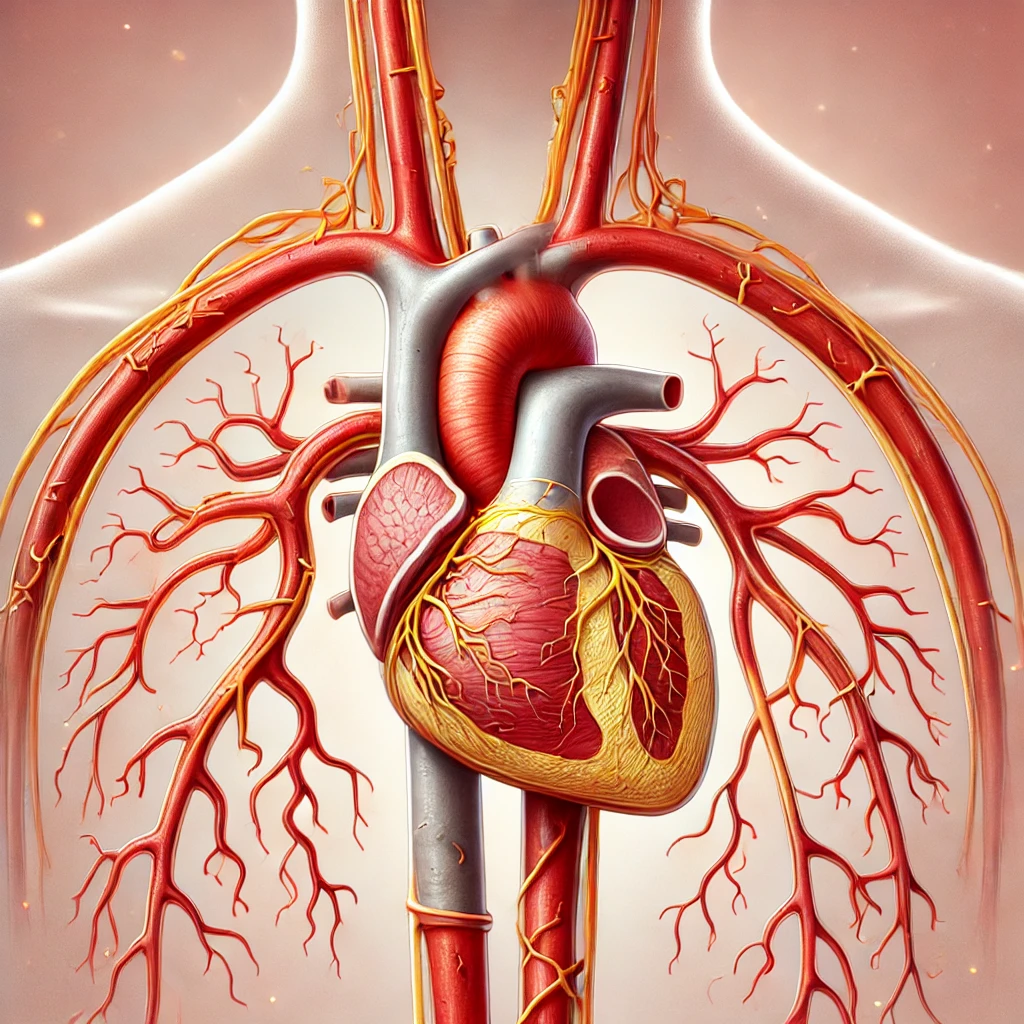
- What it is: A rare, long-lasting inflammation of the aorta and its main branches that can cause narrowing, blockage or bulging of the arteries.
- Common symptoms: Fatigue, fever, weight loss and aches early on; later weak or absent pulses, high blood pressure, dizziness, limb pain with activity and, in some people, stroke-like or vision symptoms.
- Conventional care: Glucocorticoids combined with other immune-suppressing medicines, biologic drugs for resistant disease, blood pressure control and, when needed, vascular procedures.
- How integrative care fits: Supportive care for stress, sleep, fatigue and treatment side effects, given with your rheumatology team's knowledge.
- Evidence at a glance: None found for the disease itself. Acupuncture, Ayurveda and herbs have only been studied for related symptoms, and Ayurveda for this disease has a single case report.
What is Takayasu's Arteritis?
Takayasu's arteritis is a rare, long-lasting inflammation of the aorta (the body's main artery) and its major branches. It can cause the vessel walls to thicken and narrow, close off, or bulge into aneurysms.[1, 2] It is not a condition that can be managed with complementary care alone, and it needs ongoing care from a rheumatologist or other specialist.
Common symptoms
The early stage often brings vague symptoms such as fever, tiredness, weight loss and general aches, along with high inflammation markers on blood tests. This stage is easy to miss.[3]
As the arteries narrow, the later stage can bring:
- Weak or missing pulses, or a blood pressure that differs between the two arms
- High blood pressure, especially when the kidney arteries are involved
- Dizziness, limb pain on exertion, or chest pain
- Stroke-like symptoms, vision loss or heart failure in severe cases[1, 3]
Causes and risk factors
The cause is not known. An abnormal immune response, in which immune cells attack the artery wall, appears to be central.[1] The disease mostly affects women, with onset typically between ages 20 and 40, and it is seen more often in parts of Asia than in the United States.[2] Genetic differences in immune-related genes are thought to explain part of this, while the role of environmental triggers is poorly understood.[2]
How it is diagnosed and treated conventionally
Diagnosis rests on suspicion from symptoms and examination, supported by imaging of the arteries, such as CT, MRI or angiography, and blood markers of inflammation.[1, 2] Imaging is also central to follow-up.[2]
Treatment normally starts with glucocorticoids combined with another immune-suppressing drug, and biologic medicines are used for disease that relapses or does not respond.[4, 5] Many of the recommendations in the 2021 American College of Rheumatology guideline are conditional because the supporting evidence is of low quality.[4] Blocked or damaged arteries may need angioplasty, stenting or surgery, and lifelong monitoring is considered essential because relapses and new artery damage can occur.[3]
Why Takayasu's Arteritis calls for a whole-person approach
The disease itself is driven by the immune system and must be treated by specialists. Living with it also involves things the medicines do not fully address, including the effects of long-term glucocorticoids, fatigue, sleep, stress and blood pressure.
This is the area where supportive care may have a role. The evidence below is about those symptoms in general. It is not evidence that any of these therapies affects the disease.
Immune activity and inflammation
Researchers describe Takayasu's arteritis as inflammation of the artery wall driven by abnormal immune activity, which is why treatment aims to suppress it.[1, 3] Some laboratory and review literature proposes that acupuncture influences inflammatory signaling, but this has not been tested as a treatment for large-vessel vasculitis.[6]
Treatment side effects
Long-term glucocorticoid use can thin the bones, and the American College of Rheumatology publishes guidance on assessing and treating glucocorticoid-induced osteoporosis. That care belongs with your physician.[7]
Blood pressure
High blood pressure is a common feature when the kidney arteries are narrowed, and it is managed with medicines by your physicians.[3]
Sleep, stress and fatigue
Fatigue is among the earliest and most persistent complaints.[3] Stress, poor sleep and fatigue are the symptoms where supportive therapies have been studied most, although not in people with this disease.
Acupuncture as supportive care in Takayasu's Arteritis
What the research shows
No clinical trials of acupuncture for Takayasu's arteritis were found in PubMed. The evidence below concerns symptoms that people with the disease may share, and it was gathered in other patient groups.
For high blood pressure, a meta-analysis of 23 trials (1,788 patients) found that acupuncture added to blood pressure medicine lowered readings more than sham acupuncture added to medicine, based on only two trials. Acupuncture alone did not lower blood pressure more than medication. The authors judged the trials to be of limited quality and called for larger studies.[8] Your blood pressure must stay under your physician's management.
For fatigue, a meta-analysis of 16 trials in chronic fatigue syndrome found that acupuncture was more effective than sham acupuncture and other treatments, but most studies were of low quality, so no firm conclusion could be drawn.[9]
For sleep, a meta-analysis of 24 trials in insomnia found improvement against drug treatment after about three weeks, with very different results across trials.[10]
In rheumatoid arthritis, another autoimmune disease, a review of 13 trials suggested possible benefit for pain, function and quality of life. Ten of those were published in China and the authors said the evidence was not strong enough for a clinical guideline.[11]
How acupuncture may work
A review of the anti-inflammatory effects of acupuncture proposes that it may release nerve signaling molecules that affect blood vessels and inflammatory messengers. It also notes that large randomized trials showing a sustained effect were missing.[6] This is a proposed mechanism from 2003, not a demonstrated effect in Takayasu's arteritis.
What treatment involves
Treatment uses fine, sterile, single-use needles, usually left in place for about 20 to 40 minutes. A course of several visits is followed by a reassessment of whether it is helping.
In prospective studies, about 9 in 100 patients had a minor reaction such as bleeding, pain or a mark at the needle site, and serious events occurred in about 1 in 10,000 patients.[12] Tell your practitioner first if you take blood thinners, have a bleeding disorder, are pregnant, or have a pacemaker, and mention that your immune system is suppressed by medication, since this can affect how you heal and how infections are handled.
Ayurvedic medicine as supportive care in Takayasu's Arteritis
The Ayurvedic view
In Ayurveda, diseases of the blood vessels with pain and reduced circulation are described under the heading of Vata disorders. A published case report used the term Siragata Vata, meaning vitiated Vata affecting the blood vessels, for Takayasu's arteritis.[13] This is a traditional framework and not a medical diagnosis.
Therapies that may be used
Ayurvedic care is chosen for the individual. In a supportive role it may include:
- Dietary and daily routine advice aimed at regular meals, steady sleep and stress reduction
- Gentle oil massage and relaxation practices
- Individually prescribed herbs such as ashwagandha, traditionally used for stress and low energy
Panchakarma, including medicated enemas and sweating therapies, is not appropriate during pregnancy, acute illness or frailty. It is also not suitable while the disease is active or while a person is on high-dose immune-suppressing treatment, and it should be considered only with the agreement of the treating specialist. Any herbal preparation applied to the skin (transdermal medication therapy) is a supportive option only, and we make no claim of benefit for it in this disease.
What the research shows
Research on Ayurveda for Takayasu's arteritis is very limited: a search found one single-patient case report and no trials. The case report described a 42-year-old woman treated with an extensive Panchakarma and herbal program who was reported to improve on a disease activity score.[13] One case without a comparison cannot show that the treatment caused the change.
For related symptoms, two meta-analyses of randomized trials found that ashwagandha extract reduced stress and anxiety scores compared with placebo. One reviewed 12 trials and rated the certainty of evidence as low.[14, 15] A meta-analysis of five trials found a small improvement in sleep, with limited long-term safety data.[16] These trials were mostly in healthy or anxious adults, not people with vasculitis or on immunosuppressants.
Herbal medicine as supportive care in Takayasu's Arteritis
Herbs and formulas that have been studied
No herbal formula has been tested in trials for Takayasu's arteritis. Turmeric (curcumin) is the only herb for which any related evidence was found. A review of 31 trials in ten autoimmune diseases included one trial in arteritis and reported that clinical results improved there, without saying which type of arteritis it was. The authors said Takayasu arteritis did not have enough clinical data for pooling and that larger trials were needed.[17]
What the research shows
There is no confirmed trial evidence for herbal medicine in this disease. The curcumin review found data too sparse for any conclusion about Takayasu arteritis.[17] Symptom-level evidence exists for ashwagandha and stress, anxiety and sleep, as described above, and its certainty is low.[14, 16]
Safety and herb-drug interactions
This matters more here than in many conditions, because people with Takayasu's arteritis often take immune-suppressing medicines and may take blood thinners or blood pressure drugs. A review of herb-drug interactions describes St. John's wort lowering levels of the immunosuppressants cyclosporine and tacrolimus, and case reports of bleeding when danshen, garlic or ginkgo were taken with warfarin or aspirin.[18] A review of warfarin cases also lists dang gui, ginger and Boswellia.[19]
Product quality is another concern. In one study about one fifth of Ayurvedic medicines bought online contained detectable lead, mercury or arsenic.[20] Herbs should come from tested sources and be prescribed individually by a qualified practitioner after review of your full medicine list. Tell us if you are pregnant or breastfeeding or have liver or kidney disease.
Translating traditional medicine into modern biological language
This is interpretation, not equivalence. Chinese medicine would describe blocked flow of qi and blood in the vessels, and Ayurveda describes disturbed Vata in the blood vessels.[13] Researchers study ideas that loosely parallel such pictures, including inflammatory signaling, blood vessel tone and the nervous system's response to stress.[6]
No study has shown that a traditional pattern corresponds to the immune injury of the artery wall in Takayasu's arteritis. The traditional language is used to guide supportive care for the person, not to explain the disease.
How this care fits with your medical care
Supportive care here is complementary. For a condition like this, we ask that you are under a physician's care for it and that your treating team knows you are receiving complementary care. Keep your rheumatologist, and your cardiologist or vascular specialist if you have one, and do not stop or change prescribed medicines, including glucocorticoids, without your prescriber.
We do not diagnose or monitor the disease, assess disease activity or adjust medication. Please bring your diagnosis, recent imaging and blood test results, your full list of medicines and supplements, and your blood pressure readings. If you take immune-suppressing drugs, tell us so that we can choose supportive care appropriately.
When to seek urgent medical care
Takayasu's arteritis can cause sudden, serious complications from blocked or weakened arteries.[3]
- Sudden weakness, numbness, trouble speaking, or loss or blurring of vision
- Chest pain, shortness of breath or fainting
- Severe headache with a very high blood pressure reading
- Sudden severe pain in the chest, back or abdomen
- A cold, pale, painful or numb arm or leg
- Fever with a new flare of symptoms while on immune-suppressing medicine
If any of these occur, call 911 or go to the nearest emergency department.
Frequently asked questions
What is Takayasu’s arteritis?
Takayasu’s arteritis is a rare, long-lasting inflammation of the aorta and its major branches. The inflammation can narrow, block or weaken the arteries and reduce blood flow to the brain, arms, kidneys or heart. It mainly affects younger women. It needs treatment from a rheumatologist, usually with glucocorticoids and other immune-suppressing medicines, and lifelong monitoring.
Can acupuncture help people with Takayasu’s arteritis?
No trials have tested acupuncture for Takayasu’s arteritis itself, so we cannot say it affects the disease. Research in other groups suggests it may help some people with sleep problems, fatigue and pain, although many studies are of low quality. We offer it only as supportive care for symptoms, alongside your specialist treatment.
Do Ayurvedic or herbal medicines work for Takayasu’s arteritis?
There is no good evidence that they do. The Ayurvedic literature on this disease is a single case report, and no herbal trials were found. Ashwagandha has been studied for stress, anxiety and sleep in other adults, with low-certainty results. Herbs can interact with immune-suppressing medicines and blood thinners, so any use must be reviewed first.
Can I reduce my steroids or other medicines if I use this care?
No. Complementary care does not replace your medicines, and nothing here shows that it lowers the need for them. Stopping or lowering immune-suppressing drugs on your own can allow the disease to flare. Make any change to prescribed treatment only with your rheumatologist.
What should I bring to my first visit?
Bring your diagnosis, recent imaging and blood test results, a complete list of your medicines and supplements, and your recent blood pressure readings. Tell us the name of your rheumatologist and any other specialists. We ask that your treating team knows you are receiving complementary care.
Does insurance cover acupuncture for Takayasu’s arteritis?
It may. Netra Integrative Health Clinic is in-network with Blue Cross Blue Shield, Cigna and UnitedHealthcare. Other plans may be covered through out-of-network benefits, and we offer a free benefits check. HSA and FSA cards and CareCredit are also accepted. Call (908) 402-7301 to ask about your plan.
References
- Trinidad B, Surmachevska N, Lala V. Takayasu Arteritis. StatPearls [Internet]. 2023. PMID 29083666. StatPearls chapter on Takayasu arteritis describing it as a large-artery inflammatory disease of young Asian women, with immune-mediated mechanisms, angiographic diagnosis and corticosteroid-based treatment.
- Sawalha AH, Misra DP, Goel R, et al. Advances in the pathophysiology, diagnosis and treatment of Takayasu arteritis. Nat Rev Rheumatol. 2025;21(12):737-751. PMID 41198934. 2025 Nature Reviews Rheumatology review of Takayasu arteritis pathophysiology, genetics, imaging-based diagnosis and expanding biologic treatment options.
- Joseph G, Goel R, Thomson VS, et al. Takayasu Arteritis: JACC Focus Seminar 3/4. J Am Coll Cardiol. 2022. PMID 36599755. JACC review of Takayasu arteritis covering early and pulseless stages, ischemic complications, immunosuppressive and vascular treatment, and the need for lifelong surveillance.
- Maz M, Chung SA, Abril A, et al. 2021 American College of Rheumatology/Vasculitis Foundation Guideline for the Management of Giant Cell Arteritis and Takayasu Arteritis. Arthritis Rheumatol. 2021;73(8):1349-1365. PMID 34235884. 2021 American College of Rheumatology and Vasculitis Foundation guideline on giant cell and Takayasu arteritis, recommending non-glucocorticoid immunosuppressants with glucocorticoids and noting mostly low-quality evidence.
- Kermani TA, Tomelleri A, Scaramuzzi D, et al. Management of Takayasu Arteritis - A 2026 Update. Curr Rheumatol Rep. 2026;28(1). PMID 41860699. 2026 review of Takayasu arteritis management covering disease activity assessment, glucocorticoids with DMARDs, biologics and the need for more high-quality trials.
- Zijlstra FJ, van den Berg-de Lange I, Huygen FJ, et al. Anti-inflammatory actions of acupuncture. Mediators Inflamm. 2003;12(2):59-69. PMID 12775355. Review proposing mechanisms for anti-inflammatory actions of acupuncture, including nerve peptides and cytokine balance, and noting the lack of large randomized trials.
- Humphrey MB, Russell L, Danila MI, et al. 2022 American College of Rheumatology Guideline for the Prevention and Treatment of Glucocorticoid-Induced Osteoporosis. Arthritis Rheumatol. 2023;75(12):2088-2102. PMID 37845798. 2022 American College of Rheumatology guideline on preventing and treating glucocorticoid-induced osteoporosis in adults taking glucocorticoids for more than three months.
- Zhao XF, Hu HT, Li JS, et al. Is Acupuncture Effective for Hypertension? A Systematic Review and Meta-Analysis. PLoS One. 2015;10(7):e0127019. PMID 26207806. Meta-analysis of 23 trials (1,788 patients) finding acupuncture helped when added to blood pressure medicine but not alone, with limited trial quality and poor adverse event reporting.
- Zhang Q, Gong J, Dong H, et al. Acupuncture for chronic fatigue syndrome: a systematic review and meta-analysis. Acupunct Med. 2019;37(4):211-222. PMID 31204859. Meta-analysis of 16 trials (1,346 people) of acupuncture for chronic fatigue syndrome, favoring acupuncture over sham but with low-quality studies and no firm conclusion.
- Kim SA, Lee SH, Kim JH, et al. Efficacy of Acupuncture for Insomnia: A Systematic Review and Meta-Analysis. Am J Chin Med. 2021;49(5):1135-1150. PMID 34049475. Meta-analysis of 24 trials of acupuncture for insomnia finding improvement over drug treatment after about three weeks, with high heterogeneity.
- Seca S, Miranda D, Cardoso D, et al. Effectiveness of Acupuncture on Pain, Physical Function and Health-Related Quality of Life in Patients with Rheumatoid Arthritis: A Systematic Review of Quantitative Evidence. Chin J Integr Med. 2019;25(9):704-709. PMID 30569405. Systematic review of 13 trials (974 patients) suggesting acupuncture may relieve pain and improve function in rheumatoid arthritis, with methodological limitations.
- Bäumler P, Zhang W, Stübinger T, et al. Acupuncture-related adverse events: systematic review and meta-analyses of prospective clinical studies. BMJ Open. 2021;11(9):e045961. PMID 34489268. Systematic review of 21 prospective studies finding minor acupuncture reactions in about 9 percent of patients and serious events in about 1 per 10,000.
- Singh SK, Rajoria K, Sharma S. Ayurvedic management for a rare disorder Takayasu arteritis - A case report. Ayu. 2020;41(2):79-86. PMID 34908792. Case report of one woman with Takayasu arteritis treated with Panchakarma and Ayurvedic herbs, described as improved on an activity score, without a comparison group.
- Akhgarjand C, Asoudeh F, Bagheri A, et al. Does Ashwagandha supplementation have a beneficial effect on the management of anxiety and stress? A systematic review and meta-analysis of randomized controlled trials. Phytother Res. 2022;36(11):4115-4124. PMID 36017529. Meta-analysis of 12 trials (1,002 participants) finding ashwagandha reduced stress and anxiety compared with placebo, with low certainty of evidence.
- Arumugam V, Vijayakumar V, Balakrishnan A, et al. Effects of Ashwagandha (Withania Somnifera) on stress and anxiety: A systematic review and meta-analysis. Explore (NY). 2024;20(6):103062. PMID 39348746. Meta-analysis of 9 trials (558 patients) finding ashwagandha formulations lowered perceived stress, anxiety scores and cortisol versus placebo, with limited long-term safety data.
- Cheah KL, Norhayati MN, Husniati Yaacob L, et al. Effect of Ashwagandha (Withania somnifera) extract on sleep: A systematic review and meta-analysis. PLoS One. 2021;16(9):e0257843. PMID 34559859. Meta-analysis of 5 trials (400 adults) finding ashwagandha extract gave a small improvement in sleep, with limited data on serious adverse effects.
- Zeng L, Yang T, Yang K, et al. Curcumin and Curcuma longa Extract in the Treatment of 10 Types of Autoimmune Diseases: A Systematic Review and Meta-Analysis of 31 Randomized Controlled Trials. Front Immunol. 2022;13:896476. PMID 35979355. Meta-analysis of 31 trials in ten autoimmune diseases including one arteritis trial, concluding that Takayasu arteritis data were insufficient and larger trials are needed.
- Hu Z, Yang X, Ho PC, et al. Herb-drug interactions: a literature review. Drugs. 2005;65(9):1239-82. PMID 15916450. Literature review of herb-drug interactions, including St. John's wort with immunosuppressants and bleeding with danshen, garlic and ginkgo taken with warfarin or aspirin.
- Milić N, Milosević N, Golocorbin Kon S, et al. Warfarin interactions with medicinal herbs. Nat Prod Commun. 2014;9(8):1211-6. PMID 25233607. Review of case reports of warfarin interactions with medicinal herbs, including dang gui, ginger and Boswellia.
- Saper RB, Phillips RS, Sehgal A, et al. Lead, mercury, and arsenic in US- and Indian-manufactured Ayurvedic medicines sold via the Internet. JAMA. 2008;300(8):915-23. PMID 18728265. JAMA study finding detectable lead, mercury or arsenic in about one fifth of Ayurvedic medicines purchased over the Internet.
This page is for general education and is not medical advice. Acupuncture, Ayurvedic medicine and herbal medicine are complementary therapies; they do not replace diagnosis or treatment by your physician. Do not stop or change prescribed treatment without talking to your prescriber. In an emergency call 911.