

















- What it is: A lifelong inflammatory disease of the rectum and colon that causes inflammation and ulcers in the lining of the large intestine.
- Common symptoms: Bloody diarrhea, abdominal cramping, urgency, fatigue, and sometimes weight loss or inflammation in other parts of the body.
- Conventional care: Aminosalicylates, corticosteroids, immune-modifying and biologic medicines, regular monitoring, and surgery to remove the colon for some people.
- How integrative care fits: Acupuncture, Ayurvedic care and individually prescribed herbs are offered only as supportive care, with your gastroenterologist's knowledge.
- Evidence at a glance: Limited for acupuncture, from trials at high or unclear risk of bias; moderate for adjunct curcumin (turmeric) in small trials; very limited for Ayurveda as a system.
- Role of care: acupuncture, Ayurvedic medicine and herbal medicine are offered as complementary care alongside your physician's diagnosis and treatment, not as a replacement.
- First visit: a 60-minute consultation about your history, symptoms and goals. Treatment generally starts at a later visit.
- Follow-up: treatment sessions and follow-up consultations are about 30 minutes each. Progress is reviewed at follow-up visits and the plan is adjusted as needed.
- Where: in person at 5001 Hadley Rd, Ste 210, South Plainfield, NJ, by appointment only. See what to expect at your first visit.
What is Ulcerative Colitis?
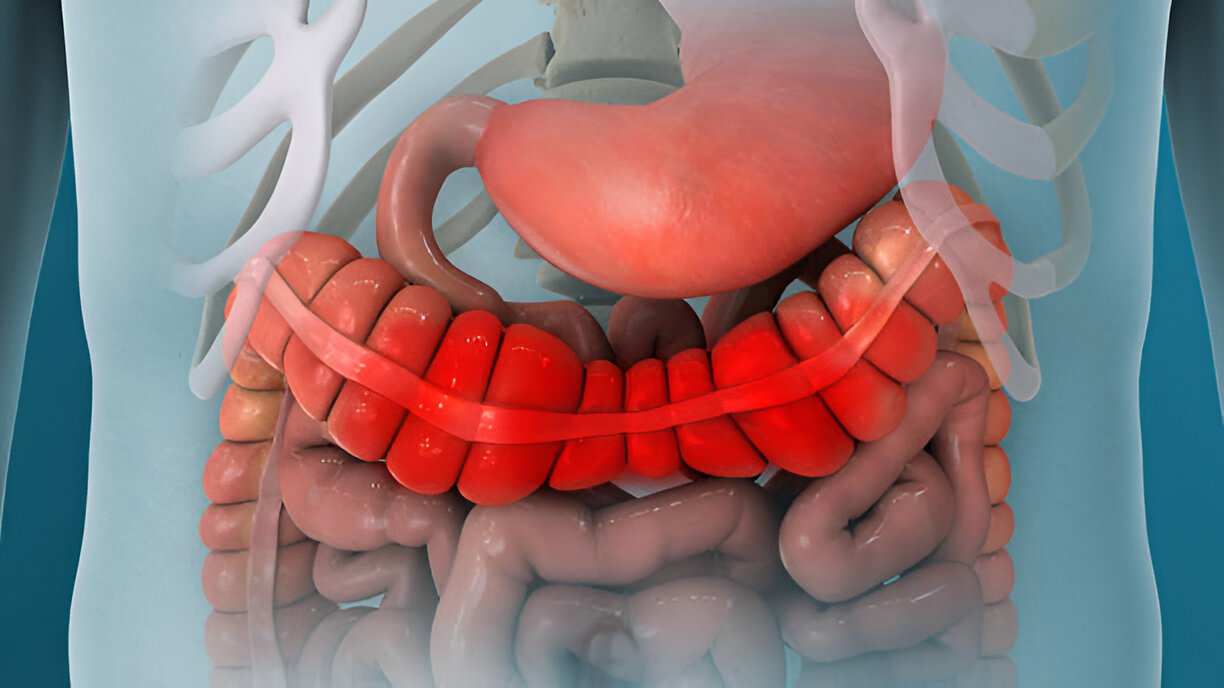
Ulcerative colitis is a lifelong inflammatory condition of the colon and rectum, in which inflammation starts in the rectum and extends upward in a continuous pattern.[1, 2] It is the most common form of inflammatory bowel disease and has no cure, though it can be controlled with treatment.[1]
For a condition like this, we ask that you are under a physician's care for it and that your treating team knows you are receiving complementary care.
Common symptoms
The hallmark symptoms are chronic diarrhea with rectal bleeding and impaired quality of life.[3] Many people also have:
- Abdominal pain and cramping, and a sudden urge to pass stool
- Fatigue, which is common in inflammatory bowel disease and can persist even when the disease is quiet[4, 5]
- Inflammation outside the bowel, such as primary sclerosing cholangitis, which affects about 27% of people with ulcerative colitis[3]
Symptoms come and go, with flares and periods of remission.[2]
Causes and risk factors
The cause is not known. It is thought to occur in people with a genetic predisposition after environmental exposures, with a weakened gut barrier, the gut microbiota and an overactive immune response all implicated.[2]
How it is diagnosed and treated conventionally
Diagnosis combines symptoms, blood and stool tests, and colonoscopy with biopsy.[2, 3] People with the disease need regular monitoring of symptoms and inflammation markers and colonoscopy for dysplasia surveillance starting about 8 years after diagnosis.[3]
Aminosalicylate (5-ASA) drugs are first-line for mild to moderate disease. Moderate to severe disease may need corticosteroids to start remission, followed by biologics or small-molecule medicines to maintain it.[2, 3] Despite these options, about 20% of patients are hospitalized within 5 years of diagnosis and about 7% have their colon removed.[3]
Why Ulcerative Colitis calls for a whole-person approach
Ulcerative colitis involves the gut lining, the immune system, the gut bacteria and the brain-gut connection at once, so medicines are only one part of living with it.[2] Even good medical therapy leaves many people with symptoms: response rates to the best current treatments range from about 30% to 60% in trials.[3]
Supportive care aims at the symptoms and burdens that medicines may not fully address, while your physicians control the inflammation.
Inflammation and the immune system
Researchers believe a dysregulated immune response is central to the disease.[2] This is why treatment is directed by a gastroenterologist and why complementary options are studied only as add-ons.
Mood, stress and the brain-gut connection
Depression is common in inflammatory bowel disease, and a meta-analysis of 24 studies found that depression was linked to a higher risk of flares, hospitalization and surgery.[6] Caring for mood and stress is therefore part of good overall care.
Fatigue
Fatigue is a common, burdensome symptom in inflammatory bowel disease, and managing it is difficult.[4]
Nutrition
Chronic diarrhea and inflammation can interfere with nutrient absorption, so a physician or dietitian may check for deficiencies.[2] Dietary changes during a flare should be guided by your treating team.
Acupuncture as supportive care in Ulcerative Colitis
What the research shows
Acupuncture may help symptoms and clinical response as an add-on to standard drugs, but the evidence is limited by low-quality trials. A meta-analysis of 13 randomized trials with 1,030 people found that acupuncture combined with mesalazine gave better clinical results than mesalazine alone, though the quality of evidence was low to moderate and the trials had high or unclear risk of bias. Adverse events did not differ significantly between groups.[7]
A 2025 network meta-analysis of 76 trials with 7,484 participants ranked several acupuncture-related approaches, such as warm acupuncture and acupuncture combined with other therapy, highest for several outcomes. It called these findings preliminary and asked for larger, higher-quality trials.[8] A review of moxibustion found only 5 low-quality trials and concluded the evidence was insufficient to show it works.[9]
Many of these trials compared acupuncture with older drugs such as mesalazine and sulfasalazine, so the findings may not apply to people on current biologic therapy.[7, 9] A broader review of complementary treatments in bowel disease found only two acupuncture trials.[10]
For fatigue, a pilot trial of 52 people with quiet inflammatory bowel disease found that electroacupuncture and sham electroacupuncture both improved fatigue more than waiting, with no clear difference between real and sham.[5] A Cochrane review rated the evidence for electroacupuncture on fatigue as low certainty.[4]
How acupuncture may work
The proposed explanation is an anti-inflammatory effect. In the 2025 network meta-analysis, some acupuncture-related treatments were linked with lower blood levels of the inflammatory molecules IL-6 and TNF-alpha.[8] This is an association in trials of uncertain quality and does not prove how acupuncture works in people.
What treatment involves
Treatment uses fine, sterile, single-use needles, usually left in place for about 20 to 40 minutes. A course is several visits, and we reassess to see whether symptoms such as discomfort, fatigue or stress are improving. Acupuncture is directed at symptoms and does not treat colon inflammation.
Serious problems are rare. In prospective studies about 9 in 100 patients had a minor reaction such as bleeding, soreness or redness at a needle site, and serious events occurred in about 1 in 10,000 patients.[11] Tell the practitioner first if you have a bleeding disorder, take blood thinners, are pregnant, or have a pacemaker (relevant to electroacupuncture). People on immune-suppressing medicines should also tell us, since they may be more prone to infection.
Ayurvedic medicine as supportive care in Ulcerative Colitis
The Ayurvedic view
In Ayurveda, bloody, mucus-containing diarrhea is traditionally compared with Pravahika, a dysentery-like disorder, and related conditions of the large intestine described in terms of Pitta and weak digestive fire (agni). These are traditional categories, not biomedical diagnoses, and they do not replace a diagnosis by a gastroenterologist.
Therapies that may be used
Care is chosen for the individual and traditionally combines:
- Simple, warm, easily digested meals, kept in line with the advice of your gastroenterologist or dietitian
- Calming routines such as breathing practices, gentle exercise and regular sleep
- Individually prescribed herbs, of which turmeric (Haridra) and Boswellia (Shallaki) are the best studied, described under herbal medicine below
Panchakarma procedures, especially purgative therapies and enemas, are not appropriate during a flare, with bleeding, in acute illness, in pregnancy, or in frailty, and we would not use them for active colitis.
What the research shows
We found no controlled trials of Ayurvedic treatment systems, including Panchakarma, in ulcerative colitis. We found only a single published case report, which cannot show that a treatment works. The research on individual herbs that Ayurveda uses, such as turmeric and Boswellia, is covered in the next section.[12]
Some Ayurvedic products contain heavy metals. About one fifth of those bought online had detectable lead, mercury or arsenic, so products should come from tested sources.[13]
Herbal medicine as supportive care in Ulcerative Colitis
Herbs and formulas that have been studied
Several herbs have been tested in trials of ulcerative colitis, alongside standard drugs. They include curcumin (from turmeric), Andrographis paniculata, aloe vera gel, Plantago ovata (psyllium seed), Boswellia serrata and Indigo naturalis, a traditional Chinese preparation.[12, 14] Chinese herbal medicine is also widely used in China, often by mouth with an enema.[15]
What the research shows
Curcumin has the most support, but it is limited and mostly as an add-on. A meta-analysis of 6 randomized trials with 385 participants found adjuvant curcumin improved the rate of clinical remission, but not clinical improvement or endoscopic remission.[16] A systematic review of 28 trials of 18 herbs in active disease found a higher rate of clinical remission with turmeric, and a higher clinical response with Indigo naturalis, while Andrographis showed no significant benefit. The authors still called for larger, well-designed trials and manufacturing regulation.[14]
For keeping people in remission, a Cochrane review found only one trial of 89 patients. Fewer patients relapsed with curcumin at six months, but the difference was not statistically significant, and there was no significant difference at 12 months.[17] An earlier review of 21 trials in bowel disease reported promising results for several herbs, but called the studies limited and varied.[12]
For traditional Chinese medicine in general, an evidence map of 73 systematic reviews found the review quality very low and advised that it be recommended only cautiously.[15]
Safety and herb-drug interactions
Herbs are active substances and can interact with medicines. People with ulcerative colitis often take immune-modifying drugs, and a review of herb-drug interactions describes St John's wort lowering blood levels of ciclosporin, which in some cases led to organ rejection.[18] Case reports also describe bleeding when warfarin was combined with herbs including dang gui, dan shen, ginger, ginseng and Boswellia.[19]
Herbal and dietary supplements are also a recognized cause of liver injury, so people taking medicines that affect the liver need extra care.[20] Product quality varies, and the trials above used different preparations, so their results may not apply to a store-bought product. Tell us if you are pregnant or breastfeeding or have liver or kidney disease. Please do not add or change any herb or supplement without telling your gastroenterologist.
Translating traditional medicine into modern biological language
These links are interpretation, not equivalence. Chinese medicine may describe colitis as damp-heat in the intestines, or as spleen deficiency in long-lasting cases. Researchers studying acupuncture and herbs look at inflammatory signaling molecules such as IL-6 and TNF-alpha as possible parallels.[8]
Ayurveda's Pitta excess and weak agni describe heat, inflammation and poor digestion. Modern medicine links ulcerative colitis to a weakened gut barrier, the gut microbiota and an overactive immune response.[2] No study has shown that a dosha or pattern corresponds to a specific biological process.
How this care fits with your medical care
This care is supportive and complementary. We do not diagnose or manage ulcerative colitis, and we do not prescribe or change medicines. Keep your gastroenterologist, continue your prescribed treatment and surveillance colonoscopies, and do not stop or reduce aminosalicylates, steroids, immune-modifying drugs or biologics without your prescriber.
Please bring your diagnosis, recent colonoscopy and lab results, and a full list of medicines and supplements. We also ask that your treating team knows you are receiving complementary care. New or changing bowel symptoms should be reviewed by your physician.
When to seek urgent medical care
Severe flares and complications of ulcerative colitis can become emergencies.[3]
- Heavy rectal bleeding or passing blood clots
- Many bloody stools a day with fever, a fast heartbeat or dizziness
- Severe abdominal pain or a swollen, rigid abdomen
- Persistent vomiting or signs of dehydration, such as very little urine
- Fever of 100.4 F or higher with a flare
- New eye pain, yellowing of the skin or eyes, or severe joint swelling
If any of these occur, call 911 or go to the nearest emergency department.
Frequently asked questions
What is ulcerative colitis?
Ulcerative colitis is a lifelong inflammatory bowel disease that causes inflammation and sores in the lining of the rectum and colon. It typically causes bloody diarrhea, abdominal cramping and urgency, with flares and quiet periods. The cause is not fully known and there is no cure, but medicines can control it. It needs ongoing care from a gastroenterologist.
Can acupuncture help people with ulcerative colitis?
It may help symptoms as an add-on to standard treatment, but the evidence is limited. A meta-analysis of 13 trials found better clinical results when acupuncture was added to mesalazine, though the trials had a high or unclear risk of bias. Acupuncture is supportive care only and does not replace medication or monitoring.
Do Ayurvedic or herbal medicines work for ulcerative colitis?
Ayurveda as a system has not been tested in controlled trials for ulcerative colitis. Some individual herbs, especially curcumin from turmeric, have shown benefit as add-ons in small trials, but the evidence is limited and products vary. Herbs can interact with immune-modifying medicines and blood thinners, so tell your gastroenterologist about any you use.
Can I stop my colitis medicine if I have this care?
No. This care is complementary. Do not stop or change aminosalicylates, steroids, immune-modifying drugs or biologics without your prescriber. Stopping medicine can trigger a flare. Heavy bleeding, severe pain, fever or dehydration need emergency care.
What should I bring to my first visit?
Bring your diagnosis, recent colonoscopy and blood or stool test results, and a full list of medicines and supplements. Also bring the names of your treating physicians so we can keep them informed. Let us know if you take blood thinners or immune-suppressing drugs.
Does insurance cover acupuncture for ulcerative colitis?
It may. Netra Integrative Health Clinic is in-network with Blue Cross Blue Shield, Cigna and UnitedHealthcare. Other plans may cover acupuncture through out-of-network benefits, and we offer a free benefits check. Insurance coverage applies to acupuncture only; all other treatments, including Ayurvedic and herbal medicine, are self-pay. HSA and FSA cards and CareCredit are also accepted. Call (908) 402-7301 to ask about your plan.
References
- Lynch WD, Hsu R. Ulcerative Colitis. StatPearls [Internet]. 2023. PMID 29083748. StatPearls chapter on ulcerative colitis describing a lifelong colonic inflammatory disease that begins in the rectum, spreads continuously, and has no cure.
- Le Berre C, Honap S, Peyrin-Biroulet L. Ulcerative colitis. Lancet. 2023;402(10401):571-584. PMID 37573077. 2023 Lancet review of ulcerative colitis covering causes, diagnosis, medical treatments and the need for colectomy in some patients.
- Gros B, Kaplan GG. Ulcerative Colitis in Adults: A Review. JAMA. 2023;330(10):951-965. PMID 37698559. 2023 JAMA review of ulcerative colitis covering symptoms, monitoring, colonoscopy surveillance, treatment options and outcomes such as hospitalization and colectomy.
- Farrell D, Artom M, Czuber-Dochan W, et al. Interventions for fatigue in inflammatory bowel disease. Cochrane Database Syst Rev. 2020;4(4):CD012005. PMID 32297974. Cochrane review of interventions for fatigue in inflammatory bowel disease, with low-certainty evidence for electroacupuncture.
- Horta D, Lira A, Sanchez-Lloansi M, et al. A Prospective Pilot Randomized Study: Electroacupuncture vs. Sham Procedure for the Treatment of Fatigue in Patients With Quiescent Inflammatory Bowel Disease. Inflamm Bowel Dis. 2020;26(3):484-492. PMID 31091322. Pilot trial of 52 patients with quiet inflammatory bowel disease finding electroacupuncture and sham both improved fatigue versus waitlist.
- Ji Y, Li H, Dai G, et al. Systematic review and meta-analysis: Impact of depression on prognosis in inflammatory bowel disease. J Gastroenterol Hepatol. 2024;39(8):1476-1488. PMID 38655853. Meta-analysis of 24 studies finding depression linked to more flares, hospitalization and surgery in inflammatory bowel disease.
- Wang X, Zhao NQ, Sun YX, et al. Acupuncture for ulcerative colitis: a systematic review and meta-analysis of randomized clinical trials. BMC Complement Med Ther. 2020;20(1):309. PMID 33054760. Meta-analysis of 13 acupuncture trials (1,030 participants) in ulcerative colitis, with benefit as an add-on to mesalazine but high or unclear risk of bias.
- Zhang L, Sun Y, Ru Z, et al. Comparative clinical efficacy of acupuncture-related therapies for ulcerative colitis: a systematic review and network meta-analysis. Front Med (Lausanne). 2025;12:1676608. PMID 41458494. 2025 network meta-analysis of 76 trials (7,484 participants) comparing acupuncture-related therapies for ulcerative colitis, with preliminary findings.
- Lee DH, Kim JI, Lee MS, et al. Moxibustion for ulcerative colitis: a systematic review and meta-analysis. BMC Gastroenterol. 2010;10:36. PMID 20374658. Meta-analysis of 5 low-quality trials of moxibustion for ulcerative colitis, concluding that evidence was insufficient.
- Langhorst J, Wulfert H, Lauche R, et al. Systematic review of complementary and alternative medicine treatments in inflammatory bowel diseases. J Crohns Colitis. 2015;9(1):86-106. PMID 25518050. Systematic review of complementary medicine in inflammatory bowel disease, finding limited and mixed-quality trials of herbs, mind-body therapies and acupuncture.
- Bäumler P, Zhang W, Stübinger T, et al. Acupuncture-related adverse events: systematic review and meta-analyses of prospective clinical studies. BMJ Open. 2021;11(9):e045961. PMID 34489268. Systematic review of 21 prospective studies finding minor acupuncture reactions in about 9 percent of patients and serious events in about 1 per 10,000.
- Ng SC, Lam YT, Tsoi KK, et al. Systematic review: the efficacy of herbal therapy in inflammatory bowel disease. Aliment Pharmacol Ther. 2013;38(8):854-63. PMID 23981095. Systematic review of 21 controlled trials of herbal therapy in inflammatory bowel disease, with encouraging but limited and varied results.
- Saper RB, Phillips RS, Sehgal A, et al. Lead, mercury, and arsenic in US- and Indian-manufactured Ayurvedic medicines sold via the Internet. JAMA. 2008;300(8):915-23. PMID 18728265. JAMA study finding detectable lead, mercury or arsenic in about one fifth of Ayurvedic medicines purchased over the Internet.
- Iyengar P, Godoy-Brewer G, Maniyar I, et al. Herbal Medicines for the Treatment of Active Ulcerative Colitis: A Systematic Review and Meta-Analysis. Nutrients. 2024;16(7). PMID 38612967. Meta-analysis of 28 trials of 18 herbs in active ulcerative colitis, finding benefit with turmeric and Indigo naturalis, not Andrographis.
- Sun YX, Wang X, Liao X, et al. An evidence mapping of systematic reviews and meta-analysis on traditional Chinese medicine for ulcerative colitis. BMC Complement Med Ther. 2021;21(1):228. PMID 34517855. Evidence map of 73 systematic reviews of traditional Chinese medicine for ulcerative colitis, finding very low review quality.
- Yin J, Wei L, Wang N, et al. Efficacy and safety of adjuvant curcumin therapy in ulcerative colitis: A systematic review and meta-analysis. J Ethnopharmacol. 2022;289:115041. PMID 35091013. Meta-analysis of 6 trials (385 participants) of adjuvant curcumin in ulcerative colitis, finding more clinical remission but not endoscopic remission.
- Kumar S, Ahuja V, Sankar MJ, et al. Curcumin for maintenance of remission in ulcerative colitis. Cochrane Database Syst Rev. 2012;10(10):CD008424. PMID 23076948. Cochrane review finding one trial of curcumin for maintaining remission in ulcerative colitis, with no significant relapse difference.
- Hu Z, Yang X, Ho PC, et al. Herb-drug interactions: a literature review. Drugs. 2005;65(9):1239-82. PMID 15916450. Literature review of herb-drug interactions, including St John's wort lowering ciclosporin levels and bleeding with warfarin.
- Milić N, Milosević N, Golocorbin Kon S, et al. Warfarin interactions with medicinal herbs. Nat Prod Commun. 2014;9(8):1211-6. PMID 25233607. Review of reported interactions between warfarin and medicinal herbs, including bleeding with dang gui, dan shen, ginger, ginseng and Boswellia.
- Navarro VJ, Khan I, Björnsson E, et al. Liver injury from herbal and dietary supplements. Hepatology. 2017;65(1):363-373. PMID 27677775. Hepatology review of liver injury caused by herbal and dietary supplements.
This page is for general education and is not medical advice. Acupuncture, Ayurvedic medicine and herbal medicine are complementary therapies; they do not replace diagnosis or treatment by your physician. Do not stop or change prescribed treatment without talking to your prescriber. In an emergency call 911.