











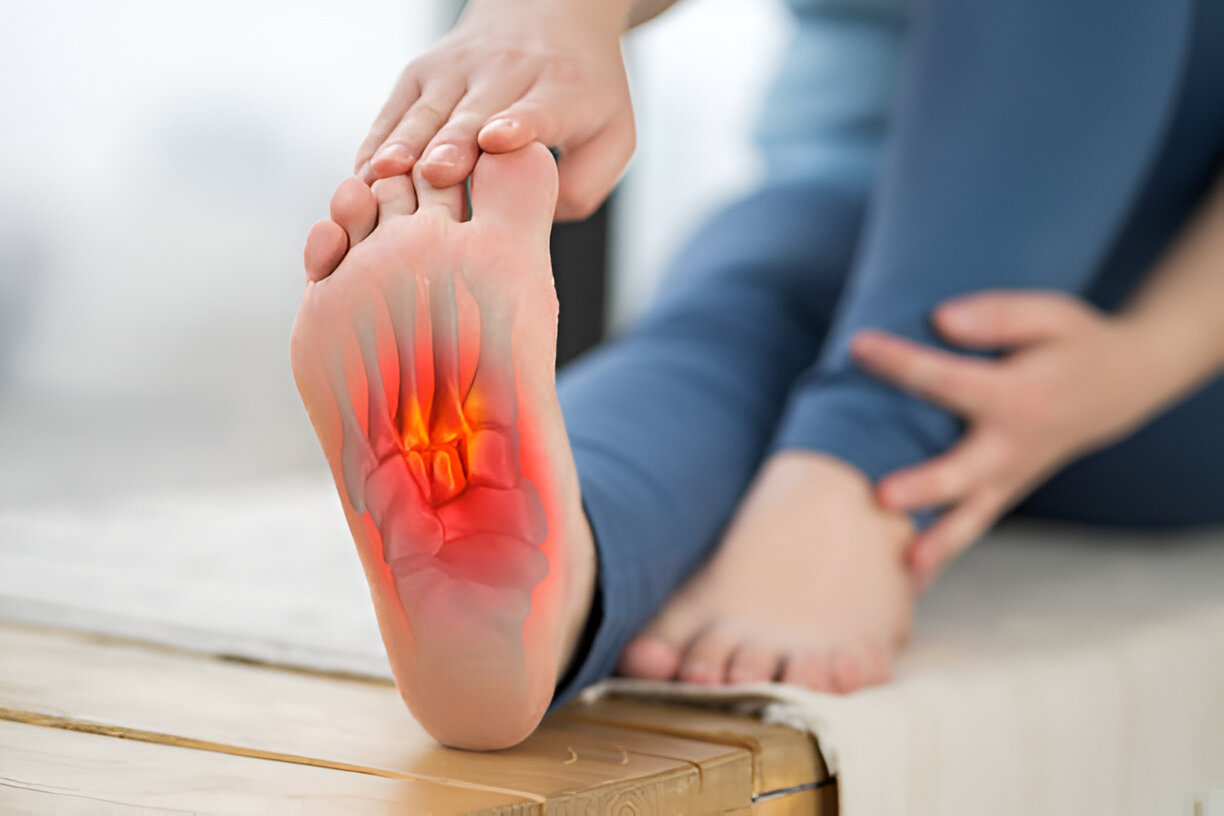
- What it is: Pain and impaired function in the Achilles tendon at the back of the ankle, linked to mechanical loading and usually called Achilles tendinopathy today.
- Common symptoms: Pain and stiffness in the tendon or at its heel attachment, often worse with running, jumping or the first steps in the morning, sometimes with swelling.
- Conventional care: Activity changes and a program of progressive tendon loading exercises, pain control, and procedures or surgery for cases that do not improve.
- How integrative care fits: Acupuncture, Ayurvedic therapies and individually prescribed herbs are used alongside rehabilitation to help with pain and general health.
- Evidence at a glance: Limited for acupuncture, with one small randomized trial; very limited for herbal medicine and none found for Ayurveda, with no trials of either in Achilles tendinopathy itself.
What is Achilles Tendinitis?
Achilles tendinitis is pain and reduced function in the Achilles tendon, the strongest and largest tendon in the body, which connects the calf muscles to the heel bone.[1] Doctors now prefer the term Achilles tendinopathy, because the problem in a painful tendon is a disordered, degenerative healing process more than simple inflammation.[2, 3] This page uses both names.
Common symptoms
The main symptom is localized pain and difficulty with loading the tendon, such as running, jumping or pushing off the foot.[3, 4] The pain can be in the middle of the tendon or where it attaches to the heel, and the two types are treated somewhat differently.[4]
Many people also notice morning stiffness, tenderness and swelling along the tendon. A sudden sharp pop or a sudden loss of push-off strength is different and needs urgent assessment (see the last section).[1]
Causes and risk factors
Repeated overloading of the tendon is the most common trigger, and the cause is usually a mix of factors.[3] Ageing, certain medicines and other health conditions can also play a part.[3]
A systematic review of cohort studies found limited evidence for several risk factors, including earlier lower-limb tendon problems, use of ofloxacin-type (quinolone) antibiotics, moderate alcohol use and weaker calf muscles. Many other suspected factors, including being overweight, were not associated with the condition, and all the included studies were at high risk of bias.[5]
How it is diagnosed and treated conventionally
Achilles tendinopathy is mostly diagnosed from your history and a physical examination. Ultrasound or MRI is used when the diagnosis is unclear.[2, 4]
Most people improve with activity changes and rehabilitation built around progressive loading of the tendon.[4, 6] Pain relievers may help you complete exercises, and injections near load-bearing tendons carry a risk of rupture, so they need a physician's judgment.[2] Shockwave therapy is another option, although a meta-analysis found only a small and inconclusive effect for Achilles tendinopathy.[7] Surgery is considered when other treatment fails.[4]
Why Achilles Tendinitis calls for a whole-person approach
Achilles tendinopathy is not caused by one thing. Mechanical load matters, but so do ageing, medicines, other health conditions and the way the body processes pain.[3]
Care that looks at several of these factors, alongside the loading program, is a reasonable way to support recovery. It does not replace rehabilitation.
Load and recovery
Overloading is the usual starting point, and tendons respond best to progressive loading rather than complete rest.[3, 6] Calf strength and how the foot moves during walking were among the factors examined in risk factor research, although the evidence was limited.[5]
Medicines and other health conditions
Some medicines are linked to tendon problems. Quinolone antibiotics showed up as a possible risk factor in cohort studies.[5] Tell your prescriber, not just us, if tendon pain starts while you are taking a medicine.
Pain pathways in the tendon
Chronic tendon pain does not line up neatly with how damaged the tendon looks. A review found it is instead linked to nerve fibers growing into the tendon, raised levels of pain-signaling chemicals and links between nerves and immune cells.[8] This helps explain why a tendon can hurt even when its structure has not changed much.
Inflammation and metabolism
Persistent low-grade inflammation and metabolic changes in the tendon are an active area of research in Achilles tendinopathy.[3] How much they matter for any one person is not yet clear.
Acupuncture for Achilles Tendinitis
What the research shows
The research on acupuncture for Achilles tendinopathy is limited to one small trial. In a two-center trial of 64 adults with chronic Achilles tendinopathy, people given acupuncture had larger gains in a standard Achilles function and pain score (VISA-A) at 8, 16 and 24 weeks and larger drops in pain at 8 weeks than people given eccentric exercises alone.[9] The comparison group was an exercise program, not a sham treatment, so the trial cannot separate a real needling effect from expectation.
A 2016 systematic review of acupuncture for musculoskeletal conditions of the arms and legs included this trial and summarized it as superior to exercise for Achilles tendinopathy. The review judged the overall evidence for acupuncture in these conditions to be inconsistent.[10]
Dry needling, a related technique that places needles into tender tendon or muscle tissue, has been studied more. A systematic review of 7 trials in several tendinopathies, including Achilles tendinopathy, found it relieved pain about as well as the other treatments tested, up to 6 months.[11] A separate review of four studies of needling the tendon itself, one in Achilles tendinosis, also reported improved patient scores, with a trend toward more benefit when blood products were added.[12] Both reviews rest on very few trials, and dry needling is not the same as traditional acupuncture.
How acupuncture may work
How acupuncture might help a painful Achilles tendon has not been established. The studies above measured pain and function, not what happens inside the tendon. In traditional Chinese medicine, tendon pain is described as stagnation of qi and blood in the channels of the lower leg, and needles are placed to restore flow. This is a traditional framework, not a proven explanation.
What treatment involves
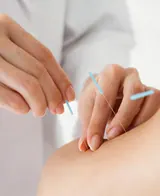
Treatment uses fine, sterile, single-use needles placed at points around the calf, ankle and lower leg, and sometimes elsewhere in the body, usually left in place for about 20 to 40 minutes. We usually plan a short course of visits and reassess whether it is helping. The Achilles trial gave treatment as a course of sessions over several weeks and followed people for 24 weeks.[9]
Serious problems from acupuncture are rare. In prospective studies, about 9 in 100 patients had a minor reaction such as bleeding, pain or redness at a needle site, and serious events occurred in about 1 in 10,000 patients.[13] Tell the practitioner first if you have a bleeding disorder, take blood thinners, are pregnant, or have a pacemaker (relevant to electroacupuncture).
Ayurvedic medicine for Achilles Tendinitis
The Ayurvedic view
Ayurveda has no classical name that matches Achilles tendinopathy exactly. In this tradition, tendons and ligaments (snayu) are linked to Vata, the principle said to govern movement, and pain and stiffness with activity are often described as a Vata imbalance, sometimes with accumulated heaviness or toxins (ama). These are traditional categories used to plan treatment, not biomedical diagnoses.
Therapies that may be used
Care is chosen for the individual and traditionally combines:
- Diet and daily routine intended to calm Vata, such as warm, regular meals and steady sleep
- Warm medicated oil massage and gentle local heat over the calf and ankle
- Herbs such as turmeric and Boswellia, which are traditional anti-inflammatory herbs and have been studied in tendon pain[14]
- Rest from aggravating activity, alongside the loading exercises your clinician recommends
Panchakarma, the traditional cleansing program, is generally not directed at a single tendon and is not appropriate during pregnancy, acute illness or frailty. We would not use it in place of rehabilitation.
What the research shows
No clinical trials of Ayurvedic treatment for Achilles tendinopathy were found, so the evidence for Ayurveda in this condition is very limited. A PubMed search for Ayurvedic treatment of tendinopathy turned up no controlled trials. The closest research is on turmeric and Boswellia for tendon pain in general, which is uncontrolled or laboratory-based and is covered in the herbal section below.[14, 15]
Herbal medicine for Achilles Tendinitis
Herbs and formulas that have been studied
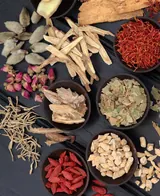
Turmeric (curcumin) is the most studied herb for tendon problems. Boswellia (frankincense) is often studied together with it.[14, 15] Reviews of plant-based supplements for tendon pain discuss these and a few other plant extracts, and they mostly cover tendinopathy in general rather than the Achilles tendon.[14, 16] Chinese herbal formulas and herbal preparations applied to the skin are traditionally used for tendon pain too. We did not find controlled trials of them in Achilles tendinopathy. Transdermal medication therapy at our clinic means herbal preparations applied to the skin.
What the research shows
The evidence is very limited and does not isolate the effect of any one herb. One open-label study of 670 people with tendinopathy of various kinds who took a curcumin and Boswellia supplement for a month reported lower pain and function scores. It had no comparison group, and its authors said randomized trials were needed.[15]
A systematic review of supplements for tendon problems, including curcumin and boswellic acid, found encouraging laboratory results that clinical studies had not confirmed. The clinical studies were small and of poor methodological quality, and often combined several products at once.[14] A review of plant-derived nutraceuticals described anti-inflammatory effects on signaling pathways involved in tendinitis and noted limitations of these agents.[16] None of this shows that an herb works for the Achilles tendon.
Safety and herb-drug interactions
Herbs are active substances and can interact with medicines. Case reports describe serious problems such as bleeding and hematomas when warfarin was combined with herbs including dan shen (Salvia miltiorrhiza), dang gui (Angelica sinensis), ginger and Boswellia.[17] A broader review found that herb-drug interactions can have serious clinical consequences, so people taking blood thinners, aspirin or other prescription drugs need a practitioner's review first.[18]
In one study, about one fifth of Ayurvedic products bought online contained detectable lead, mercury or arsenic.[19] Herbs should come from tested sources and be prescribed individually. Tell us if you are pregnant or breastfeeding, have liver or kidney disease, or have surgery planned.
Translating traditional medicine into modern biological language
The links drawn here are interpretation, not equivalence. Chinese medicine describes tendon pain as stagnation of qi and blood in the channels, often after overuse. Researchers instead study mechanical load, tendon matrix changes, nerve ingrowth, pain-signaling chemicals and inflammatory pathways in the tendon.[3, 8]
Ayurveda's aggravated Vata describes pain and stiffness that limit movement, and its anti-inflammatory herbs loosely parallel the inflammatory signaling that researchers study with turmeric.[16] No study has shown that a dosha or a qi pattern corresponds to a specific biological process in the Achilles tendon.
How this care fits with your medical care
Integrative care for Achilles tendinitis is complementary. Keep your physician, sports medicine doctor or physical therapist, and continue the loading exercises they prescribe, because progressive loading is the core of conventional treatment.[4, 6] Do not stop or change prescribed medicines without your prescriber.
We do not diagnose the cause of heel or calf pain. Please bring your diagnosis, any ultrasound or MRI reports, a full list of medicines and supplements (including recent antibiotics or steroid injections), and your rehabilitation plan.
When to seek urgent medical care
Some changes in the Achilles area need prompt medical assessment rather than complementary care.[1]
- A sudden snap or pop at the back of the ankle, followed by trouble pushing off or standing on tiptoe
- A visible gap or sudden weakness in the tendon
- Marked swelling, redness and warmth, especially with fever
- Calf pain, swelling or tenderness with new shortness of breath
- Severe pain after an injury, or being unable to bear weight
If you have trouble breathing, chest pain or a suspected tendon rupture with severe symptoms, call 911 or go to the nearest emergency department.
Frequently asked questions
What is Achilles tendinitis?
Achilles tendinitis is pain and stiffness in the Achilles tendon, the thick cord that joins the calf muscles to the heel bone. It is now usually called Achilles tendinopathy because the problem is mainly a degenerative change from overload rather than simple inflammation. It often comes on gradually and is worse with running, jumping or the first steps in the morning.
Can acupuncture help with Achilles tendinitis?
It may help, but the evidence is limited. One small trial of 64 adults found acupuncture improved pain and function more than eccentric exercises alone, but it had no sham group. Reviews call the overall evidence for acupuncture in limb conditions inconsistent. Acupuncture is used alongside rehabilitation, not in place of it.
Do Ayurvedic or herbal treatments work for Achilles tendinitis?
The evidence is very limited. We found no trials of Ayurvedic treatment or herbs in Achilles tendinopathy. Turmeric and Boswellia have been studied in tendon pain in general, mostly in laboratory work and one uncontrolled study, so benefit is uncertain. Herbs should be prescribed individually and checked against your medicines.
Can I skip my exercises or medicine if I have acupuncture?
No. Progressive loading exercises are the core of conventional treatment, and acupuncture, Ayurveda and herbal medicine are complementary care. Do not stop or change prescribed medicines without talking to your prescriber. A sudden pop, a gap in the tendon or inability to push off the foot needs prompt medical assessment.
How soon might I notice a change with acupuncture?
It differs from person to person and no result can be promised. In the one randomized trial, differences were measured at 8, 16 and 24 weeks, which shows that tendon problems often take months to settle. We reassess after a short course of visits to see whether treatment is helping.
Does insurance cover acupuncture for Achilles tendinitis?
It may. Netra Integrative Health Clinic accepts most major insurance plans that include out-of-network acupuncture benefits, for example Aetna, Blue Cross Blue Shield, Cigna and UnitedHealthcare, and offers a free benefits check. HSA and FSA cards and CareCredit are also accepted. Call (908) 402-7301 to ask about your plan.
References
- Medina Pabón MA, Bergman R, Naqvi U. Achilles Tendinopathy. StatPearls [Internet]. 2026. PMID 30844176. StatPearls chapter on Achilles tendinopathy covering tendon anatomy, blood supply, insertional and noninsertional tendinopathy, paratenonitis and rupture.
- Kane SF, Olewinski LH, Tamminga KS. Management of Chronic Tendon Injuries. Am Fam Physician. 2019;100(3):147-157. PMID 31361101. American Family Physician review of chronic tendon injuries: tendinopathy versus tendinitis, diagnosis, loading exercise, drugs, and rupture risk with injections.
- Traweger A, Scott A, Kjaer M, et al. Achilles tendinopathy. Nat Rev Dis Primers. 2025;11(1):20. PMID 40148342. 2025 Nature Reviews Disease Primers overview of Achilles tendinopathy: causes, tendon changes, load, ageing, medicines, inflammation and treatment challenges.
- von Rickenbach KJ, Borgstrom H, Tenforde A, et al. Achilles Tendinopathy: Evaluation, Rehabilitation, and Prevention. Curr Sports Med Rep. 2021;20(6):327-334. PMID 34099611. Review of Achilles tendinopathy evaluation, rehabilitation and prevention, noting clinical diagnosis, progressive loading and a generally good prognosis.
- van der Vlist AC, Breda SJ, Oei EHG, et al. Clinical risk factors for Achilles tendinopathy: a systematic review. Br J Sports Med. 2019;53(21):1352-1361. PMID 30718234. Systematic review of 10 cohort studies at high risk of bias finding limited evidence for nine risk factors, including quinolone use and alcohol.
- Silbernagel KG, Hanlon S, Sprague A. Current Clinical Concepts: Conservative Management of Achilles Tendinopathy. J Athl Train. 2020;55(5):438-447. PMID 32267723. Review of conservative management of Achilles tendinopathy, centered on progressive tendon loading and return-to-sport planning.
- Charles R, Fang L, Zhu R, et al. The effectiveness of shockwave therapy on patellar tendinopathy, Achilles tendinopathy, and plantar fasciitis: a systematic review and meta-analysis. Front Immunol. 2023;14:1193835. PMID 37662911. Meta-analysis of shockwave therapy for patellar and Achilles tendinopathy and plantar fasciitis, finding a small, inconclusive effect in the Achilles tendon.
- Ackermann PW, Alim MA, Pejler G, et al. Tendon pain - what are the mechanisms behind it?. Scand J Pain. 2023;23(1):14-24. PMID 35850720. Review of chronic tendon pain mechanisms: nerve ingrowth, pain mediators, neuro-immune links, and eccentric exercise and shockwave as best-supported treatments.
- Zhang BM, Zhong LW, Xu SW, et al. Acupuncture for chronic Achilles tendnopathy: a randomized controlled study. Chin J Integr Med. 2013;19(12):900-4. PMID 23263998. Randomized trial of 64 adults with chronic Achilles tendinopathy finding acupuncture improved VISA-A scores and pain more than eccentric exercises at 8 to 24 weeks.
- Cox J, Varatharajan S, Côté P, et al. Effectiveness of Acupuncture Therapies to Manage Musculoskeletal Disorders of the Extremities: A Systematic Review. J Orthop Sports Phys Ther. 2016;46(6):409-29. PMID 27117725. Systematic review of acupuncture for extremity musculoskeletal disorders; one trial favored acupuncture for Achilles tendinopathy, with inconsistent evidence overall.
- Nuhmani S, Khan MH, Ahsan M, et al. Dry needling in the management of tendinopathy: A systematic review of randomized control trials. J Bodyw Mov Ther. 2023;33:128-135. PMID 36775507. Systematic review of 7 randomized trials of dry needling in tendinopathy, finding pain relief comparable to other treatments up to 6 months.
- Krey D, Borchers J, McCamey K. Tendon needling for treatment of tendinopathy: A systematic review. Phys Sportsmed. 2015;43(1):80-6. PMID 25613418. Systematic review of 4 studies of tendon needling, including one in Achilles tendinosis, reporting improved patient-reported outcomes.
- Bäumler P, Zhang W, Stübinger T, et al. Acupuncture-related adverse events: systematic review and meta-analyses of prospective clinical studies. BMJ Open. 2021;11(9):e045961. PMID 34489268. Systematic review of 21 prospective studies finding minor acupuncture reactions in about 9 percent of patients and serious events in about 1 per 10,000.
- Fusini F, Bisicchia S, Bottegoni C, et al. Nutraceutical supplement in the management of tendinopathies: a systematic review. Muscles Ligaments Tendons J. 2016;6(1):48-57. PMID 27331031. Systematic review of nutraceuticals for tendinopathy, including curcumin and boswellic acid, finding promising lab data but poor-quality clinical studies.
- Henrotin Y, Dierckxsens Y, Delisse G, et al. Curcuminoids and Boswellia serrata extracts combination decreases tendinopathy symptoms: findings from an open-label post-observational study. Curr Med Res Opin. 2021;37(3):423-430. PMID 33287570. Open-label, uncontrolled study of 670 people with tendinopathy taking a curcumin and Boswellia supplement for a month, reporting lower pain and limitation.
- Mueller AL, Brockmueller A, Kunnumakkara AB, et al. Modulation of Inflammation by Plant-Derived Nutraceuticals in Tendinitis. Nutrients. 2022;14(10). PMID 35631173. Review of plant-derived nutraceuticals and their anti-inflammatory signaling effects in tendinitis, with limitations noted.
- Milić N, Milosević N, Golocorbin Kon S, et al. Warfarin interactions with medicinal herbs. Nat Prod Commun. 2014;9(8):1211-6. PMID 25233607. Review of reported interactions between warfarin and medicinal herbs, with case reports of serious bleeding events involving herbs including dan shen, dang gui, ginger and Boswellia.
- Hu Z, Yang X, Ho PC, et al. Herb-drug interactions: a literature review. Drugs. 2005;65(9):1239-82. PMID 15916450. Literature review of herb-drug interactions, many from case reports, concluding that interactions can have serious clinical consequences.
- Saper RB, Phillips RS, Sehgal A, et al. Lead, mercury, and arsenic in US- and Indian-manufactured Ayurvedic medicines sold via the Internet. JAMA. 2008;300(8):915-23. PMID 18728265. JAMA study finding detectable lead, mercury or arsenic in about one fifth of Ayurvedic medicines purchased over the Internet.
This page is for general education and is not medical advice. Acupuncture, Ayurvedic medicine and herbal medicine are complementary therapies; they do not replace diagnosis or treatment by your physician. Do not stop or change prescribed treatment without talking to your prescriber. In an emergency call 911.