













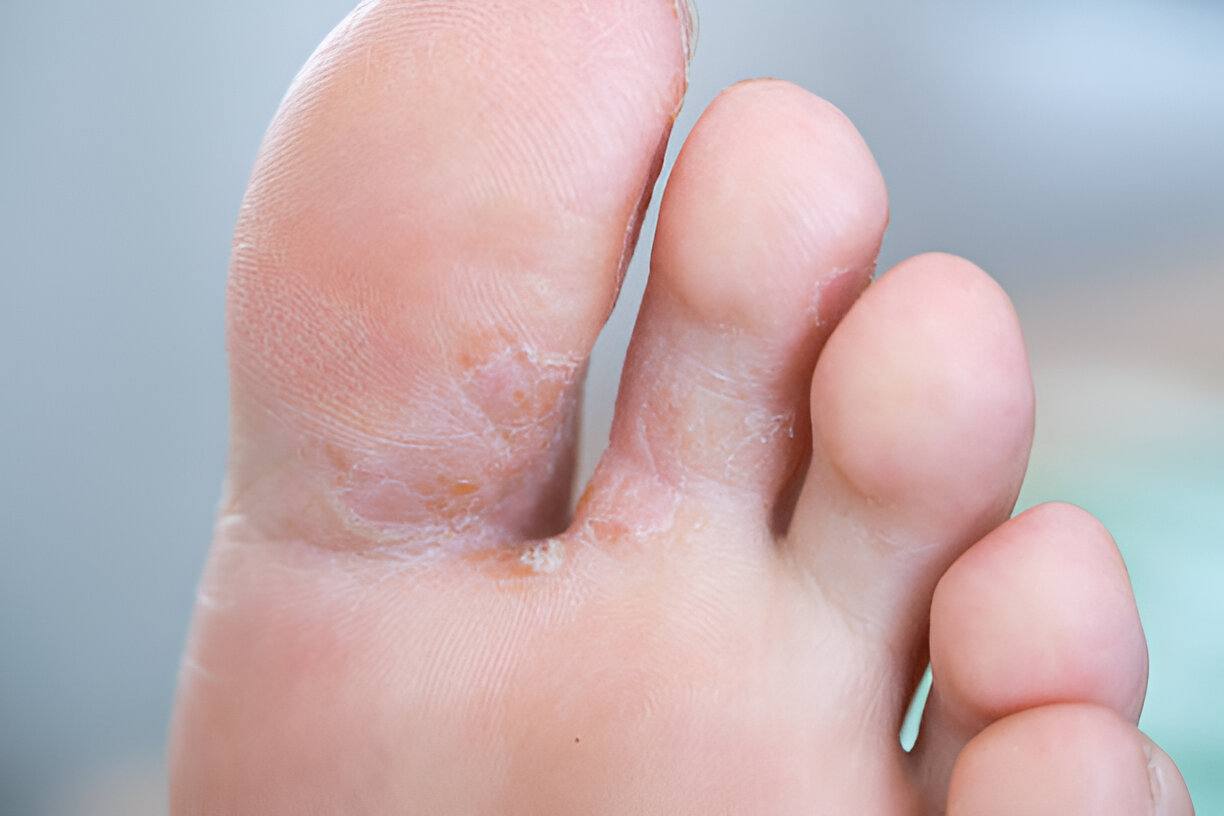
- What it is: A fungal infection of the nail unit, most often caused by dermatophyte fungi, that mainly affects toenails.
- Common symptoms: Nails that turn yellow, white or brown, thicken, crumble, separate from the nail bed or smell unpleasant, sometimes with pain.
- Conventional care: Confirming the diagnosis with a lab test, then oral terbinafine or topical antifungal lacquers or solutions, with nail trimming and prevention steps.
- How integrative care fits: Herbal and Ayurvedic skin and foot care and general support may be used alongside antifungal treatment, not instead of it.
- Evidence at a glance: No trials of acupuncture or Ayurveda for nail fungus; limited, mostly small, older trials of topical plant products such as tea tree oil.
What is Fungal Nail Infection?
A fungal nail infection, or onychomycosis, is an infection of the nail unit by fungi, most often dermatophytes such as Trichophyton rubrum, and less often yeasts or molds.[1] When a dermatophyte is the cause it is also called tinea unguium.[1] Toenails are affected far more often than fingernails.[1]
Common symptoms
Fungal nail infection is a chronic problem that causes discolored, thickened and misshapen nails.[1]
- Nail color change to yellow, white or brown
- Thickening of the nail plate and crumbling edges
- Lifting or separation of the nail from the nail bed
- A foul smell from the nail
- Pain or trouble with shoes and daily activities in some people[2, 3]
An abnormal nail is not always a fungal infection, because other conditions can cause a dystrophic nail.[1]
Causes and risk factors
Infection usually comes from fungi in the environment or from skin infection elsewhere on the foot. Athlete's foot (tinea pedis), which spreads by walking barefoot in locker rooms, showers and pools, often goes along with nail infection.[4] People with diabetes and those who wear occlusive shoes are at higher risk of tinea pedis.[4]
Onychomycosis is more than a cosmetic problem, because untreated infection can cause pain and physical limitation and lower quality of life.[2]
How it is diagnosed and treated conventionally
Accurate diagnosis matters before treatment starts, because therapy is lengthy and can have side effects.[2] A lab test, such as a potassium hydroxide preparation with fungal culture, a special stain, or PCR, is the preferred approach.[2]
Oral terbinafine is the preferred treatment because it is more effective and shorter than topical therapy, and people taking it with certain antidepressants, antipsychotics, beta blockers or tamoxifen should be monitored for drug interactions.[2] Topical agents such as ciclopirox, efinaconazole and tavaborole are less effective but can be used for mild to moderate disease, with fewer adverse effects.[2] A Cochrane review found high-quality evidence for efinaconazole and moderate-quality evidence for tavaborole, although complete clearance rates with topical treatment were relatively low.[5]
Nail trimming and debridement alongside medicine improve results, and about a quarter of people see the infection return, so prevention steps such as avoiding barefoot walking in public places and disinfecting shoes and socks are recommended.[2]
Why Fungal Nail Infection calls for a whole-person approach
A nail infection is not only about the nail. The fungus lives on the foot skin and in footwear, and health conditions such as diabetes and poor circulation change both the risk and the consequences.[1, 4]
Any complementary care therefore needs to sit alongside proper diagnosis, antifungal treatment and foot care, since the infection is slow to clear and often returns.[2, 6]
Athlete's foot and shared infection
Skin infection of the feet and nail infection often occur together, and treating only one can allow reinfection from the other.[4]
Diabetes and circulation
People with diabetes, weakened immunity or peripheral vascular disease are at higher risk of complications from untreated foot fungal infection, including cellulitis and bone infection.[4] In one trial in people with type 2 diabetes, blood glucose control played an important role in how well onychomycosis responded to treatment.[7]
Footwear and moisture
Occlusive shoes raise risk, and disinfecting shoes and socks is advised to reduce recurrence.[2, 4]
Treatment is slow and adherence matters
Treatment is lengthy and requires persistence, and poor adherence and recurrence are common reasons for failure.[6]
Acupuncture for Fungal Nail Infection
What the research shows
We found no clinical studies of acupuncture for fungal nail infection, so there is no evidence that it clears the infection. A systematic review of complementary therapies for onychomycosis found studies only of topical natural products, not acupuncture.[8]
How acupuncture may work
No research has examined whether acupuncture affects nail fungus, so we make no claim about a mechanism and do not offer it as a treatment for the infection.
What treatment involves
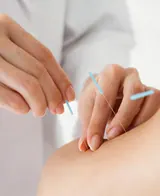
If acupuncture is used for general wellbeing alongside your medical care, it involves fine, sterile, single-use needles at points chosen for the person, left in place for about 20 to 40 minutes, over a short course of visits with reassessment. In prospective studies about 9 in 100 patients had a minor reaction such as soreness or bleeding at a needle site, and serious events occurred in about 1 in 10,000 patients.[9] Tell the practitioner first if you have a bleeding disorder, take blood thinners, are pregnant, or have a pacemaker (relevant to electroacupuncture). People with diabetes or poor circulation in the feet should tell us before any needling near the feet.
Ayurvedic medicine for Fungal Nail Infection
The Ayurvedic view
Ayurveda groups many chronic skin and nail problems under kushtha, a broad traditional category, and relates them to imbalance of Kapha and Pitta and to weak digestion (agni) and accumulated waste (ama). This is a traditional framework and not a biomedical diagnosis.
Therapies that may be used
Care is individualized and traditionally may include:
- Diet and daily routine intended to support digestion and lessen damp, heavy qualities
- Foot hygiene and keeping the feet dry
- Herbal pastes or oils applied to the skin around the nails, prescribed individually
Panchakarma is an intensive course of cleansing procedures. It is generally not appropriate during pregnancy, acute illness or frailty, and we do not consider it a treatment for nail fungus.
What the research shows
No clinical trials of Ayurvedic treatment for fungal nail infection were found, so the evidence is none. Studies of herbs and plant products applied to nails are covered below.[8] Ayurvedic preparations also need quality checks, since about one fifth of Ayurvedic medicines bought online contained detectable lead, mercury or arsenic.[10]
Herbal medicine for Fungal Nail Infection
Herbs and formulas that have been studied
Clinical research on natural products for onychomycosis is mainly of topical plant products. A systematic review of 17 articles covered tea tree oil, Ageratina pichinchensis, spirulina (Arthrospira maxima), a natural conifer resin lacquer, Vicks VapoRub, propolis extract and ozonized sunflower oil.[8] These are mostly not Chinese or Ayurvedic formulas, and we list them as research, not as recommendations.
In the laboratory, a Chinese herbal formula called Huangqin decoction stopped the growth of Trichophyton rubrum, but this was not a study in people.[11]
What the research shows
The evidence is limited, and the authors of the systematic review said large randomized placebo-controlled trials are needed before these therapies are endorsed to patients.[8]
In a trial of 117 patients with toenail infection confirmed by culture, undiluted tea tree oil and a clotrimazole solution gave similar results after 6 months, with about 60% in each group showing partial or full improvement but culture clearance of only 11% to 18%.[12] A smaller trial of 60 patients combined butenafine with tea tree oil in a cream and reported clearance in 80% of the treated group versus none on placebo, so the effect cannot be credited to tea tree oil alone.[13]
An extract of Ageratina pichinchensis in a lacquer was not significantly different from 8% ciclopirox lacquer in a trial of 96 patients, and a later trial in people with type 2 diabetes found similar results.[7, 14] We offer transdermal medication therapy, an herbal preparation applied to the skin, but no study shows it clears nail infection.
Safety and herb-drug interactions
Topical plant products can cause skin irritation or allergy, and in the tea tree and butenafine cream trial four patients had mild inflammation.[13] Stop any product that burns or inflames the skin and check with your physician.
Herbs taken by mouth can interact with medicines, with reports including bleeding with warfarin and danshen or ginkgo, and lower drug levels with St. John's wort.[15] This matters if you take oral terbinafine, which has its own interactions.[2] Tell us about all medicines, including diabetes and blood-thinning medicines, and whether you are pregnant or breastfeeding or have liver or kidney disease. Herbs should come from tested sources and be prescribed individually.[10]
Translating traditional medicine into modern biological language
This section is interpretation, not equivalence. Chinese medicine often describes nail fungus as damp-heat or as nails poorly nourished by blood, and Ayurveda as kushtha with Kapha excess and weak agni. Researchers describe a dermatophyte infection in nail keratin that is slow to treat and often returns.[1, 6]
The traditional focus on dampness, digestion and general vitality loosely parallels the practical biological focus on moisture, circulation and host health, but no study has tested whether a qi pattern or dosha corresponds to risk of nail infection.
How this care fits with your medical care
Complementary care for fungal nail infection is secondary to medical treatment. If you have a nail infection, see a physician or dermatologist for a lab-confirmed diagnosis and a treatment plan, and do not stop or change prescribed antifungal treatment without your prescriber.[2]
We do not diagnose nail disease. Please bring your diagnosis and nail test results, a full list of medicines and supplements, and information on diabetes, circulation or immune conditions. For a condition like this, we ask that you are under a physician's care for it and that your treating team knows you are receiving complementary care.
When to seek urgent medical care
Foot infections can become serious in people with diabetes, weak immunity or poor circulation.[4]
- Spreading redness, warmth, swelling or pus around the nail or foot
- Fever or chills with a foot or nail infection
- A foot sore or ulcer that does not heal, especially with diabetes or poor circulation
- Black or dark discoloration of the nail or skin, or a dark streak that is new or changing
- Increasing pain, or a cold, pale or blue foot or toe
If any of these occur, call 911 or go to the nearest emergency department.
Frequently asked questions
What is a fungal nail infection?
A fungal nail infection, or onychomycosis, is a long-lasting infection of the nail by fungi, most often dermatophytes. It makes the nail yellow, white or brown, thick, brittle and sometimes loose, and mostly affects toenails. Other nail problems can look similar, so a lab test is recommended before treatment. It can cause pain and affect daily activities.
Can acupuncture help with fungal nail infection?
No studies were found, so we cannot say it helps. There is no evidence that acupuncture clears the fungus, and we do not offer it as a treatment for the infection. It may be used for general wellbeing alongside your medical care. Diagnosis and antifungal treatment should come from your physician or dermatologist.
Do Ayurvedic or herbal remedies work for fungal nail infection?
The evidence is thin. No Ayurvedic trials were found. A few small trials of plant products applied to the nail, such as tea tree oil and Ageratina extract, found some improvement, but most were small and older, and large placebo-controlled trials are still needed. Herbs can irritate skin and interact with medicines.
Can I stop my antifungal medicine if I use herbs or other natural treatments?
No. Complementary care does not replace antifungal treatment. Do not stop or change prescribed medicine without talking to your prescriber. Treatment is slow, and stopping early or relying on unproven products can leave the infection in place, especially if you have diabetes or poor circulation.
How soon might I notice a change?
Nails grow slowly, and nail infections take months to treat, so change is gradual. The trials of topical plant products ran 4 to 6 months. No result can be promised from complementary care, and we reassess with you after a short course of visits while you stay in touch with your physician.
Does insurance cover care for fungal nail infection?
Acupuncture may be covered, but coverage for nail infection itself is unlikely. Netra Integrative Health Clinic is in-network with Blue Cross Blue Shield, Cigna and UnitedHealthcare. Other plans may be covered through out-of-network benefits, and we offer a free benefits check. HSA and FSA cards and CareCredit are also accepted. Call (908) 402-7301 to ask about your plan.
References
- Bodman MA, Syed HA, Krishnamurthy K. Onychomycosis. StatPearls [Internet]. 2025. PMID 28722883. StatPearls chapter on onychomycosis covering definition, causative fungi, toenail predominance, symptoms, and the importance of accurate diagnosis.
- Frazier WT, Santiago-Delgado ZM, Stupka KC. Onychomycosis: Rapid Evidence Review. Am Fam Physician. 2021;104(4):359-367. PMID 34652111. American Family Physician evidence review of onychomycosis diagnosis, oral terbinafine and topical therapy, drug interactions, debridement and prevention of the roughly 25 percent relapse rate.
- Lipner SR, Scher RK. Onychomycosis: Clinical overview and diagnosis. J Am Acad Dermatol. 2019;80(4):835-851. PMID 29959961. Journal of the American Academy of Dermatology review of onychomycosis epidemiology, risk factors, presentation and diagnosis, noting pain and effects on daily life.
- Nigam PK, Syed HA, Saleh D. Tinea Pedis. StatPearls [Internet]. 2023. PMID 29262247. StatPearls chapter on tinea pedis covering transmission, risk with diabetes and occlusive shoes, and complications in immunocompromised or vascular disease patients.
- Foley K, Gupta AK, Versteeg S, et al. Topical and device-based treatments for fungal infections of the toenails. Cochrane Database Syst Rev. 2020;1(1):CD012093. PMID 31978269. Cochrane review of 56 trials (12,501 participants) of topical and device treatments for toenail fungus, with low complete clearance rates and uncertain device evidence.
- Thomas J, Peterson GM, Christenson JK, et al. Antifungal Drug Use for Onychomycosis. Am J Ther. 2019;26(3):e388-e396. PMID 31082864. Review of antifungal drug use for onychomycosis noting lengthy treatment, adherence problems, recurrence and the need for definitive diagnosis.
- Romero-Cerecero O, Islas-Garduño AL, Zamilpa A, et al. Effectiveness of an encecalin standardized extract of Ageratina pichinchensis on the treatment of onychomycosis in patients with diabetes mellitus. Phytother Res. 2020;34(7):1678-1686. PMID 32086985. Double-blind trial of Ageratina pichinchensis lacquer versus ciclopirox in patients with type 2 diabetes, with similar effects and a noted role for glucose control.
- Nickles MA, Lio PA, Mervak JE. Complementary and Alternative Therapies for Onychomycosis: A Systematic Review of the Clinical Evidence. Skin Appendage Disord. 2022;8(4):269-279. PMID 35983465. Systematic review of 17 clinical studies of complementary therapies for onychomycosis, mainly topical natural products, finding preliminary evidence and calling for larger trials.
- Bäumler P, Zhang W, Stübinger T, et al. Acupuncture-related adverse events: systematic review and meta-analyses of prospective clinical studies. BMJ Open. 2021;11(9):e045961. PMID 34489268. Systematic review of 21 prospective studies finding minor acupuncture reactions in about 9 percent of patients and serious events in about 1 per 10,000.
- Saper RB, Phillips RS, Sehgal A, et al. Lead, mercury, and arsenic in US- and Indian-manufactured Ayurvedic medicines sold via the Internet. JAMA. 2008;300(8):915-23. PMID 18728265. JAMA study finding detectable lead, mercury or arsenic in about one fifth of Ayurvedic medicines purchased over the Internet.
- Shen C, Luo Z, Zhan P, et al. Antifungal activity and potential mechanism of action of Huangqin decoction against Trichophyton rubrum. J Med Microbiol. 2024;73(2). PMID 38348868. Laboratory study showing Huangqin decoction inhibited growth of Trichophyton rubrum and damaged its cell membrane, without human data.
- Buck DS, Nidorf DM, Addino JG. Comparison of two topical preparations for the treatment of onychomycosis: Melaleuca alternifolia (tea tree) oil and clotrimazole. J Fam Pract. 1994;38(6):601-5. PMID 8195735. Randomized double-blind trial of 117 patients comparing tea tree oil with clotrimazole for toenail onychomycosis, with similar partial improvement and low culture clearance.
- Syed TA, Qureshi ZA, Ali SM, et al. Treatment of toenail onychomycosis with 2% butenafine and 5% Melaleuca alternifolia (tea tree) oil in cream. Trop Med Int Health. 1999;4(4):284-7. PMID 10357864. Randomized placebo-controlled trial of 60 patients using a butenafine plus tea tree oil cream, reporting clearance in 80 percent of treated patients.
- Romero-Cerecero O, Zamilpa A, Jiménez-Ferrer JE, et al. Double-blind clinical trial for evaluating the effectiveness and tolerability of Ageratina pichinchensis extract on patients with mild to moderate onychomycosis. A comparative study with ciclopirox. Planta Med. 2008;74(12):1430-5. PMID 18671197. Double-blind trial of 96 patients comparing Ageratina pichinchensis lacquer with ciclopirox lacquer, with no significant difference between treatments.
- Hu Z, Yang X, Ho PC, et al. Herb-drug interactions: a literature review. Drugs. 2005;65(9):1239-82. PMID 15916450. Literature review of herb-drug interactions including warfarin with danshen and ginkgo, and St. John's wort with many drugs.
This page is for general education and is not medical advice. Acupuncture, Ayurvedic medicine and herbal medicine are complementary therapies; they do not replace diagnosis or treatment by your physician. Do not stop or change prescribed treatment without talking to your prescriber. In an emergency call 911.