

















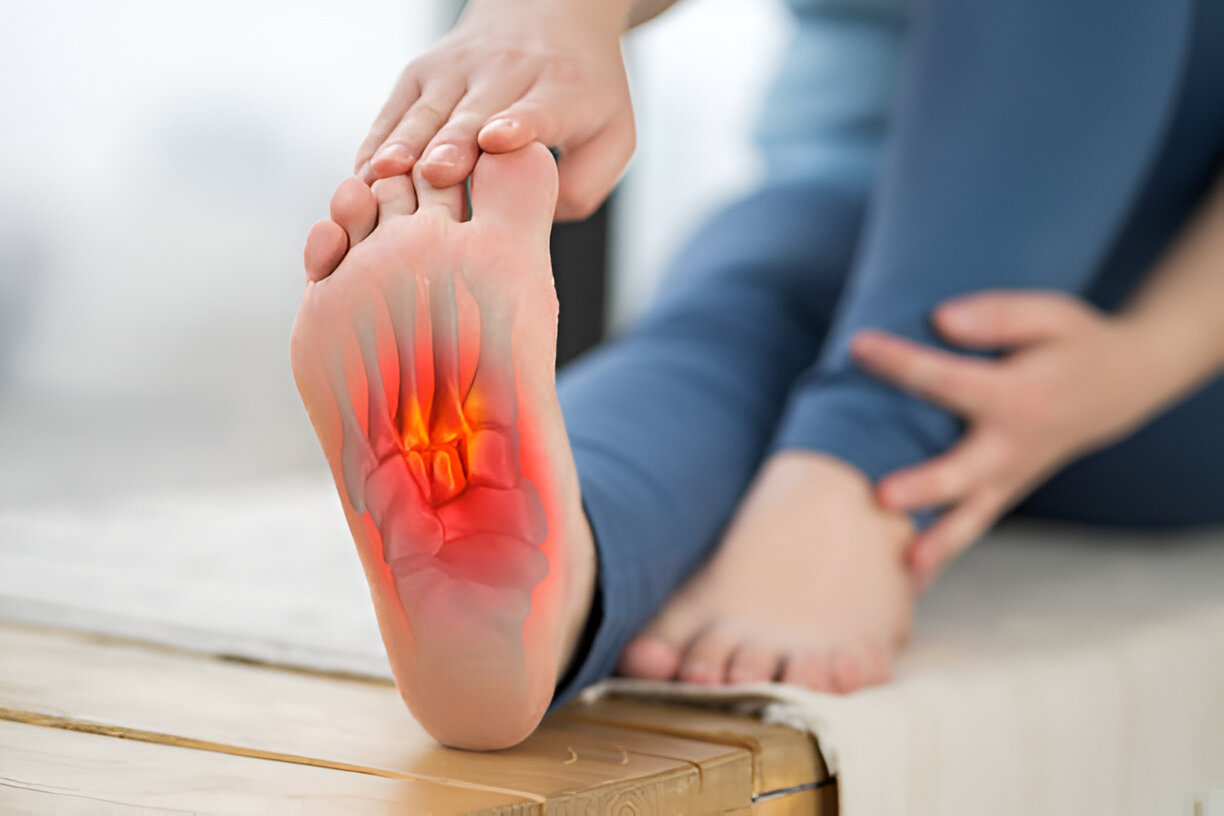
- What it is: Pain under or around the heel, most often plantar fasciitis, a degenerative irritation where the plantar fascia attaches to the heel bone.
- Common symptoms: Sharp pain at the bottom of the heel, often worst with the first steps after rest and after long periods on your feet.
- Conventional care: Activity changes, stretching and rehabilitation, anti-inflammatory medicines, taping or supports, shockwave therapy, injections, and rarely surgery.
- How integrative care fits: Acupuncture, Ayurvedic therapies and individually prescribed herbs are used alongside medical care to help with pain and function.
- Evidence at a glance: Limited for acupuncture, with small trials against waitlist or other treatments and no large sham-controlled trial found; very limited for Ayurveda (case reports only) and limited for herbs (pilot patch studies and one small injection trial).
What is Heel Pain?
Heel pain is pain in the underside or back of the heel, and in adults it most often comes from the plantar fascia, the thick band of tissue that supports the arch of the foot. Other causes include fat pad thinning, a stress fracture of the heel bone, and pinched nerves in the foot.[1]
Common symptoms
The classic symptom of plantar fasciitis is sharp pain at one spot on the heel.[2] It is often worst with the first steps after getting out of bed or sitting for a while, and it tends to ease with movement and return after long periods standing or walking. Heel pain that comes with numbness, burning or tingling can point to a nerve cause instead.[1]
Causes and risk factors
Most cases of plantar fasciitis come from overuse stress on the fascia where it attaches to the heel. Despite the "-itis" in the name, tissue studies show few inflammatory cells, so many clinicians now see it as a degenerative problem.[2]
A review of 51 studies found that a higher body mass index was the only clinical factor consistently linked to plantar fasciitis. The studies were mostly case-control, which cannot show cause.[3] Heel pain can also be referred from the lower spine or linked to body-wide conditions such as inflammatory arthritis.[1]
How it is diagnosed and treated conventionally
Diagnosis rests on your history and a foot examination. Ultrasound can confirm plantar fasciitis, while X-rays, MRI or nerve tests are used when a fracture, tumor or nerve problem is suspected.[1]
Treatment is usually non-surgical and includes changes in activity, anti-inflammatory medicines, rehabilitation and local injections, with surgery reserved for stubborn cases. Pain can recur, and many people are not satisfied with their first treatments.[1, 2] A review of systematic reviews found general agreement that shockwave therapy helps, but many of the reviews were small or varied widely in their results.[4] A larger meta-analysis found several short-term options, including taping and stretching, that reduced pain, but only shockwave therapy beat control treatment in the medium and long term.[5]
Why Heel Pain calls for a whole-person approach
Heel pain is rarely caused by one thing. Load on the foot, body weight, how long you stand, the condition of the tissue and the way your nervous system processes pain can all contribute, and they differ from person to person.
For that reason, care that looks beyond the heel itself can be a reasonable addition to treatment aimed at the foot. The links below are the ones best supported by research.
Load and overuse
Overuse stress at the fascia attachment is the main cause of plantar fasciitis.[2] Long hours on hard floors or a sudden rise in walking or running can add to that load.
Body weight
A higher body mass index was the one clinical factor consistently linked to plantar fasciitis in a meta-analysis, and the link was strongest in people who were not athletes.[3]
Tissue changes rather than simple inflammation
Plantar fasciitis shows degenerative change with a notable lack of inflammatory cells.[2] Ultrasound studies pooled in a meta-analysis found a thicker, darker plantar fascia with more blood vessel signal in people with the condition.[3]
Nearby muscles and nerves
Pain felt in the heel can also come from irritated nerves around the heel or from the lower spine, so a full examination matters.[1] Dry needling of tight trigger points in the calf and foot muscles has been studied for heel pain, with results described below.[6]
Acupuncture for Heel Pain
What the research shows
Research suggests acupuncture may reduce heel pain, but the trials are small and mostly compare it with no treatment or with other acupuncture methods. A systematic review of five randomized trials and three other comparative studies concluded that the higher-quality studies reported significant benefit. In one, acupuncture added to standard care including anti-inflammatory medicine improved pain and function more than standard care alone. The review did not pool the data and noted that research on this topic needs to be more uniform.[7]
A 2026 trial of 120 adults with long-lasting plantar fasciitis compared acupuncture with a waitlist. At week 4, 56.7% of the acupuncture groups had at least halved their worst pain, against 33.3% of the waitlist group. By week 16 the higher-intensity needling group still did clearly better than the waitlist group, while the lower-intensity group's difference was not statistically significant.[8] An 80-person trial in Hong Kong of electroacupuncture with warm needling, given as six 30-minute sessions, found less first-step pain and better foot function than a waitlist at 4 weeks.[9] Neither trial used sham needling, so part of the effect may come from expectation.
Another trial of 92 people compared electroacupuncture with manual acupuncture, 12 sessions over 4 weeks. The two did not differ, and both groups improved.[10]
Dry needling, which uses acupuncture-type needles at muscle trigger points without the traditional framework, is a related but different technique. A meta-analysis of six trials found low-quality evidence for short-term pain relief and moderate-quality evidence for longer-term pain and disability, and the authors urged caution because few trials existed.[6] In a larger pooled analysis of many treatments, dry needling lowered short-term pain, but only shockwave therapy was effective in the medium and long term.[5]
How acupuncture may work
Laboratory research suggests that acupuncture and electroacupuncture act on pain pathways in the tissue and in the nervous system. A review of inflammatory pain studies describes effects on immune cells and nerve endings in the tissue, on opioid and cannabinoid signaling, and on pain processing in the spinal cord and brain.[11] The review notes that how acupuncture relieves pain has not been conclusively established, and it did not study heel pain in particular.
What treatment involves
Treatment uses fine, sterile, single-use needles placed at points on the foot, ankle, lower leg and sometimes elsewhere on the body, usually left in for about 20 to 40 minutes. Practitioners differ in the points and methods they choose, and the research reflects this.[12] The trials above gave 6 to 12 sessions over four weeks.[9, 10] We reassess after a short course of visits.
Serious problems from acupuncture are rare. In prospective studies, about 9 in 100 patients had a minor reaction such as bleeding, pain or redness at a needle site, and serious events occurred in about 1 in 10,000 patients.[13] Tell the practitioner first if you have a bleeding disorder, take blood thinners, are pregnant, or have a pacemaker (relevant to electroacupuncture).
Ayurvedic medicine for Heel Pain
The Ayurvedic view
Ayurveda links heel pain with Vatakantaka, a name often translated as a thorn-like pricking pain in the foot. It is traditionally described as arising from improper placement of the heel on the ground and, in the modern Ayurvedic literature, related to conditions such as calcaneal spur.[14] In this framework it is tied to aggravated Vata, the principle said to govern movement. These are traditional categories for choosing treatment, not biomedical diagnoses.
Therapies that may be used
Care is chosen for the individual and traditionally combines:
- Diet and daily routine intended to calm Vata, such as warm, regular meals and steady sleep hours
- Warm oil massage and warm herbal sweat therapy for the foot and lower leg
- Herbs prescribed individually by a practitioner
- Transdermal medication therapy, in which an herbal preparation is applied to the skin
- Procedures such as bloodletting and heat cautery that appear in Ayurvedic case reports, which are not part of our services
Panchakarma procedures are not appropriate during pregnancy, acute illness or frailty, or before red-flag symptoms have been medically assessed.
What the research shows
The research on Ayurveda for heel pain is very limited. A PubMed search found no clinical trials and no systematic reviews. The literature found consists of single case reports from India.[14, 15]
One report describes a patient with a calcaneal spur whose pain fell from 8 to 2 on a 10-point scale after warm sweat therapy and four bloodletting sessions.[14] Another describes a woman with Haglund's deformity who improved after needle-piercing therapy, heat cautery and oral Ayurvedic medicines.[15] A single case cannot show that a treatment caused the change, since heel pain often varies over time.
Herbal medicine for Heel Pain
Herbs and formulas that have been studied
Herbal research for heel pain is sparse. Traditional Chinese medicine uses medicated patches, ointments and rubs applied over painful tissue for conditions such as plantar fasciitis, and pilot research has examined patches made from three herbs.[16] A Chinese herbal extract based on sinomenine, injected under ultrasound guidance, has also been compared with a corticosteroid injection.[17] Injections are not part of our services, and we mention this study only to show where research stands.
What the research shows
The evidence is limited. A review of topical herbal patches in Chinese medicine described pilot clinical studies in plantar fasciitis as very positive, but it acknowledged the lack of scientific evidence of efficacy for the practice as a whole, and these were only pilot studies.[16] A single-center trial of 54 patients with chronic plantar fasciitis found that the sinomenine extract injection gave lower pain scores at 3 months than corticosteroid injection. It was a small trial, and its result does not apply to herbs taken by mouth or applied to the skin.[17]
No trials of oral Ayurvedic or Chinese herbal formulas for plantar fasciitis turned up in our search. We do not claim that herbs treat heel pain. Herbal preparations applied to the skin, including transdermal medication therapy, may be used for comfort, but we make no claim of effect.
Safety and herb-drug interactions
Herbs are active substances and can interact with medicines. Case reports describe serious problems such as bleeding and hematomas when warfarin was combined with herbs including dang gui (Angelica sinensis), dan shen (Salvia miltiorrhiza), ginger, ginseng and Boswellia.[18] People taking blood thinners, including those who use anti-inflammatory medicines for heel pain, need a practitioner's review before using herbs.
In one study, about one fifth of Ayurvedic products bought online contained detectable lead, mercury or arsenic.[19] Herbs should come from tested sources and be prescribed individually. Tell us if you are pregnant or breastfeeding, have liver or kidney disease, or have surgery planned.
Translating traditional medicine into modern biological language
The links drawn here are interpretation, not equivalence. Chinese medicine describes heel pain as blocked flow of qi and blood in the channels of the foot, often with weakness of the kidney system. Researchers studying acupuncture measure things that loosely parallel the first idea: local tissue effects, nerve signaling and pain processing in the spinal cord and brain.[11]
Ayurveda's aggravated Vata describes sharp, pricking pain that limits movement. No study has shown that a dosha corresponds to a specific biological process. The best-supported biological view of plantar fasciitis today is of overuse and degenerative change in the fascia, not simple inflammation.[2]
How this care fits with your medical care
Integrative care for heel pain is complementary. Keep your physician, podiatrist or physical therapist, and do not stop or change prescribed medicines without your prescriber. We do not diagnose the cause of heel pain, so new or worsening pain should be medically evaluated.
Please bring your diagnosis, any imaging reports, a full list of medicines and supplements, and details of any injections, orthotics or surgery, planned or past. A recent steroid injection near the heel is worth mentioning, because injections carry a small risk of plantar fascia rupture or infection that your physician manages.[20]
When to seek urgent medical care
Some heel symptoms point to a fracture, infection or circulation problem rather than ordinary plantar fasciitis.[1]
- Sudden severe heel pain after a fall or injury, or being unable to put weight on the foot
- A hot, red, swollen heel, especially with fever
- Numbness, burning or tingling in the foot that is spreading or getting worse
- A pale, cold or blue foot, or a foot wound that is not healing, especially with diabetes
- Heel pain that is present at night or at rest and keeps getting worse, or comes with unexplained weight loss
- Heel pain together with swelling in several joints, or in someone with inflammatory arthritis, that your physician has not assessed
If any of these occur, call 911 or go to the nearest emergency department.
Frequently asked questions
What is heel pain?
Heel pain is pain under or behind the heel. In adults it is most often caused by plantar fasciitis, an overuse and degenerative irritation of the band of tissue along the sole of the foot. Other causes include a heel bone stress fracture, thinning of the heel fat pad and pinched nerves. Pain is often worst with the first steps after rest.
Can acupuncture help with heel pain?
Research suggests it may help. Small randomized trials compared with waitlists found less heel pain after acupuncture, and a systematic review of the field judged the higher-quality studies to show benefit. However, trials are small, the ones we found did not use sham needling, and acupuncture methods vary. Results differ between people, and acupuncture is used alongside medical care, not in its place.
Does Ayurvedic or herbal medicine work for heel pain?
We do not know. Ayurvedic care for heel pain has been described only in individual case reports, and herbal research is limited to pilot studies of Chinese medicated patches and one small trial of an herbal injection. None of this shows that these approaches work. Herbs should be prescribed individually and checked against your medicines.
Can I stop my anti-inflammatory medicine, orthotics or stretching if I have acupuncture?
No. Acupuncture, Ayurveda and herbal medicine are complementary care. Keep up the stretching, footwear changes and any treatment your physician or podiatrist recommends, and do not stop or change prescribed medicines without talking to your prescriber.
How soon might I notice a change with acupuncture?
It differs from person to person and no result can be promised. In the trials, patients received 6 to 12 sessions over four weeks, and differences from waitlist groups were measured at week 4. We reassess after a short course of visits to see whether treatment is helping.
Does insurance cover acupuncture for heel pain?
It may. Netra Integrative Health Clinic is in-network with Blue Cross Blue Shield, Cigna and UnitedHealthcare. Other plans may be covered through out-of-network benefits, and we offer a free benefits check. HSA and FSA cards and CareCredit are also accepted. Call (908) 402-7301 to ask about your plan.
References
- Allam AE, Chang KV. Plantar Heel Pain. StatPearls [Internet]. 2024. PMID 29763043. StatPearls chapter on plantar heel pain covering its causes, evaluation with history, imaging and nerve testing, and treatments from lifestyle changes and medicines to injection and surgery.
- Buchanan BK, Sina RE, Kushner D. Plantar Fasciitis. StatPearls [Internet]. 2024. PMID 28613727. StatPearls chapter on plantar fasciitis describing degenerative irritation at the heel attachment, the absence of inflammatory cells, overuse as the usual cause, and frequent recurrence.
- van Leeuwen KD, Rogers J, Winzenberg T, et al. Higher body mass index is associated with plantar fasciopathy/'plantar fasciitis': systematic review and meta-analysis of various clinical and imaging risk factors. Br J Sports Med. 2016;50(16):972-81. PMID 26644427. Systematic review of 51 studies finding higher body mass index was the only consistent clinical factor linked to plantar fasciitis, along with thicker fascia on imaging.
- Rhim HC, Kwon J, Park J, et al. A Systematic Review of Systematic Reviews on the Epidemiology, Evaluation, and Treatment of Plantar Fasciitis. Life (Basel). 2021;11(12). PMID 34947818. Review of 96 systematic reviews on plantar fasciitis finding general consensus on body mass index as a risk and shockwave therapy as effective, with high heterogeneity.
- Guimarães JS, Arcanjo FL, Leporace G, et al. Effects of therapeutic interventions on pain due to plantar fasciitis: A systematic review and meta-analysis. Clin Rehabil. 2023;37(6):727-746. PMID 36571559. Meta-analysis of 236 studies of plantar fasciitis treatments finding several options reduced short-term pain, but only shockwave therapy was effective in the medium and long term.
- Llurda-Almuzara L, Labata-Lezaun N, Meca-Rivera T, et al. Is Dry Needling Effective for the Management of Plantar Heel Pain or Plantar Fasciitis? An Updated Systematic Review and Meta-Analysis. Pain Med. 2021;22(7):1630-1641. PMID 33760098. Meta-analysis of six trials of trigger point dry needling for plantar heel pain finding low- to moderate-quality evidence of benefit.
- Clark RJ, Tighe M. The effectiveness of acupuncture for plantar heel pain: a systematic review. Acupunct Med. 2012;30(4):298-306. PMID 23099290. Systematic review of five randomized trials and three other studies of acupuncture for plantar heel pain, reporting benefit in higher-quality studies without pooling data.
- Wang W, Kang J, Wang X, et al. Efficacy of acupuncture for chronic recalcitrant plantar fasciitis: A randomized trial. Complement Ther Med. 2026;97:103329. PMID 41713561. 2026 randomized trial of 120 adults with chronic plantar fasciitis finding acupuncture gave more pain responders than a waitlist at 4 weeks, with greater effect from high-intensity needling.
- Ho LF, Guo Y, Ching JY, et al. Efficacy of electroacupuncture plus warm needling therapy for plantar heel pain: a randomised waitlist-controlled trial. Acupunct Med. 2021;39(4):283-291. PMID 32815386. Waitlist-controlled trial of 80 adults finding electroacupuncture with warm needling reduced first-step pain and improved foot function at 4 weeks.
- Wang W, Liu Y, Jiao R, et al. Comparison of electroacupuncture and manual acupuncture for patients with plantar heel pain syndrome: a randomized controlled trial. Acupunct Med. 2021;39(4):272-282. PMID 32811186. Trial of 92 patients finding electroacupuncture no better than manual acupuncture for plantar heel pain, with both groups improving.
- Zhang Q, Zhou M, Huo M, et al. Mechanisms of acupuncture-electroacupuncture on inflammatory pain. Mol Pain. 2023;19:17448069231202882. PMID 37678839. Review of laboratory studies on how acupuncture and electroacupuncture relieve inflammatory pain through peripheral and central pathways.
- Clark MT, Clark RJ, Toohey S, et al. Rationales and treatment approaches underpinning the use of acupuncture and related techniques for plantar heel pain: a critical interpretive synthesis. Acupunct Med. 2017;35(1):9-16. PMID 27390253. Interpretive synthesis of 25 clinical sources showing acupuncture approaches and rationales for plantar heel pain vary widely, with no single method dominating.
- Bäumler P, Zhang W, Stübinger T, et al. Acupuncture-related adverse events: systematic review and meta-analyses of prospective clinical studies. BMJ Open. 2021;11(9):e045961. PMID 34489268. Systematic review of 21 prospective studies finding minor acupuncture reactions in about 9 percent of patients and serious events in about 1 per 10,000.
- Joshi S, Toshikhane SH, Toshikhane HD. Syringing method as an alternative to Śṛṇga therapy in Vātakaṇṭaka. Anc Sci Life. 2014;34(1):50-2. PMID 25737611. Case report of one patient with calcaneal spur pain treated with Ayurvedic sweat therapy and bloodletting, describing the Vatakantaka concept.
- Dorage PA, Thatere AA, Prabhale RS. Ayurvedic management of Haglund's deformity diagnosed as Vatakantaka - A case report. J Ayurveda Integr Med. 2025;16(6):101185. PMID 41086670. Case report of one patient with Haglund's deformity treated with Ayurvedic needle-piercing, heat cautery and oral medicines.
- Leung PC, Ko EC, Siu WS, et al. Selected Topical Agents Used in Traditional Chinese Medicine in the Treatment of Minor Injuries- A Review. Front Pharmacol. 2016;7:16. PMID 26903864. Review of Chinese topical herbal patches for minor injuries, noting lack of efficacy evidence and describing pilot studies including plantar fasciitis.
- Zhong M, Yu B, Wang R, et al. Ultrasound-Guided Zhengqing Fengtongning vs Corticosteroid Injections for Plantar Fasciitis: A Randomized Controlled Trial on Short- and Long-Term Efficacy. Med Sci Monit. 2026;32:e950455. PMID 41620820. Single-center trial of 54 patients comparing an ultrasound-guided herbal extract injection with corticosteroid injection for chronic plantar fasciitis.
- Milić N, Milosević N, Golocorbin Kon S, et al. Warfarin interactions with medicinal herbs. Nat Prod Commun. 2014;9(8):1211-6. PMID 25233607. Review of reported interactions between warfarin and medicinal herbs, with case reports of serious bleeding events involving herbs including dang gui, dan shen, ginger, ginseng and Boswellia.
- Saper RB, Phillips RS, Sehgal A, et al. Lead, mercury, and arsenic in US- and Indian-manufactured Ayurvedic medicines sold via the Internet. JAMA. 2008;300(8):915-23. PMID 18728265. JAMA study finding detectable lead, mercury or arsenic in about one fifth of Ayurvedic medicines purchased over the Internet.
- David JA, Sankarapandian V, Christopher PR, et al. Injected corticosteroids for treating plantar heel pain in adults. Cochrane Database Syst Rev. 2017;6(6):CD009348. PMID 28602048. Cochrane review of 39 studies of corticosteroid injection for plantar heel pain finding low-quality evidence of slight short-term benefit, with rare ruptures and infections reported.
This page is for general education and is not medical advice. Acupuncture, Ayurvedic medicine and herbal medicine are complementary therapies; they do not replace diagnosis or treatment by your physician. Do not stop or change prescribed treatment without talking to your prescriber. In an emergency call 911.