

















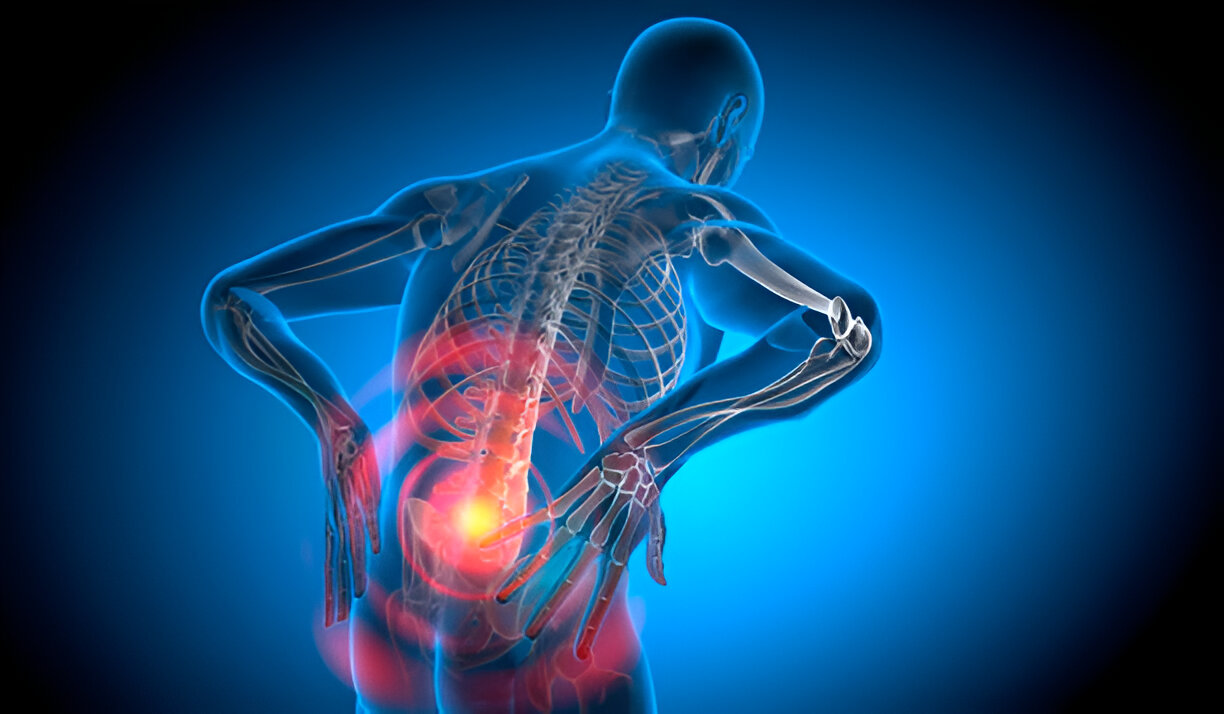
- What it is: A spinal disc whose soft center bulges or leaks through the outer ring, most often in the lower back, where it may irritate a nearby nerve.
- Common symptoms: Low back pain, pain shooting down one leg, tingling, numbness and sometimes weakness; many herniations cause few symptoms.
- Conventional care: Staying active, physical therapy, pain medicines, sometimes steroid injections, and surgery when symptoms are severe, progressive or last.
- How integrative care fits: Acupuncture, Ayurvedic therapies and individually prescribed herbs are used alongside medical care to help with pain and function.
- Evidence at a glance: Moderate for acupuncture, including one sham-controlled trial in sciatica from a herniated disc; limited for herbal medicine; very limited for Ayurveda.
What is Herniated Disc?
A herniated disc, also called a slipped or ruptured disc, occurs when the gel-like center of a spinal disc pushes through a tear in its tougher outer ring. In the lower back, about 95% of herniations occur at the L4-L5 or L5-S1 levels, and disc problems are among the most common causes of back pain.[1]
Common symptoms
Symptoms depend on where the disc sits and whether it touches a nerve. A lumbar herniation can cause low back pain, and when a nerve root is irritated, pain, tingling or numbness that travels down one leg, which is often called sciatica.[2] Weakness in the leg or foot can occur when the nerve is compressed.
Some herniations cause no symptoms at all. Leg pain that seems to be sciatica is sometimes referred pain from the back and not nerve root pressure, which matters because the course and treatment differ.[2]
Causes and risk factors
Discs lose water and become less resilient as they age, and a tear in the outer ring lets the center push out.[1] A review of risk factors for back pain and sciatica found that older age, smoking, physical stress on the spine such as vibration, and psychological stress including depression raised the risk of a future episode.[3]
Both pressure on the nerve and inflammation around it appear to be needed for a herniated disc to cause nerve symptoms.[2]
How it is diagnosed and treated conventionally
Diagnosis rests mainly on your history and a physical examination. MRI is typically used when symptoms are severe, getting worse, or lasting, or when surgery is being considered.[1, 2]
The outlook is often good. In the first 6 to 8 weeks, treatment is usually conservative: advice to stay active, physical therapy, pain medicines including anti-inflammatory drugs, and sometimes steroid injections near the nerve.[2] A meta-analysis of 11 cohort studies found that about two thirds of herniated discs shrank on their own with conservative care, although the studies were observational.[4]
Surgery such as discectomy is an option when pain is severe or does not settle. A review of 24 trials in people with sciatica from a disc herniation found very low to low certainty evidence that discectomy eased leg pain faster than non-surgical care, with a negligible difference at 12 months.[5]
Why Herniated Disc calls for a whole-person approach
A herniated disc is not only a mechanical problem. Inflammation, nerve sensitivity, muscle tension, general health and stress all appear to shape whether a herniation hurts and how long pain lasts.
Care that also addresses these factors is therefore a reasonable addition to treatment aimed at the spine. The factors below are the ones best supported by research.
Inflammation around the nerve
Inflammation as well as compression is thought to be needed for a nerve root to cause symptoms.[2] Studies of herniated discs that shrink on their own describe inflammation, new blood vessel growth and immune cell activity as part of that process.[6]
A sensitized nerve
Pain from an irritated nerve root is a form of neuropathic pain, which can be complex and hard to treat.[7]
Muscle tension and movement
Muscle spasm around the spine can add to pain, and acupuncture is proposed to act partly by relaxing it.[7] Staying active is part of standard early care.[2]
General health, stress and mood
A review of 15 systematic reviews found that poor general health, including smoking, and psychological stress, including depression, each raised the risk of a future episode of back pain or sciatica.[3]
Acupuncture for Herniated Disc
What the research shows
Research suggests acupuncture may reduce leg pain and improve function, with the best evidence in chronic sciatica from a herniated disc. In a trial at six hospitals in China, 216 adults received 10 sessions of real or sham acupuncture over 4 weeks. On a 100-point scale, leg pain fell by about 31 points with real acupuncture and about 15 with sham. Disability also improved more, and the differences were still present at one year.[8]
A meta-analysis of 30 randomized trials with 3,503 participants found acupuncture gave a better response rate than traction and several anti-inflammatory medicines for lumbar disc herniation, and lower pain scores than traction and diclofenac. Most of the comparisons were against active treatments, not sham acupuncture, and the authors called for larger, more rigorous trials.[9]
A TCM guideline for lumbar disc herniation also covered manual acupuncture and electroacupuncture in its graded recommendations.[10] Most trials come from China, so results may not carry over to every setting.
How acupuncture may work
Researchers propose that acupuncture acts on several levels at once. A review of mechanism studies lists relaxing muscle spasm, reducing pressure on nerve roots, improving small-vessel blood flow, lowering the release of inflammatory signaling molecules, and changing how the spinal cord and brain process pain.[7] These are proposed explanations, not settled facts.
What treatment involves
Treatment uses fine, sterile, single-use needles placed at points on the back, buttock and leg, usually left in place for about 20 to 40 minutes. The sham-controlled trial gave 10 sessions over four weeks.[8] We reassess after a short course of visits.
Serious problems from acupuncture are rare. In prospective studies, about 9 in 100 patients had a minor reaction such as bleeding, pain or redness at a needle site, and serious events occurred in about 1 in 10,000 patients.[11] Tell the practitioner first if you have a bleeding disorder, take blood thinners, are pregnant, or have a pacemaker (relevant to electroacupuncture).
Ayurvedic medicine for Herniated Disc
The Ayurvedic view
Ayurveda has no exact counterpart for a herniated disc. Leg pain with a disc cause is traditionally compared with Gridhrasi, a Vata disorder named for the walk of a person in pain.[12] Low back pain with stiffness is traditionally called Katigraha. In this framework Vata is the principle said to govern movement. These are traditional categories for choosing treatment, not biomedical diagnoses.
Therapies that may be used
Care is chosen for the individual and traditionally combines:
- Diet and daily routine intended to calm Vata, such as warm, regular meals and steady sleep hours
- Warm oil massage and local heat over the back and leg
- Herbs such as nirgundi (Vitex negundo) and guggulu-based formulas, which small clinical studies of Gridhrasi have tested[12, 13]
- Basti, a medicated enema therapy from Panchakarma, which has been reported in a case of disc prolapse[14]
Panchakarma procedures are not appropriate during pregnancy, acute illness or frailty, or before red-flag symptoms have been medically assessed.
What the research shows
The research on Ayurveda for herniated disc is very limited. A PubMed search found no systematic reviews and no placebo-controlled trials for disc herniation. One report describes a single 46-year-old woman with a prolapsed disc whose pain and disability improved over 7.5 months of oral medicines, oils, fomentation and Basti, with MRI showing less nerve compression.[14] A case report cannot show that the treatment caused the change, especially since many herniated discs improve over time.[4]
Studies of Gridhrasi (sciatica) are also small. A study of 102 patients found symptoms improved with a nirgundi extract and improved more when Matra Basti was added, but it had no placebo or untreated group.[13] A 40-patient single-group study of a guggulu formula reported mild to moderate improvement in most.[12]
Herbal medicine for Herniated Disc
Herbs and formulas that have been studied
Most relevant research covers Chinese herbal formulas for lumbar disc herniation and Western herbs for general low back pain. The 2024 TCM guideline covered formulas including Shentong Zhuyu decoction, Shenzhuo decoction, Simiao San, Duhuo Jisheng decoction and several patent capsules.[10] Western herbs studied for low back pain include devil's claw, white willow bark and capsicum (cayenne) applied to the skin.[15]
What the research shows
The evidence is limited and comes mostly from lower-quality trials. A meta-analysis of 27 trials with 3,133 patients found Chinese herbal compounds gave better response rates and pain scores than conventional medicines for lumbar disc herniation. The authors downgraded the evidence for risk of bias, inconsistent results and sparse safety reporting.[16] A meta-analysis of nine trials, all from China, found Shentong Zhuyu decoction gave better response rates and pain scores than the comparison treatments, and again noted the limited quality of the studies.[17]
A Cochrane review covered 14 trials of non-specific low back pain, not disc herniation. It found moderate-quality evidence that topical capsicum reduces chronic low back pain more than placebo, and low to moderate-quality evidence for short-term relief with devil's claw and white willow bark.[15] Whether this carries over to nerve root pain is not known. Transdermal medication therapy, in which an herbal preparation is applied to the skin, may be used at the clinic, and we make no claim of effect for it.
Safety and herb-drug interactions
Herbs are active substances and can interact with medicines. Case reports describe serious problems such as bleeding and hematomas when warfarin was combined with herbs including dang gui (Angelica sinensis), dan shen (Salvia miltiorrhiza), ginger, ginseng and Boswellia.[18] People taking blood thinners need a practitioner's review before using herbs for pain.
In one study, about one fifth of Ayurvedic products bought online contained detectable lead, mercury or arsenic.[19] Herbs should come from tested sources and be prescribed individually. Tell us if you are pregnant or breastfeeding, have liver or kidney disease, or have surgery planned.
Translating traditional medicine into modern biological language
The links drawn here are interpretation, not equivalence. Chinese medicine describes pain from a disc as blocked flow of qi and blood in the channels of the back and leg, often with blood stasis and weakness of the kidney system. Researchers studying acupuncture for nerve root pain measure things that loosely parallel this picture: local blood flow, muscle spasm, inflammatory signaling and the way the nervous system amplifies pain.[7]
Ayurveda's aggravated Vata describes sharp, shooting pain that limits movement. No study has shown that a dosha corresponds to a specific biological process.
How this care fits with your medical care
Integrative care for a herniated disc is complementary. Keep your physician, physical therapist or spine specialist, and do not stop or change prescribed medicines without your prescriber. We do not diagnose the cause of back or leg pain, so new or worsening pain should be medically evaluated.
Please bring your diagnosis, any MRI or other imaging reports, a full list of medicines and supplements, and details of any injections or surgery, planned or past. If surgery is scheduled, tell us so we can plan around it.
When to seek urgent medical care
Some symptoms point to severe nerve compression, such as cauda equina syndrome, or another serious cause, and need emergency assessment.[1]
- New trouble passing urine, or loss of bladder or bowel control
- Numbness in the groin, genitals or inner thighs (the "saddle" area)
- Leg weakness that is new or getting worse, such as a foot that drags
- Severe pain, numbness or weakness in both legs
- Back pain with fever, unexplained weight loss or a history of cancer
- Symptoms that begin after a serious fall or accident
If any of these occur, call 911 or go to the nearest emergency department.
Frequently asked questions
What is herniated disc?
A herniated disc is a spinal disc whose soft center pushes through a tear in its tougher outer ring. In the lower back it can irritate a nearby nerve and cause back pain and pain, tingling, numbness or weakness in the leg. Some herniations cause no symptoms, and many shrink on their own with conservative care over weeks to months.
Can acupuncture help with herniated disc?
Research suggests it may help. A sham-controlled trial of 216 adults with chronic sciatica from a herniated disc found that real acupuncture reduced leg pain and disability more than sham acupuncture, with benefit lasting a year. A meta-analysis of 30 trials agrees, although most compared acupuncture with other treatments and study quality varied. Acupuncture is used alongside medical care, not in place of it.
Does Ayurvedic or herbal medicine work for herniated disc?
The evidence is thinner than for acupuncture. Ayurveda for disc problems has been described only in case reports and small studies without placebo groups, so benefit is uncertain. Chinese herbal formulas showed better results than conventional drugs in meta-analyses, but the reviewers downgraded the evidence for risk of bias and inconsistent results. Herbs should be prescribed individually and checked against your medicines.
Can I stop my pain medicine or avoid surgery if I have acupuncture?
No. Acupuncture, Ayurveda and herbal medicine are complementary care. Do not stop or change prescribed medicines without talking to your prescriber, and follow your physician’s advice about injections or surgery. If you have weakness, bladder or bowel changes, or pain that keeps getting worse, you need prompt medical assessment.
How soon might I notice a change with acupuncture?
It differs from person to person and no result can be promised. In the main sham-controlled trial, patients had 10 sessions over four weeks, and the difference between real and sham acupuncture began to appear at about two weeks. We reassess after a short course of visits to see whether treatment is helping.
Does insurance cover acupuncture for herniated disc?
It may. Netra Integrative Health Clinic is in-network with Blue Cross Blue Shield, Cigna and UnitedHealthcare. Other plans may be covered through out-of-network benefits, and we offer a free benefits check. HSA and FSA cards and CareCredit are also accepted. Call (908) 402-7301 to ask about your plan.
References
- Al Qaraghli MI, De Jesus O. Lumbar Disc Herniation. StatPearls [Internet]. 2023. PMID 32809713. StatPearls chapter on lumbar disc herniation covering disc anatomy, how common back pain is, and that most lumbar herniations occur at L4-L5 or L5-S1.
- Valat JP, Genevay S, Marty M, et al. Sciatica. Best Pract Res Clin Rheumatol. 2010;24(2):241-52. PMID 20227645. Clinical review of sciatica explaining that inflammation and compression both matter, referred versus radicular pain, the usually favorable course, and conservative care in the first 6 to 8 weeks.
- Parreira P, Maher CG, Steffens D, et al. Risk factors for low back pain and sciatica: an umbrella review. Spine J. 2018;18(9):1715-1721. PMID 29792997. Umbrella review of 15 systematic reviews finding that older age, smoking, poor general health, physical spinal stress and depression raise the risk of back pain or sciatica.
- Zhong M, Liu JT, Jiang H, et al. Incidence of Spontaneous Resorption of Lumbar Disc Herniation: A Meta-Analysis. Pain Physician. 2017;20(1):E45-E52. PMID 28072796. Meta-analysis of 11 cohort studies finding that about two thirds of lumbar disc herniations shrank spontaneously with conservative treatment.
- Liu C, Ferreira GE, Abdel Shaheed C, et al. Surgical versus non-surgical treatment for sciatica: systematic review and meta-analysis of randomised controlled trials. BMJ. 2023;381:e070730. PMID 37076169. BMJ meta-analysis of 24 trials finding discectomy relieved leg pain faster than non-surgical care, with negligible difference at 12 months and low-certainty evidence.
- Zhao Y, Jia Z, Aili A, et al. Mechanisms and management of self-resolving lumbar disc herniation: bridging molecular pathways to non-surgical clinical success. J Orthop Surg Res. 2025;20(1):528. PMID 40426259. Case report and literature review of spontaneous resorption of lumbar disc herniation, describing inflammation, new vessel growth and macrophage activity as part of the process.
- Li HL, Zhang Y, Zhou JW. Acupuncture for radicular pain: a review of analgesic mechanism. Front Mol Neurosci. 2024;17:1332876. PMID 38596777. Review of proposed pain-relieving mechanisms of acupuncture in radicular pain, including effects on muscle spasm, microcirculation, inflammatory signaling and central pain processing.
- Tu JF, Shi GX, Yan SY, et al. Acupuncture vs Sham Acupuncture for Chronic Sciatica From Herniated Disk: A Randomized Clinical Trial. JAMA Intern Med. 2024;184(12):1417-1424. PMID 39401008. Multicenter sham-controlled trial of 216 patients finding 10 acupuncture sessions reduced leg pain and disability in chronic sciatica from herniated disc, lasting 52 weeks.
- Tang S, Mo Z, Zhang R. Acupuncture for lumbar disc herniation: a systematic review and meta-analysis. Acupunct Med. 2018;36(2):62-70. PMID 29496679. Meta-analysis of 30 trials (3,503 participants) finding acupuncture better than traction and several drugs for lumbar disc herniation, with a call for more rigorous trials.
- Qin X, Sun K, Xu W, et al. An evidence-based guideline on treating lumbar disc herniation with traditional Chinese medicine. J Evid Based Med. 2024;17(1):187-206. PMID 38502879. Evidence-based guideline with 20 recommendations covering Chinese herbal formulas, acupuncture and related therapies for lumbar disc herniation.
- Bäumler P, Zhang W, Stübinger T, et al. Acupuncture-related adverse events: systematic review and meta-analyses of prospective clinical studies. BMJ Open. 2021;11(9):e045961. PMID 34489268. Systematic review of 21 prospective studies finding minor acupuncture reactions in about 9 percent of patients and serious events in about 1 per 10,000.
- Sathavane GV, Pandya DH, Baghel MS. Effect of Vatari Guggulu in the management of Gridhrasi (sciatica). Ayu. 2015;36(1):41-5. PMID 26730137. Single-group study of 40 patients with Gridhrasi given a guggulu formula for 30 days, reporting mostly mild to moderate improvement and describing the Ayurvedic classification.
- Ali M, Shukla VD, Dave AR, et al. A clinical study of Nirgundi Ghana Vati and Matra Basti in the management of Gridhrasi with special reference to sciatica. Ayu. 2010;31(4):456-60. PMID 22048539. Clinical study of 102 patients with Gridhrasi comparing nirgundi extract alone and with Matra Basti; both groups improved, with no placebo or untreated control.
- Deshpande SV, Deshpande VS, Bhosale A, et al. Conservative management of acute prolapsed inter-vertebral disc with ayurveda: A case report. J Ayurveda Integr Med. 2022;13(2):100561. PMID 35661935. Case report of one woman with an acute prolapsed disc treated with Ayurvedic oral medicines, oils, fomentation and Basti, reporting improvement over 7.5 months.
- Oltean H, Robbins C, van Tulder MW, et al. Herbal medicine for low-back pain. Cochrane Database Syst Rev. 2014;2014(12):CD004504. PMID 25536022. Cochrane review of 14 trials of herbal medicine for non-specific low back pain, covering topical capsicum, devil's claw, white willow bark and comfrey.
- Guan J, Yang G, Yang K, et al. Efficacy and safety of Chinese herbal compounds for lumbar disc herniation: a systematic review of randomized controlled trials. Syst Rev. 2025;14(1):223. PMID 41239367. Meta-analysis of 27 trials (3,133 patients) finding Chinese herbal compounds outperformed conventional drugs for lumbar disc herniation, with evidence downgraded for bias and heterogeneity.
- Sun K, Zhu LG, Wei X, et al. [Efficacy and safety of Shentong Zhuyu Decoction for lumbar disc herniation: systematic review and Meta-analysis]. Zhongguo Zhong Yao Za Zhi. 2020;45(5):1159-1166. PMID 32237460. Meta-analysis of nine Chinese trials (824 patients) finding Shentong Zhuyu decoction beat comparison treatments for lumbar disc herniation, limited by study quality.
- Milić N, Milosević N, Golocorbin Kon S, et al. Warfarin interactions with medicinal herbs. Nat Prod Commun. 2014;9(8):1211-6. PMID 25233607. Review of reported interactions between warfarin and medicinal herbs, with case reports of serious bleeding events involving herbs including dang gui, dan shen, ginger, ginseng and Boswellia.
- Saper RB, Phillips RS, Sehgal A, et al. Lead, mercury, and arsenic in US- and Indian-manufactured Ayurvedic medicines sold via the Internet. JAMA. 2008;300(8):915-23. PMID 18728265. JAMA study finding detectable lead, mercury or arsenic in about one fifth of Ayurvedic medicines purchased over the Internet.
This page is for general education and is not medical advice. Acupuncture, Ayurvedic medicine and herbal medicine are complementary therapies; they do not replace diagnosis or treatment by your physician. Do not stop or change prescribed treatment without talking to your prescriber. In an emergency call 911.