
















- What it is: Pain in the wrist, palm, fingers or thumb from conditions such as carpal tunnel syndrome, tendon inflammation, trigger finger, or arthritis.
- Common symptoms: Aching, numbness or tingling, weakness, stiffness, swelling, clicking or locking, often with night symptoms or pain during gripping.
- Conventional care: Activity changes, splinting, steroid injection, exercise and hand therapy, pain medicines, and surgery when other care fails.
- How integrative care fits: Acupuncture, Ayurvedic therapies and individually prescribed herbs are used alongside medical care to help with pain, stiffness and stress.
- Evidence at a glance: Limited for acupuncture, mostly in carpal tunnel syndrome with low-certainty reviews and mixed trial results; very limited for herbal medicine; none found for Ayurveda.
What is Wrist and Hand Pain?
Wrist and hand pain is a symptom, not a single disease, and common causes include carpal tunnel syndrome, trigger finger, de Quervain tenosynovitis and arthritis at the base of the thumb.[1] Each of these can cause significant disability, and each is diagnosed and treated differently.
Common symptoms
Symptoms depend on the cause. Carpal tunnel syndrome typically causes numbness and tingling in the thumb, index, middle and part of the ring finger, with weakness of the thumb when severe.[1] Symptoms often begin at night and later appear during repetitive tasks such as typing.[2]
Other common features include:
- Pain, swelling and tenderness at the thumb side of the wrist (de Quervain tenosynovitis)[1]
- A finger that catches, clicks or locks (trigger finger)[1]
- Aching and stiffness at the base of the thumb (thumb joint arthritis)[1]
- Pain, swelling and loss of smooth movement from inflamed tendon sheaths (tenosynovitis)[3]
Causes and risk factors
Risk factors vary by condition. Carpal tunnel syndrome is more common in women and in people who are obese, have diabetes, or work with keyboards, mice, heavy machinery or vibrating tools.[1] Hypothyroidism, rheumatoid arthritis and pregnancy also raise the risk.[2]
De Quervain tenosynovitis is more common in women and in people who use a mobile phone frequently, and trigger finger affects about 2% of the general population and up to 20% of adults with diabetes.[1] Thumb base arthritis is common in postmenopausal women.[1]
How it is diagnosed and treated conventionally
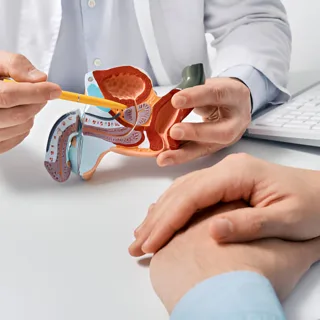
Diagnosis rests on your history and a hand examination. Electrodiagnostic tests or ultrasound are used when the diagnosis is unclear or before surgery.[1, 4] A physician or hand specialist makes this diagnosis, and it matters because the causes are treated differently.
First-line care for the common hand conditions is a steroid injection, immobilization (splinting), or both. When these do not help, or the disease progresses, surgery is considered.[1] For carpal tunnel syndrome, conservative options include splinting, corticosteroids, physical therapy and yoga, while patients whose symptoms have not improved after 4 to 6 months should be offered surgical decompression.[4]
Why Wrist and Hand Pain calls for a whole-person approach
Hand pain is often a local problem, but general health, work habits and other conditions affect who develops it and how it responds to care.[1, 2]
For that reason, we ask about your general health, your work and your daily hand use as well as the painful area. Care for pain and stiffness is used alongside treatment of the underlying hand condition.
Metabolic health and other conditions
Diabetes, obesity, an underactive thyroid and rheumatoid arthritis are linked to carpal tunnel syndrome, and diabetes is linked to trigger finger.[1, 2] Managing these conditions with your physician is part of managing hand pain.
Repetitive use and work
Keyboard and mouse work, vibrating tools and frequent phone use are associated with hand conditions in the literature.[1, 2] Changes to workstations and tasks are a usual part of conservative care.
Nerve involvement
In carpal tunnel syndrome, pressure within the carpal tunnel compresses the median nerve and causes numbness and tingling.[2] Nerve symptoms need medical evaluation because severe or long-lasting compression can lead to weakness and wasting of hand muscles.[2]
Joint wear and inflammation
Arthritis of the thumb base is common after menopause, and non-surgical treatments relieve pain but do not change how the disease progresses.[1]
Acupuncture for Wrist and Hand Pain
What the research shows
The evidence is limited and mostly concerns carpal tunnel syndrome, the best-studied cause of wrist and hand pain for acupuncture. Results are mixed.
A 2023 systematic review of 16 trials (1,025 participants) found that acupuncture as an add-on treatment might help symptoms, function and pain in carpal tunnel syndrome, but the certainty of the evidence was low or very low. Acupuncture alone was better than night splints for pain but not for symptom severity or function.[5] An earlier review of 10 trials found manual acupuncture better than ibuprofen or prednisolone for symptom relief and electroacupuncture plus splinting better than splinting alone, while noting that most trials had a high risk of bias.[6] A 2011 review of six trials called the evidence encouraging but not convincing.[7]
The best trial results are modest. In a trial of 181 people, 13 sessions of electroacupuncture over 17 weeks added to night splinting gave small improvements in symptoms, disability and function compared with splinting alone, and the pain difference was small and clinically unimportant.[8] In a placebo-controlled trial of 41 people with mild to moderate carpal tunnel syndrome, acupuncture was not better than placebo acupuncture, and both groups improved.[9]
For de Quervain tenosynovitis, a 2024 meta-analysis of 14 trials (851 patients) found less pain with acupuncture than with topical pain medicine and no significant difference from corticosteroid injection, with limits in the number and quality of studies.[10] A network meta-analysis found that acupuncture did not differ significantly from placebo for pain in de Quervain tenosynovitis, while corticosteroid injection with short immobilization remained the main effective treatment.[11]
For arthritis of peripheral joints (knee, hip and hand), a Cochrane review found sham-controlled benefits that were small and probably partly due to placebo effects, although trials against waiting lists showed larger benefits.[12] All of the trials in that review were of knee or hip arthritis, so it says nothing direct about hand arthritis.[12]
How acupuncture may work
How acupuncture might help wrist and hand pain is not settled. The mixed results of sham-controlled trials suggest that non-specific factors may account for part of any benefit: in one carpal tunnel trial, real and placebo acupuncture both improved symptoms, and in arthritis trials the sham-controlled benefit was small and probably partly due to placebo effects.[9, 12]
What treatment involves
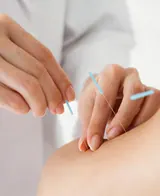
Treatment uses fine, sterile, single-use needles placed at points on the hand, forearm, arm and sometimes the neck or shoulder, usually left in place for about 20 to 40 minutes. In trials for carpal tunnel syndrome, courses ranged from 8 sessions over 4 weeks to 13 sessions over 17 weeks.[8, 13] We reassess after a short course of visits.
Serious problems from acupuncture are rare. In prospective studies, about 9 in 100 patients had a minor reaction such as brief bleeding, soreness or redness at a needle site, and serious events occurred in about 1 in 10,000 patients.[14] Tell the practitioner first if you have a bleeding disorder, take blood thinners, are pregnant, or have a pacemaker (relevant to electroacupuncture). If you have numb fingers or diabetes, mention it so needling is done with care.
Ayurvedic medicine for Wrist and Hand Pain
The Ayurvedic view
Ayurveda has no exact counterpart to wrist and hand pain. In this tradition, pain, stiffness and numbness in the joints and limbs are generally thought of as disturbance of Vata, the principle said to govern movement, with swelling and heaviness attributed to Kapha. These are traditional categories for choosing treatment, not biomedical diagnoses.
Therapies that may be used
Care is chosen for the individual and traditionally combines:
- Diet and daily routine intended to calm Vata, such as warm, regular meals and steady sleep hours
- Warm herbal oil massage of the hands, forearms and shoulders, with gentle warmth
- Gentle hand and wrist movement and breathing practices
- Herbs prescribed individually by a qualified practitioner, such as turmeric and Boswellia, traditionally used for stiffness and inflammation[15]
Panchakarma procedures are not appropriate during pregnancy, acute illness or frailty, and are not a usual step for a problem limited to the hand. Transdermal medication therapy, an herbal preparation applied to the skin, may be used on the hand or wrist, but no trial of it for wrist and hand pain was found.
What the research shows
No clinical trials of Ayurvedic treatment for wrist and hand pain were found in a PubMed search, so there is no evidence on whether it helps. Turmeric (Curcuma longa) extract, curcumin and Boswellia extract showed pain relief in a review of supplements for hand, hip and knee arthritis, but the quality of that evidence was very low and most studies were not of hand arthritis.[15] Please treat Ayurvedic care here as traditional and supportive.
Herbal medicine for Wrist and Hand Pain
Herbs and formulas that have been studied
The research is thin. For hand arthritis, a topical gel made from Arnica has been tested against an ibuprofen gel.[16] For osteoarthritis of the hand, hip and knee, oral supplements including Curcuma longa, curcumin and Boswellia serrata extracts have been studied.[15] Traditional Chinese medicine also uses topical herbal preparations and oral formulas for pain and numbness in the hand, chosen by pattern, but trials for carpal tunnel syndrome and other wrist conditions were not found.
What the research shows
The evidence is very limited. A Cochrane review found moderate-quality evidence from one trial of 174 people with hand osteoarthritis that Arnica gel gave similar benefit to ibuprofen gel, with a similar number of adverse events.[16] A review of 69 trials of supplements for hand, hip and knee osteoarthritis found short-term pain benefit for several supplements, including turmeric and Boswellia extracts, but rated the overall evidence very low in quality and found no supplement with a clinically important benefit at long term.[15]
These results concern arthritis. No herbal trials were found for carpal tunnel syndrome, trigger finger or tendon inflammation of the wrist.
Safety and herb-drug interactions
Herbs are active substances and can interact with medicines. Case reports describe bleeding when warfarin was combined with herbs including dang gui (Angelica sinensis), dan shen (Salvia miltiorrhiza), ginger, ginseng and Boswellia.[17] People taking blood thinners need a practitioner's review before using herbs for pain. Herbs can also affect blood sugar medicines, so people with diabetes should tell us about all their medications.
In one study, about one fifth of Ayurvedic products bought online contained detectable lead, mercury or arsenic.[18] Herbs should come from tested sources and be prescribed individually. Tell us if you are pregnant or breastfeeding, or have liver or kidney disease.
Translating traditional medicine into modern biological language
The links drawn here are interpretation, not equivalence. Chinese medicine often describes hand and wrist pain, numbness and weakness as obstruction of qi and blood in the channels of the arm, sometimes with cold or dampness. Researchers studying these conditions look at things that loosely parallel this picture: pressure on the median nerve, inflammation of tendon sheaths, joint wear, and the way the nervous system processes pain.[1, 2, 3]
Ayurveda's aggravated Vata describes aching, stiffness, numbness and restricted movement. No study has shown that a dosha corresponds to a specific biological process.
How this care fits with your medical care
Integrative care for wrist and hand pain is complementary. Keep your physician or hand specialist, and do not stop or change prescribed medicines, splints, injections or surgery plans without their advice. We do not diagnose the cause of hand pain, so new, worsening or unexplained symptoms should be medically evaluated first.
Please bring your diagnosis, any nerve test or imaging reports, a list of medicines and supplements, details of splints, injections or surgery, and your latest blood sugar results if you have diabetes.
When to seek urgent medical care
Some hand and wrist symptoms need prompt assessment.
- Hand pain after a fall, blow or other injury, or a visibly deformed wrist or finger
- A hot, red, swollen joint or hand, especially with fever
- A hand that is cold, pale or blue, or sudden severe pain with loss of pulse or sensation
- Constant numbness, or weakness and wasting of the muscles at the base of the thumb[2]
- A finger that is locked and cannot be straightened
- Sudden weakness, numbness or drooping on one side of the body or face, or hand pain with chest pain or shortness of breath
If any of these occur, call 911 or go to the nearest emergency department.
Frequently asked questions
What is wrist and hand pain?
Wrist and hand pain is a symptom with several possible causes. Common ones are carpal tunnel syndrome, trigger finger, de Quervain tenosynovitis, and arthritis at the base of the thumb. Symptoms range from aching and stiffness to numbness, clicking or locking. Because the causes are treated differently, a physician or hand specialist should diagnose it.
Can acupuncture help with wrist and hand pain?
It may help some people, but the evidence is limited. Most studies concern carpal tunnel syndrome, where reviews suggest acupuncture may help as an add-on to splinting, but the certainty is low and one placebo-controlled trial found no difference from placebo acupuncture. Acupuncture is used alongside medical care, not in place of it.
Does Ayurvedic or herbal medicine work for hand pain?
The evidence is very thin. No trials of Ayurvedic treatment for wrist and hand pain were found. For herbs, there is one trial of an Arnica gel for hand arthritis, and a very-low-quality review of turmeric and Boswellia for osteoarthritis of the hand, hip and knee. Herbs should be prescribed individually and checked against your medicines.
Can I avoid a steroid injection or surgery if I have acupuncture?
No one can promise that. Acupuncture, Ayurveda and herbal medicine are complementary care and not replacements for splinting, injection or surgery. Do not stop or change prescribed treatment without talking to your physician or hand specialist. Constant numbness, weakness, or muscle wasting needs prompt medical assessment.
How soon might I notice a change with acupuncture?
It differs from person to person and no result can be promised. In carpal tunnel trials, courses ranged from 8 sessions over 4 weeks to 13 sessions over 17 weeks. We reassess after a short course of visits to see whether pain and stiffness are improving and whether to continue.
Does insurance cover acupuncture for wrist and hand pain?
It may. Netra Integrative Health Clinic accepts most major insurance plans that include out-of-network acupuncture benefits, for example Aetna, Blue Cross Blue Shield, Cigna and UnitedHealthcare, and offers a free benefits check. HSA and FSA cards and CareCredit are also accepted. Call (908) 402-7301 to ask about your plan.
References
- Currie KB, Tadisina KK, Mackinnon SE. Common Hand Conditions: A Review. JAMA. 2022;327(24):2434-2445. PMID 35762992. JAMA review of common hand conditions (carpal tunnel syndrome, trigger finger, de Quervain tenosynovitis, thumb joint arthritis) covering risk factors, diagnosis, injection, splinting and surgery.
- Sevy JO, Sina RE, Varacallo MA. Carpal Tunnel Syndrome. StatPearls [Internet]. 2023. PMID 28846321. StatPearls chapter on carpal tunnel syndrome covering median nerve compression, symptoms, risk factors and treatment by severity.
- Ray G, Sandean DP, Tall MA. Tenosynovitis. StatPearls [Internet]. 2023. PMID 31335044. StatPearls chapter on tenosynovitis describing inflammation of the tendon sheath, common in the hand and wrist, and its features.
- Wipperman J, Goerl K. Carpal Tunnel Syndrome: Diagnosis and Management. Am Fam Physician. 2016;94(12):993-999. PMID 28075090. American Family Physician review of carpal tunnel syndrome diagnosis and conservative and surgical management.
- Dong Q, Li X, Yuan P, et al. Acupuncture for carpal tunnel syndrome: A systematic review and meta-analysis of randomized controlled trials. Front Neurosci. 2023;17:1097455. PMID 36908786. Systematic review of 16 trials (1,025 participants) of acupuncture for carpal tunnel syndrome, suggesting benefit as an add-on with low or very low certainty.
- Wu IX, Lam VC, Ho RS, et al. Acupuncture and related interventions for carpal tunnel syndrome: systematic review. Clin Rehabil. 2020;34(1):34-44. PMID 31556315. Systematic review of 10 trials (728 participants) of acupuncture for carpal tunnel syndrome, with most trials at high risk of bias.
- Sim H, Shin BC, Lee MS, et al. Acupuncture for carpal tunnel syndrome: a systematic review of randomized controlled trials. J Pain. 2011;12(3):307-14. PMID 21093382. Systematic review of six trials of acupuncture for carpal tunnel syndrome, calling the evidence encouraging but not convincing because of low study quality.
- Chung VCH, Ho RST, Liu S, et al. Electroacupuncture and splinting versus splinting alone to treat carpal tunnel syndrome: a randomized controlled trial. CMAJ. 2016;188(12):867-875. PMID 27270119. Trial of 181 people finding electroacupuncture added to splinting gave small improvements in carpal tunnel symptoms and function compared with splinting alone.
- Yao E, Gerritz PK, Henricson E, et al. Randomized controlled trial comparing acupuncture with placebo acupuncture for the treatment of carpal tunnel syndrome. PM R. 2012;4(5):367-73. PMID 22405683. Placebo-controlled trial of 41 people with carpal tunnel syndrome finding acupuncture no better than placebo acupuncture when both were used with bracing.
- Qin Y, Luo D, Qiu H, et al. A systematic review and meta-analysis of acupuncture for De Quervain's tenosynovitis treatment. Postgrad Med J. 2024;100(1188):709-720. PMID 38932434. Meta-analysis of 14 trials (851 patients) of acupuncture for de Quervain tenosynovitis, finding less pain than topical analgesics and a call for better studies.
- Chong HH, Pradhan A, Dhingra M, et al. Advancements in de Quervain Tenosynovitis Management: A Comprehensive Network Meta-Analysis. J Hand Surg Am. 2024;49(6):557-569. PMID 38613563. Network meta-analysis of 14 trials of non-surgical treatment for de Quervain tenosynovitis; steroid injection with short immobilization was effective and acupuncture did not differ from placebo for pain.
- Manheimer E, Cheng K, Linde K, et al. Acupuncture for peripheral joint osteoarthritis. Cochrane Database Syst Rev. 2010;2010(1):CD001977. PMID 20091527. Cochrane review of 16 trials of acupuncture for peripheral joint osteoarthritis finding small sham-controlled benefits, probably partly placebo, mostly in knee and hip.
- Yang CP, Hsieh CL, Wang NH, et al. Acupuncture in patients with carpal tunnel syndrome: A randomized controlled trial. Clin J Pain. 2009;25(4):327-33. PMID 19590482. Trial of 77 people comparing 8 acupuncture sessions with oral prednisolone for mild to moderate carpal tunnel syndrome, finding similar improvement.
- Bäumler P, Zhang W, Stübinger T, et al. Acupuncture-related adverse events: systematic review and meta-analyses of prospective clinical studies. BMJ Open. 2021;11(9):e045961. PMID 34489268. Systematic review of 21 prospective studies finding minor acupuncture reactions in about 9 percent of patients and serious events in about 1 per 10,000.
- Liu X, Machado GC, Eyles JP, et al. Dietary supplements for treating osteoarthritis: a systematic review and meta-analysis. Br J Sports Med. 2018;52(3):167-175. PMID 29018060. Meta-analysis of 69 trials of dietary supplements for hand, hip and knee osteoarthritis, with short-term pain relief from some including turmeric and Boswellia but very low quality evidence.
- Cameron M, Chrubasik S. Topical herbal therapies for treating osteoarthritis. Cochrane Database Syst Rev. 2013;2013(5):CD010538. PMID 23728701. Cochrane review of topical herbal therapies for osteoarthritis, including one trial of Arnica gel versus ibuprofen gel in hand osteoarthritis.
- Milić N, Milosević N, Golocorbin Kon S, et al. Warfarin interactions with medicinal herbs. Nat Prod Commun. 2014;9(8):1211-6. PMID 25233607. Review of reported interactions between warfarin and medicinal herbs, including bleeding events with dang gui, dan shen, ginger, ginseng and Boswellia.
- Saper RB, Phillips RS, Sehgal A, et al. Lead, mercury, and arsenic in US- and Indian-manufactured Ayurvedic medicines sold via the Internet. JAMA. 2008;300(8):915-23. PMID 18728265. JAMA study finding detectable lead, mercury or arsenic in about one fifth of Ayurvedic medicines purchased over the Internet.
This page is for general education and is not medical advice. Acupuncture, Ayurvedic medicine and herbal medicine are complementary therapies; they do not replace diagnosis or treatment by your physician. Do not stop or change prescribed treatment without talking to your prescriber. In an emergency call 911.