



















- What it is: Narrowing of the tendon sheath at the base of a finger or thumb, with tendon inflammation, so the tendon catches as the digit bends and straightens.
- Common symptoms: Palm pain or an ache at the base of the finger, a tender nodule, snapping or clicking, and a finger that locks, often worse in the morning.
- Conventional care: Rest from aggravating tasks, splinting, corticosteroid injection, and release surgery when other care fails.
- How integrative care fits: Acupuncture and Ayurvedic or herbal care may be used alongside medical care to help with pain and stiffness, not to treat the locking itself.
- Evidence at a glance: Very limited for acupuncture in trigger finger, with the main studies covering a needle-knife procedure; none found for Ayurveda or herbal medicine in trigger finger.
What is Trigger Finger?
Trigger finger, also called stenosing tenosynovitis, is a common condition caused by narrowing of the tendon sheath that guides a finger or thumb tendon, together with thickening and inflammation where the tendon meets the sheath.[1] This makes the digit catch or lock as it bends and straightens.
Common symptoms
The main symptom is a finger or thumb that snaps, catches or locks, and it is usually harder to straighten the digit than to bend it.[1] Other common features include:
- Pain or an ache in the palm when the finger moves
- A tender lump (nodule) at the base of the finger
- A snapping or popping sound that becomes more noticeable as the digit moves
- Stiffness or locking, which is often worse after rest, and more often in the dominant hand[1]
The ring finger and thumb are the digits affected most often, although any finger can be involved.[1]
Causes and risk factors
Repetitive use of the hand is the traditional explanation, with the problem centered on the first pulley (the A1 pulley) near the base of the finger.[1] Diabetes is a recognized risk factor. A meta-analysis of studies on metabolic disease found diabetes was linked to trigger finger, with an odds ratio of about 3.8.[2] People with diabetes often have more severe trigger finger.[3]
Carpal tunnel syndrome is another associated condition. A meta-analysis found trigger finger is more common in people with carpal tunnel syndrome and after carpal tunnel surgery.[4] In studies, women made up most participants.[5]
How it is diagnosed and treated conventionally
Trigger finger is diagnosed from your history and a hand examination, and ultrasound is sometimes used to assess the finger.[6] A physician or hand specialist makes this diagnosis.
First-line care is usually non-surgical. A joint-blocking splint (orthosis) has been shown in studies to relieve pain and improve function, and a systematic review recommended immobilizing a single joint for 6 to 10 weeks, while noting that more randomized trials are needed.[7, 8] A corticosteroid injection into the tendon sheath is the other main option, with moderate evidence of very short-term benefit and up to three repeat injections effective in most patients.[7, 9]
When these measures fail, release of the A1 pulley is the standard surgical procedure.[7] A Cochrane review found low-quality evidence that open surgery led to less recurrence than steroid injection over 6 to 12 months, but was more painful in the first week.[5]
Why Trigger Finger calls for a whole-person approach
Trigger finger is a local problem of the tendon and its sheath, but other health factors can influence it, so care that looks only at the finger may miss something.[2, 3]
For this reason, we ask about your general health, your other hand conditions and the work or activities that load your hands. Care for pain and stiffness is complementary to treatment of the tendon itself.
Blood sugar and metabolic health
Diabetes, high cholesterol and obesity were associated with tendon problems in a systematic review, which concluded that tendon disease has several contributing causes and that periodic metabolic checks may be reasonable in people at risk.[2] Anyone with diabetes and trigger finger should have blood sugar managed by their physician.
Other hand conditions
Trigger finger often appears together with carpal tunnel syndrome, and in people with diabetes it may sit alongside other hand problems such as carpal tunnel syndrome and cheiroarthropathy.[3, 4]
Hand use and tendon load
Repetitive gripping and use of the hand is the classic mechanism, and rest from aggravating activities and splinting are part of standard care.[1, 8]
Acupuncture for Trigger Finger
What the research shows
No good-quality trials of ordinary acupuncture for trigger finger were found, so the evidence is very limited. A PubMed search found only case reports and a small case series of acupuncture or electroacupuncture for the condition, and no randomized trials of ordinary acupuncture, which cannot show whether it works.
The nearest research is on acupotomy, a needle-knife technique used in China. It is a minor release procedure rather than ordinary acupuncture. A 2023 meta-analysis of 15 trials (988 patients) found that ultrasound-guided acupotomy outperformed traditional acupotomy, surgery or injection, but the authors said the findings needed to be verified in large, standard trials, and results varied widely between studies.[10] Netra does not offer this procedure.
Research in related tendon and chronic pain conditions gives only indirect support. A 2024 meta-analysis of 14 trials (851 patients) of acupuncture for De Quervain's tenosynovitis, a related tendon condition at the thumb side of the wrist, found less pain than with topical pain medicine and no significant difference from corticosteroid injection, but called for better studies.[11] An individual patient data analysis of 39 trials of chronic musculoskeletal, osteoarthritis and headache pain found acupuncture better than both sham and no acupuncture, with small to moderate differences.[12] These findings do not show that acupuncture helps trigger finger itself.
How acupuncture may work
How acupuncture might help trigger finger is unknown, because it has not been studied for this condition. In chronic pain trials, the pain relief could not be explained by placebo effects alone, and factors beyond needling at specific points also contributed.[12]
What treatment involves
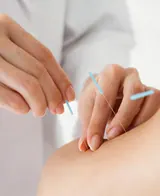
Treatment uses fine, sterile, single-use needles placed at points on the hand, forearm and nearby areas, usually left in place for about 20 to 40 minutes. A course of several visits is followed by reassessment of pain, stiffness and function. In chronic pain trials, benefit after a course of acupuncture appeared to persist over 12 months.[13]
Serious problems from acupuncture are rare. In prospective studies, about 9 in 100 patients had a minor reaction such as brief bleeding, soreness or redness at a needle site, and serious events occurred in about 1 in 10,000 patients.[14] Tell the practitioner first if you have a bleeding disorder, take blood thinners, are pregnant, or have a pacemaker (relevant to electroacupuncture). People with diabetes should also mention it, particularly if they have reduced sensation in the hands.
Ayurvedic medicine for Trigger Finger
The Ayurvedic view
Ayurveda has no exact counterpart to trigger finger. In this tradition, stiffness, locking and pain in joints and tendons are generally thought of as disturbance of Vata, the principle said to govern movement, with swelling and heaviness attributed to Kapha. These are traditional categories for choosing treatment, not biomedical diagnoses.
Therapies that may be used
Care is chosen for the individual and traditionally combines:
- Diet and daily routine intended to calm Vata, such as warm, regular meals and steady sleep hours
- Warm oil massage of the hand and forearm, with gentle warmth
- Herbs prescribed individually by a qualified practitioner, such as turmeric (curcumin), traditionally used for inflammation and stiffness and studied in arthritis pain[15]
Panchakarma procedures are not appropriate during pregnancy, acute illness or frailty, and are not a usual step for a problem limited to one finger. Transdermal medication therapy, an herbal preparation applied to the skin, may be used on the hand, but no trial of it for trigger finger was found.
What the research shows
No clinical trials of Ayurvedic treatment for trigger finger were found in a PubMed search, so there is no evidence on whether it helps. Ayurvedic products also vary in quality: in one study, about one fifth of those bought online contained detectable lead, mercury or arsenic.[16] Please treat Ayurvedic care here as traditional and supportive.
Herbal medicine for Trigger Finger
Herbs and formulas that have been studied
No herbs or Chinese formulas have been tested in trials for trigger finger. Turmeric or curcumin has been studied for pain and inflammation in arthritis.[15] Traditional Chinese medicine also uses topical herbal preparations and formulas for tendon and joint pain, chosen by pattern, but trials for this condition were not found.
What the research shows
There is no direct evidence for herbal medicine in trigger finger. A meta-analysis of 29 randomized trials in 2,396 people with several types of arthritis found that curcumin or Curcuma longa extract may improve pain and inflammation, but the trials were small and of low quality, and arthritis is a joint disease and not a tendon condition.[15] Whether this carries over to trigger finger is not known.
Safety and herb-drug interactions
Herbs are active substances and can interact with medicines. Case reports describe bleeding when warfarin was combined with herbs including dang gui (Angelica sinensis), dan shen (Salvia miltiorrhiza), ginger, ginseng and Boswellia.[17] People taking blood thinners need a practitioner's review before using herbs for pain. Herbs may also affect blood sugar medicines, so people with diabetes should tell us about all their medications.
In one study, about one fifth of Ayurvedic products bought online contained detectable lead, mercury or arsenic.[16] Herbs should come from tested sources and be prescribed individually. Tell us if you are pregnant or breastfeeding, or have liver or kidney disease.
Translating traditional medicine into modern biological language
The links drawn here are interpretation, not equivalence. Chinese medicine often describes pain and stiffness of the fingers as obstruction of qi and blood in the channels of the hand and forearm, sometimes with cold or dampness. Researchers studying tendon problems look at things that loosely parallel this picture: inflammation and thickening where the tendon meets its sheath.[1]
Ayurveda's aggravated Vata describes stiffness and restricted movement. No study has shown that a dosha corresponds to a specific biological process.
How this care fits with your medical care
Integrative care for trigger finger is complementary. Keep your physician or hand specialist, and do not stop or change prescribed medicines, splints, injections or surgery plans without their advice. We do not diagnose the cause of finger locking, so a new or worsening locked finger should be medically evaluated.
Please bring your diagnosis, a list of medicines and supplements, details of any injections, splints or surgery, and your latest blood sugar results if you have diabetes.
When to seek urgent medical care
Some hand symptoms need prompt medical assessment.
- A finger that is locked and cannot be straightened, even with gentle help
- Redness, swelling, warmth and fever, which may signal infection
- A hand that is pale, cold or blue
- Sudden numbness, weakness or loss of hand function
- Hand pain after a fall or other injury
If any of these occur, call 911 or go to the nearest emergency department.
Frequently asked questions
What is trigger finger?
Trigger finger is a condition in which a finger or thumb catches, clicks or locks as it bends and straightens. It happens when the tendon cannot glide smoothly through a narrowed, inflamed tendon sheath at the base of the finger. It is more common in people with diabetes and in people with carpal tunnel syndrome. A physician or hand specialist diagnoses it.
Can acupuncture help with trigger finger?
Evidence is very limited. We found no good-quality trials of ordinary acupuncture for trigger finger. A needle-knife technique called acupotomy has been studied in China, but it is a different, minor surgical procedure that we do not offer. Acupuncture does have supportive evidence for chronic musculoskeletal pain in general, so it may help with pain, but results are not predictable.
Does Ayurvedic or herbal medicine work for trigger finger?
No clinical trials of Ayurvedic or herbal treatment for trigger finger were found, so we cannot say whether it helps the condition. Turmeric has been studied for arthritis pain, with low-quality trials. Herbs should be prescribed individually and checked against your medicines, especially blood thinners and diabetes medicines.
Can I avoid a steroid injection or surgery if I have acupuncture?
No one can promise that. Acupuncture, Ayurveda and herbal medicine are complementary care and not replacements for splinting, injection or surgery. Do not stop or change prescribed treatment without talking to your physician or hand specialist. A finger that stays locked needs prompt medical assessment.
How soon might I notice a change with acupuncture?
It differs from person to person and no result can be promised. Because acupuncture has not been tested in trials for trigger finger, there is no trial schedule to point to. We reassess after a short course of visits to see whether pain and stiffness are improving and whether to continue.
Does insurance cover acupuncture for trigger finger?
It may. Netra Integrative Health Clinic is in-network with Blue Cross Blue Shield, Cigna and UnitedHealthcare. Other plans may be covered through out-of-network benefits, and we offer a free benefits check. HSA and FSA cards and CareCredit are also accepted. Call (908) 402-7301 to ask about your plan.
References
- Jeanmonod R, Tiwari V, Waseem M. Trigger Finger. StatPearls [Internet]. 2024. PMID 29083657. StatPearls chapter on trigger finger describing narrowing of the flexor tendon sheath, A1 pulley involvement, locking, palm pain, snapping, and the digits most often affected.
- De Luca P, Grieco G, Bargeri S, et al. The interplay between metabolic disorders and tendinopathies: Systematic review and meta-analysis. J Exp Orthop. 2025;12(3):e70429. PMID 40937086. Systematic review of metabolic disorders and tendinopathy finding diabetes linked to trigger finger (odds ratio about 3.8) and noting multiple contributing factors.
- Kuczmarski AS, Harris AP, Gil JA, et al. Management of Diabetic Trigger Finger. J Hand Surg Am. 2019;44(2):150-153. PMID 29778347. Review of diabetic trigger finger noting higher prevalence and severity in diabetes and ongoing debate over the best treatment pathway.
- Sallai P, Sebők B, Hergár L, et al. Trigger finger and carpal tunnel syndrome: a meta-analysis of co-occurrence and risk. J Plast Surg Hand Surg. 2025;60:102-108. PMID 40323072. Meta-analysis showing trigger finger is more common in people with carpal tunnel syndrome and after carpal tunnel surgery.
- Fiorini HJ, Tamaoki MJ, Lenza M, et al. Surgery for trigger finger. Cochrane Database Syst Rev. 2018;2(2):CD009860. PMID 29460276. Cochrane review of 14 trials (1,260 participants) of surgery for trigger finger; open surgery gave low-quality evidence of less recurrence than steroid injection.
- Donati D, Ricci V, Boccolari P, et al. From diagnosis to rehabilitation of trigger finger: a narrative review. BMC Musculoskelet Disord. 2024;25(1):1061. PMID 39716186. Narrative review of the assessment and non-surgical and rehabilitation treatment of trigger finger, including ultrasound examination and shock wave therapy.
- Gil JA, Hresko AM, Weiss AC. Current Concepts in the Management of Trigger Finger in Adults. J Am Acad Orthop Surg. 2020;28(15):e642-e650. PMID 32732655. Orthopaedic review of trigger finger management covering splinting, repeat steroid injections and A1 pulley release surgery.
- Lunsford D, Valdes K, Hengy S. Conservative management of trigger finger: A systematic review. J Hand Ther. 2019;32(2):212-221. PMID 29290504. Systematic review of orthosis treatment for trigger finger finding moderate to large pain reductions and recommending immobilizing one joint for 6 to 10 weeks.
- Huisstede BM, Gladdines S, Randsdorp MS, et al. Effectiveness of Conservative, Surgical, and Postsurgical Interventions for Trigger Finger, Dupuytren Disease, and De Quervain Disease: A Systematic Review. Arch Phys Med Rehabil. 2018;99(8):1635-1649.e21. PMID 28860097. Systematic review of conservative and surgical treatments for trigger finger, Dupuytren disease and De Quervain disease, with moderate evidence for short-term corticosteroid injection benefit.
- Liang YS, Chen LY, Cui YY, et al. Ultrasound-guided acupotomy for trigger finger: a systematic review and meta-analysis. J Orthop Surg Res. 2023;18(1):678. PMID 37705066. Meta-analysis of 15 trials (988 patients) of ultrasound-guided acupotomy (needle-knife) for trigger finger, with favorable results but high heterogeneity and a call for large trials.
- Qin Y, Luo D, Qiu H, et al. A systematic review and meta-analysis of acupuncture for De Quervain's tenosynovitis treatment. Postgrad Med J. 2024;100(1188):709-720. PMID 38932434. Meta-analysis of 14 trials (851 patients) of acupuncture for De Quervain's tenosynovitis, with less pain than topical medicine and a call for better studies.
- Vickers AJ, Vertosick EA, Lewith G, et al. Acupuncture for Chronic Pain: Update of an Individual Patient Data Meta-Analysis. J Pain. 2018;19(5):455-474. PMID 29198932. Individual patient data meta-analysis of 39 trials (20,827 patients) finding acupuncture superior to sham and no acupuncture for chronic musculoskeletal, osteoarthritis and headache pain.
- MacPherson H, Vertosick EA, Foster NE, et al. The persistence of the effects of acupuncture after a course of treatment: a meta-analysis of patients with chronic pain. Pain. 2017;158(5):784-793. PMID 27764035. Meta-analysis of individual patient data from 29 trials (17,922 patients) finding acupuncture effects for chronic pain persisted over 12 months.
- Bäumler P, Zhang W, Stübinger T, et al. Acupuncture-related adverse events: systematic review and meta-analyses of prospective clinical studies. BMJ Open. 2021;11(9):e045961. PMID 34489268. Systematic review of 21 prospective studies finding minor acupuncture reactions in about 9 percent of patients and serious events in about 1 per 10,000.
- Zeng L, Yang T, Yang K, et al. Efficacy and Safety of Curcumin and Curcuma longa Extract in the Treatment of Arthritis: A Systematic Review and Meta-Analysis of Randomized Controlled Trial. Front Immunol. 2022;13:891822. PMID 35935936. Meta-analysis of 29 trials (2,396 participants) of curcumin or Curcuma longa extract in arthritis, finding possible symptom benefit with low-quality evidence.
- Saper RB, Phillips RS, Sehgal A, et al. Lead, mercury, and arsenic in US- and Indian-manufactured Ayurvedic medicines sold via the Internet. JAMA. 2008;300(8):915-23. PMID 18728265. JAMA study finding detectable lead, mercury or arsenic in about one fifth of Ayurvedic medicines purchased over the Internet.
- Milić N, Milosević N, Golocorbin Kon S, et al. Warfarin interactions with medicinal herbs. Nat Prod Commun. 2014;9(8):1211-6. PMID 25233607. Review of reported interactions between warfarin and medicinal herbs, including bleeding events with dang gui, dan shen, ginger, ginseng and Boswellia.
This page is for general education and is not medical advice. Acupuncture, Ayurvedic medicine and herbal medicine are complementary therapies; they do not replace diagnosis or treatment by your physician. Do not stop or change prescribed treatment without talking to your prescriber. In an emergency call 911.