












- What it is: Reduced moisture and thinning of the vaginal tissue, most often from lower estrogen, and a main part of genitourinary syndrome of menopause.
- Common symptoms: Dryness, burning, irritation, pain with sex, and sometimes urinary urgency or repeated urinary infections.
- Conventional care: Vaginal moisturizers and lubricants, low-dose vaginal estrogen or DHEA, oral ospemifene, and systemic hormone therapy when appropriate.
- How integrative care fits: Acupuncture and individually prescribed herbs may help with wider menopausal symptoms and well-being, alongside gynecologic care for the dryness.
- Evidence at a glance: No trials of acupuncture for vaginal dryness itself; limited for herbal medicine (soy and other plant estrogens); very limited for Ayurveda (one small trial of shatavari).
What is Vaginal Dryness?
Vaginal dryness is a lack of normal moisture in the vagina, and in most women it is caused by falling estrogen. It is a leading symptom of genitourinary syndrome of menopause (GSM), a group of symptoms from low estrogen in the vulvovaginal tissues and lower urinary tract that may affect up to 50 percent of postmenopausal women.[1]
Research estimates range widely, from about 27 percent to 84 percent of postmenopausal women, and the condition is likely underdiagnosed and undertreated.[2] Women are also often unaware of the cause and of the treatments available.[3]
Common symptoms
Vaginal dryness often comes with other changes in the vulva, vagina and urinary tract.
- Burning, irritation or itching in the vulva or vagina
- Pain with sex (dyspareunia)
- Urinary urgency, pain with urination, or recurrent urinary tract infections[1]
- Soreness, and pale, thin or dry vaginal tissue found at an exam[4]
These symptoms are typically progressive and unlikely to go away on their own.[1]
Causes and risk factors
When estrogen is low, the vaginal lining becomes thinner, with less elasticity and fewer secretions.[5] Menopause is the most common cause, but the same changes can occur at other times in life.[4] Breast cancer treatment increases the chance of vaginal atrophy, because surgery, endocrine therapy and chemotherapy can lower estrogen.[4]
Other contributors, such as breastfeeding, some medicines and conditions that dry the mucous membranes, can also play a role, so a clinician should look for them.[5]
How it is diagnosed and treated conventionally
Diagnosis is clinical and based on your symptoms and an exam, after other causes of the symptoms are ruled out.[1, 6] A vaginal pH of 4.6 or higher supports the diagnosis of vulvovaginal atrophy.[4]
Over-the-counter vaginal lubricants and moisturizers give enough relief for most women with mild symptoms. Low-dose vaginal estrogen, vaginal DHEA, systemic estrogen therapy and oral ospemifene are effective for moderate to severe symptoms.[2] Local low-dose vaginal estrogen has the strongest evidence base.[6]
A systematic review of 46 trials found that vaginal estrogen, vaginal DHEA, ospemifene and vaginal moisturizers may improve dryness in the short term, though most trials lasted 12 weeks or less.[7] Vaginal hyaluronic acid and some other nonestrogen options have also been studied.[8] Safety of vaginal hormones in women with breast cancer is not fully established, and such decisions should involve the oncologist.[2]
Why Vaginal Dryness calls for a whole-person approach
Vaginal dryness is a local symptom with a hormonal cause, but it affects comfort, sexual health, urinary health and quality of life together.[1, 2]
Because the dryness is driven by low estrogen, local medical treatment is usually the most direct option. Supportive care can address the wider picture that often goes with it.
Falling estrogen and tissue changes
Urogenital tissues develop and mature in response to estrogen. In low-estrogen states, the vaginal lining thins and loses elasticity and secretions.[5] This is a physical change in the tissue, not only a matter of lubrication.
Cancer treatment and other causes
Breast cancer surgery, hormone-blocking drugs and chemotherapy can cause or worsen vaginal atrophy, and whether local estrogen is suitable for these women remains debated.[4] Anyone in this situation should coordinate care with their oncologist.
Urinary and sexual symptoms
The same low-estrogen changes can cause urgency, painful urination and recurrent urinary infections, and they can impair sexual function and quality of life.[1, 2]
Under-recognized and under-treated
In a systematic review, most women with these symptoms were dissatisfied with the treatments they had used, and vaginal health was often not discussed at medical visits.[3] Telling your clinician about the symptom is the first step.
Acupuncture for Vaginal Dryness
What the research shows
We found no clinical trials of acupuncture for vaginal dryness itself. A PubMed search turned up no systematic reviews or randomized trials of acupuncture for vaginal atrophy or genitourinary syndrome of menopause, so we cannot say whether acupuncture eases this symptom.
Acupuncture has been studied for other menopausal symptoms, mainly hot flashes. An umbrella review found acupuncture reduced the frequency and severity of vasomotor symptoms compared with no acupuncture, with smaller or non-significant differences compared with sham acupuncture, so some of the benefit may come from non-specific effects.[9] A broader 2026 review of complementary therapies for menopause described promising evidence for acupuncture but rated most of it as low or very low certainty.[10] An American Family Physician review found no high-quality, consistent evidence that acupuncture benefits menopausal symptoms more than placebo.[11]
How acupuncture may work
No studies have shown how acupuncture might affect vaginal dryness. Supportive acupuncture is used for the wider menopausal picture, such as hot flashes and sleep, and the research suggests that part of any benefit may be non-specific.[9]
What treatment involves
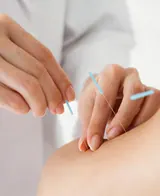
Treatment uses fine, sterile, single-use needles at points on the abdomen, lower back, legs, arms and sometimes the ear, usually left in place for about 20 to 40 minutes. We reassess after a short course of visits. No treatment is placed in the vagina.
Serious problems from acupuncture are rare. In prospective studies, about 9 in 100 patients had a minor reaction such as brief bleeding, soreness or redness at a needle site, and serious events occurred in about 1 in 10,000 patients.[12] Tell the practitioner first if you have a bleeding disorder, take blood thinners, are pregnant, or have a pacemaker (relevant to electroacupuncture).
Ayurvedic medicine for Vaginal Dryness
The Ayurvedic view
In Ayurveda, the years after menopause are associated with Vata, the principle governing dryness, lightness and movement. Dryness of tissues is understood as a loss of the moist, nourishing qualities of the body. These are traditional categories for choosing treatment, not biomedical diagnoses.
Therapies that may be used
Care is chosen for the individual and traditionally combines:
- Diet and daily routine intended to nourish and calm Vata, such as warm cooked meals, healthy fats and regular sleep hours
- Warm oil massage of the body
- Herbs such as shatavari (Asparagus racemosus), traditionally used in women's health and studied in menopause, prescribed individually by a qualified practitioner[13]
- Breathing practices and gentle yoga for stress
Panchakarma is not appropriate in pregnancy, acute illness or frailty, and is not a treatment for vaginal atrophy. Do not place oils or herbal preparations inside the vagina without your gynecologist's advice.
What the research shows
The evidence for Ayurveda in vaginal dryness is very limited. We found no trials designed for vaginal dryness. One double-blind, placebo-controlled trial of 70 women randomized to a shatavari root extract or placebo reported greater reductions in hot flashes, night sweats, insomnia, anxiety and vaginal dryness, and no significant adverse events.[13] The trial was small, and its authors called for longer studies in larger and more varied groups of women.[13]
Herbal medicine for Vaginal Dryness
Herbs and formulas that have been studied
Plant-based therapies have been studied for menopausal symptoms, including vaginal dryness. The best-studied are phytoestrogens, which are plant compounds that act weakly like estrogen, such as soy isoflavones.[14] Chinese herbal formulas for menopausal symptoms have also been tested, mainly for hot flashes.[15]
What the research shows
The evidence is limited. A meta-analysis of 62 trials with 6,653 women found phytoestrogens were associated with a small reduction in vaginal dryness scores and fewer hot flashes. The authors noted that most trials were of poor quality, with 46 at high risk of bias, and called for better studies.[14] Soy products were also described in a systematic review as giving modest improvement in vaginal dryness, but that review found no consistent high-quality evidence for most other botanical products.[11]
A Cochrane review of 22 trials of Chinese herbal medicine for menopausal symptoms found insufficient evidence that it was better or worse than placebo or hormone therapy for hot flashes, and it did not report on vaginal dryness. The quality of evidence ranged from very low to moderate.[15] A 2026 systematic review of complementary therapies for menopause found moderate-certainty evidence for Chinese herbal medicine on overall menopausal symptoms, but concluded that the overall evidence remains limited.[10]
Safety and herb-drug interactions
Herbs are active substances and can interact with medicines. Reported interactions include extra bleeding when warfarin is combined with ginkgo or danshen, lower warfarin levels with ginseng, reduced levels of several drugs with St. John's wort, and serotonin syndrome when St. John's wort was combined with antidepressants of the SSRI class.[16] About one fifth of Ayurvedic medicines bought online contained detectable lead, mercury or arsenic.[17]
Plant estrogens act on estrogen pathways. If you have had breast cancer or another hormone-sensitive condition, check with your oncologist before using any phytoestrogen product. Tell us about every medicine and supplement you take, and whether you are pregnant or breastfeeding, or have liver or kidney disease.
Translating traditional medicine into modern biological language
This is interpretation, not equivalence. Chinese medicine often describes menopausal dryness as a deficiency of yin and kidney essence that fails to moisten the tissues. Researchers studying menopause instead measure falling estrogen, thinning of the vaginal lining and changes in the vaginal environment.[1, 5]
Ayurveda's Vata dryness describes a similar sense of lost moisture and nourishment. Plant compounds such as phytoestrogens are being studied because they weakly mimic estrogen, but no study has shown that a yin deficiency or a dosha matches a specific biological process.[14]
How this care fits with your medical care
Integrative care for vaginal dryness is complementary. See your gynecologist, primary care physician or oncologist for evaluation and treatment, and do not stop or change prescribed medicines or hormone therapy without your prescriber. We do not diagnose the cause of vaginal dryness.
Please bring your diagnosis, any recent exam or pap results, a full list of medicines and supplements, and details of any breast cancer or other hormone-related treatment.
When to seek urgent medical care
Some symptoms are not ordinary vaginal dryness and need prompt assessment.
- Any vaginal bleeding after menopause
- Heavy bleeding, or bleeding after sex that does not settle
- A sore, ulcer, lump or white patch on the vulva that does not heal
- Fever, severe pelvic pain, or foul-smelling or unusual discharge
- Burning with urination along with fever or back pain
- Sudden dryness or pain after starting a new medicine or cancer treatment, which your clinician should review
For emergencies such as heavy bleeding, call 911 or go to the nearest emergency department.
Frequently asked questions
What is Vaginal Dryness?
Vaginal dryness is a lack of normal moisture in the vaginal tissue, most often caused by falling estrogen at and after menopause. It can cause burning, irritation and pain with sex, and often occurs with urinary symptoms as part of genitourinary syndrome of menopause. It is common, usually progressive without treatment, and can be treated by your clinician.
Can acupuncture help people with Vaginal Dryness?
We found no clinical trials of acupuncture for vaginal dryness itself, so we cannot say it helps this symptom. Acupuncture has been studied for hot flashes, with mixed results and benefit that may partly come from non-specific effects. It may be used as supportive care for wider menopausal symptoms, alongside medical treatment for the dryness.
Do Ayurvedic or herbal treatments help vaginal dryness?
The evidence is limited. A meta-analysis found plant estrogens such as soy gave a small reduction in vaginal dryness, but most trials were poor quality. One small trial of shatavari reported less dryness, and needs confirmation. Herbs can interact with medicines, and plant estrogens may not be suitable after breast cancer, so check with your clinician first.
Can I use these instead of vaginal moisturizers or estrogen?
No. These are complementary care. Vaginal moisturizers, lubricants and low-dose vaginal estrogen have the strongest evidence for treating dryness. Do not stop or change prescribed treatment without talking to your prescriber. Bleeding after menopause or persistent pain needs medical evaluation.
How soon might I notice a change?
It differs from person to person and no result can be promised. Studies of medical treatments for vaginal dryness mostly measured results over about 12 weeks or less. If you try supportive acupuncture for other menopausal symptoms, we reassess after a short course of visits to see whether it is helping.
Does insurance cover acupuncture for vaginal dryness?
It may. Netra Integrative Health Clinic is in-network with Blue Cross Blue Shield, Cigna and UnitedHealthcare. Other plans may be covered through out-of-network benefits, and we offer a free benefits check. HSA and FSA cards and CareCredit are also accepted. Call (908) 402-7301 to ask about your plan.
References
- Phillips NA, Bachmann GA. The genitourinary syndrome of menopause. Menopause. 2021;28(5):579-588. PMID 33534428. Narrative review of genitourinary syndrome of menopause covering symptoms, diagnosis, moisturizers, local hormone treatments and the extent of the condition.
- The NAMS 2020 GSM Position Statement Editorial Panel. The 2020 genitourinary syndrome of menopause position statement of The North American Menopause Society. Menopause. 2020;27(9):976-992. PMID 32852449. North American Menopause Society position statement on genitourinary syndrome of menopause with prevalence, effective therapies and cautions in breast cancer.
- Mili N, Paschou SA, Armeni A, et al. Genitourinary syndrome of menopause: a systematic review on prevalence and treatment. Menopause. 2021;28(6):706-716. PMID 33739315. Systematic review of 27 studies on prevalence and treatment of genitourinary syndrome of menopause, showing low awareness and frequent dissatisfaction with treatments.
- Mac Bride MB, Rhodes DJ, Shuster LT. Vulvovaginal atrophy. Mayo Clin Proc. 2010;85(1):87-94. PMID 20042564. Mayo Clinic Proceedings review of vulvovaginal atrophy covering symptoms, findings, vaginal pH, breast cancer treatment and local estrogen.
- Flores SA, Hall CA. Atrophic Vaginitis (Archived). StatPearls [Internet]. 2025. PMID 33232011. StatPearls chapter on atrophic vaginitis describing low-estrogen changes in vaginal tissue and how common they are after menopause.
- Kaufman MR, Ackerman AL, Amin KA, et al. The AUA/SUFU/AUGS Guideline on Genitourinary Syndrome of Menopause. J Urol. 2025;214(3):242-250. PMID 40298120. AUA/SUFU/AUGS guideline on genitourinary syndrome of menopause stating that low-dose vaginal estrogen has the strongest evidence base.
- Danan ER, Sowerby C, Ullman KE, et al. Hormonal Treatments and Vaginal Moisturizers for Genitourinary Syndrome of Menopause : A Systematic Review. Ann Intern Med. 2024;177(10):1400-1414. PMID 39250810. Systematic review of 46 trials finding vaginal estrogen, DHEA, ospemifene and moisturizers may improve dryness in the short term.
- Casiano Evans EA, Hobson DTG, Aschkenazi SO, et al. Nonestrogen Therapies for Treatment of Genitourinary Syndrome of Menopause: A Systematic Review. Obstet Gynecol. 2023;142(3):555-570. PMID 37543737. Systematic review of nonestrogen therapies for genitourinary syndrome of menopause finding most improved symptoms, with too few data to compare them.
- Befus D, Coeytaux RR, Goldstein KM, et al. Management of Menopause Symptoms with Acupuncture: An Umbrella Systematic Review and Meta-Analysis. J Altern Complement Med. 2018;24(4):314-323. PMID 29298078. Umbrella review of acupuncture for menopausal hot flashes finding benefit versus no acupuncture but smaller or non-significant differences versus sham.
- Maunder A, Mardon AK, Rao V, et al. Complementary therapies for management of menopausal symptoms: a systematic review to inform the update of the International Menopause Society recommendations on women's midlife health. Climacteric. 2026;29(2):165-209. PMID 41498229. 2026 systematic review of complementary therapies for menopause finding promising but mostly low-certainty evidence for acupuncture and herbal medicine.
- Hill DA, Crider M, Hill SR. Hormone Therapy and Other Treatments for Symptoms of Menopause. Am Fam Physician. 2016;94(11):884-889. PMID 27929271. American Family Physician review of menopause treatments finding no consistent high-quality evidence for acupuncture or botanicals, and modest benefit of soy for dryness.
- Bäumler P, Zhang W, Stübinger T, et al. Acupuncture-related adverse events: systematic review and meta-analyses of prospective clinical studies. BMJ Open. 2021;11(9):e045961. PMID 34489268. Systematic review of acupuncture adverse events finding minor reactions in about 9 percent of patients and serious events in about 1 per 10,000.
- Gudise VS, Dasari MP, Kuricheti SSK. Efficacy and Safety of Shatavari Root Extract for the Management of Menopausal Symptoms: A Double-Blind, Multicenter, Randomized Controlled Trial. Cureus. 2024;16(4):e57879. PMID 38725785. Double-blind placebo-controlled trial of 70 women finding shatavari root extract reduced menopausal symptoms including vaginal dryness, with no significant adverse events.
- Franco OH, Chowdhury R, Troup J, et al. Use of Plant-Based Therapies and Menopausal Symptoms: A Systematic Review and Meta-analysis. JAMA. 2016;315(23):2554-63. PMID 27327802. JAMA meta-analysis of 62 trials finding phytoestrogens modestly reduced vaginal dryness and hot flashes, with mostly poor-quality trials.
- Zhu X, Liew Y, Liu ZL. Chinese herbal medicine for menopausal symptoms. Cochrane Database Syst Rev. 2016;3(3):CD009023. PMID 26976671. Cochrane review of 22 trials of Chinese herbal medicine for menopausal symptoms finding insufficient evidence of benefit over placebo or hormone therapy.
- Hu Z, Yang X, Ho PC, et al. Herb-drug interactions: a literature review. Drugs. 2005;65(9):1239-82. PMID 15916450. Literature review of herb-drug interactions including warfarin with danshen, ginkgo and ginseng and St. John's wort with several drugs.
- Saper RB, Phillips RS, Sehgal A, et al. Lead, mercury, and arsenic in US- and Indian-manufactured Ayurvedic medicines sold via the Internet. JAMA. 2008;300(8):915-23. PMID 18728265. JAMA study finding detectable lead, mercury or arsenic in about one fifth of Ayurvedic medicines purchased over the Internet.
This page is for general education and is not medical advice. Acupuncture, Ayurvedic medicine and herbal medicine are complementary therapies; they do not replace diagnosis or treatment by your physician. Do not stop or change prescribed treatment without talking to your prescriber. In an emergency call 911.